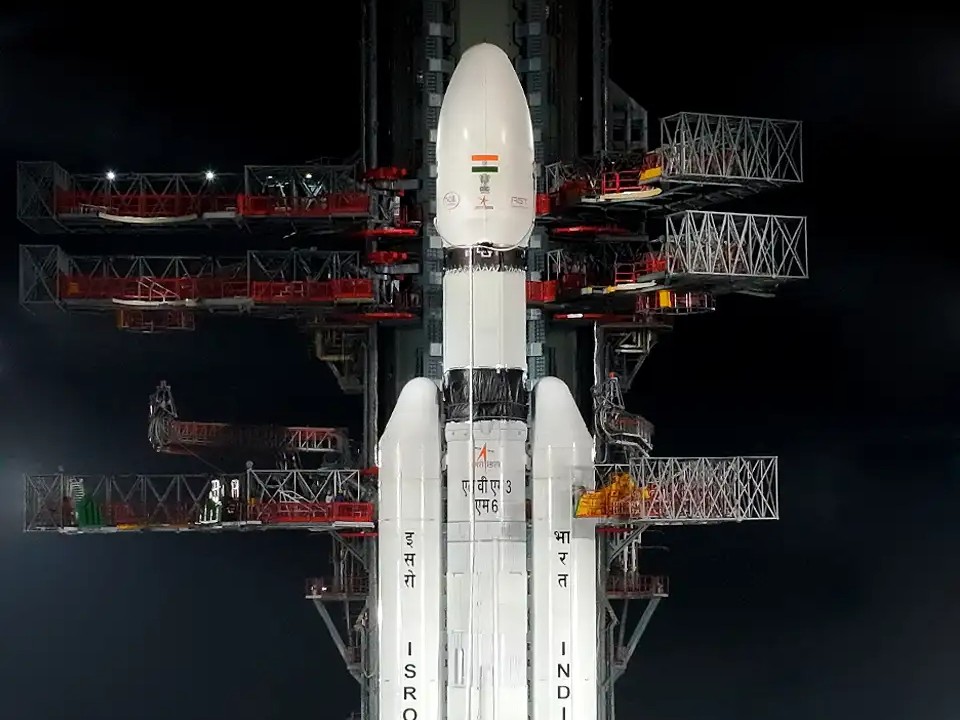
India's most powerful rocket, Launch Vehicle Mark-3 (LVM3), nicknamed Baahubali, is poised for its eighth mission on Wednesday, carrying BlueBird 6, a next-generation communications satellite, NDTV reported.
The satellite weighs nearly 6,100 kg, the heaviest payload ever launched by an Indian rocket. The mission aims to enhance connectivity by enabling direct broadband access from space to smartphones, without the need for specialised equipment, marking a major leap in India's commercial space capabilities.
ISRO said, BlueBird Block-2 Mission is a dedicated commercial mission onboard the LVM3 launch vehicle, which will launch the BlueBird Block-2 communication satellite of AST SpaceMobile, USA. This mission marks the 6th operational flight of LVM3.
LVM3 is a three-stage launch vehicle comprising two solid strap-on motors (S200), a liquid core stage (L110), and a cryogenic upper stage (C25). It has a lift-off mass of 640 tonnes, a height of 43.5 m, and a payload capability of 4,200 kg to Geosynchronous Transfer Orbit (GTO).
In its earlier missions, LVM3 successfully launched Chandrayaan-2, Chandrayaan-3, and two OneWeb missions carrying 72 satellites. The previous launch of LVM3 was the LVM3-M5/CMS-03 mission, that was successfully accomplished on November 02, 2025.
GSAT-7R which was sent on Nov. 2 was responsible to provide telecommunication coverage across the Indian Ocean Region. Its payload included transponders capable of supporting voice, data, and video links over multiple communication bands.
In this mission, LVM3-M6 will place the BlueBird Block-2 satellite, into the Low Earth Orbit and is the largest commercial communications satellite to be deployed in Low Earth Orbit. The satellite is part of a next generation of BlueBird Block-2 communication satellites, designed to provide space-based cellular broadband connectivity directly to standard mobile smartphones.
ISRO's LVM-3 To Launch Next-Generation Communication Satellite On December 24Essential Business Intelligence, Continuous LIVE TV, Sharp Market Insights, Practical Personal Finance Advice and Latest Stories — On NDTV Profit.