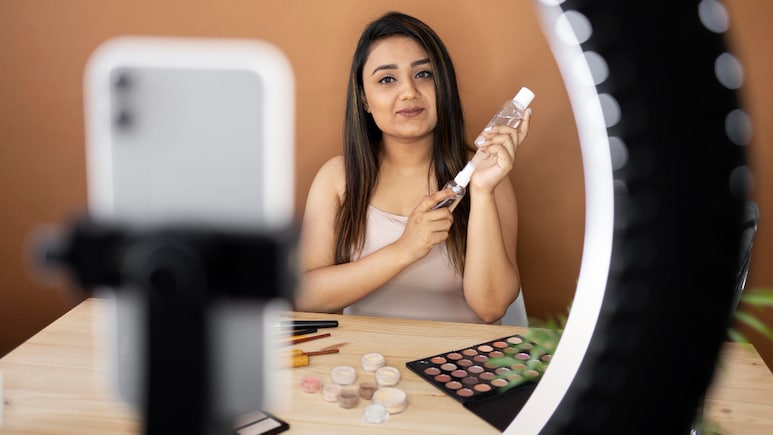
Online content creators and influencers have emerged as the defining forces of the past decade. Regardless of whether it is short-form content like Instagram reels or Tiktok videos or longer formats like video podcasts on YouTube, content creation is steadily becoming a key pillar of today's digital economy.
The spike in content consumption and its growing centrality would lead one to believe that it must spell major monetary gains, lavish lifestyles, and financial perks for majority of the creators and influencers. That, however, is not the case.
Yet, even 'in this economy', only 8-10% of India's 2-2.5 million active digital creators (defined as having over 1,000 followers) are able to monetise their content effectively, as per a May 2025 report by the Boston Consulting Group.
In a bid to change this landscape, Union Minister Ashwini Vaishnaw on Thursday urged social media platforms to "rethink" their revenue sharing models and ensure fair share for content creators.
"Social media platforms must also share revenue in a fair way with the people who are creating the content, whether it is news persons, conventional media, creators sitting in far-flung areas, influencers, the professors and researchers who are disseminating their work using the platforms," Vaishnaw stated.
Further, he indicated that if not accepted and acted upon voluntarily, India might resort to legal pathways to making sure that a fair revenue distribution becomes a reality.
“I will request all the platforms to rethink your revenue sharing policies. If this is not done voluntarily, there are so many countries which have shown the path to get it done in a legal way.”
What Revenue Distribution Model Is Opted By Social Media Platforms?
There is no standardised model for revenue distribution opted by all social media platforms unilaterally. The distribution is primarily structured around performance-based, subscription-based, and advertising-revenue-sharing models.
In the case of YouTube, revenue generated from ads displayed on or around a creator's content is shared. The platform takes a 45% cut from revenue generated via long-form videos/Ads while the creator receives 55%. The same is reversed in the case of short-form YouTube Shorts, where the online video sharing platform takes the larger 55%, as per the policy explained on YouTube Help.
Similarly, Meta (owner of social media sites like Instagram and Facebook) generally follows a 45% to platform and 55% creator split for videos, Ads on reels and In-Stream Ads. Till now, the firm has been sticking to a long-standing "no cut" policy in the case of subscription-based revenue generation.
ALSO READ: Modi, Trump And More: Top 5 Global Leaders With Highest Number Of Instagram Followers
Essential Business Intelligence, Continuous LIVE TV, Sharp Market Insights, Practical Personal Finance Advice and Latest Stories — On NDTV Profit.