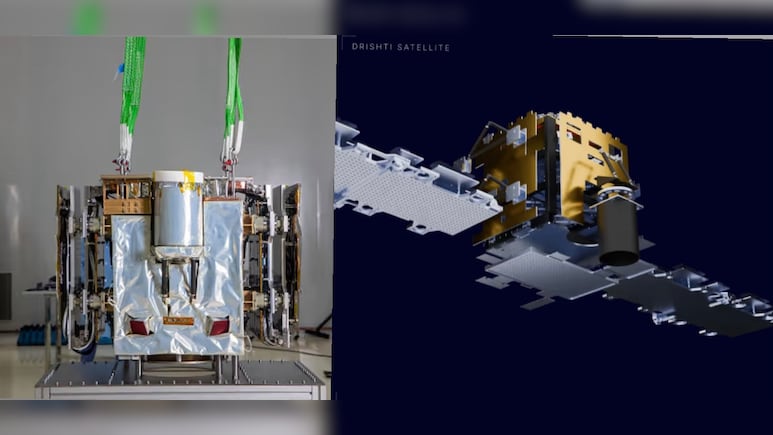
Prime Minister Narendra Modi has congratulated Indian aerospace firm GalaxEye on the successful launch of Mission Drishti, calling it a major milestone in India's space journey.
He praised the achievement as a reflection of the country's innovation ecosystem. The mission features the world's first OptoSAR satellite, and is also the largest satellite built by a private company in India.
“Mission Drishti by GalaxEye marks a major achievement in our space journey. The successful launch of the world's first OptoSAR satellite and the largest privately built satellite in India is a testament to our youth's passion for innovation and nation-building. Heartiest congratulations and best wishes to the founders and the entire team of GalaxEye," he posted on X.
Also Read | Layoffs Are Rising In Tech, But These Skills Are Helping People Unlock Better Pay
Mission Drishti by GalaxEye marks a major achievement in our space journey. The successful launch of the world's first OptoSAR satellite and the largest privately-built satellite in India is a testament to our youth's passion for innovation and nation-building.
— Narendra Modi (@narendramodi) May 3, 2026
Heartiest…
Mission Drishti marks a first-of-its-kind step forward, opening a new era in which satellite imagery is more reliable, easy to use, and widely accessible.
The Satellite
In a major leap forward for Earth observation technology, the world's first OptoSAR imaging satellite was successfully launched today, setting a new benchmark in space-based imaging capabilities.
The satellite lifted off aboard a Falcon 9 rocket from Space Launch Complex-4 East (SLC-4E) in California.
ALSO READ: Astronauts Aboard Artemis II Capture Breathtaking Images Of Earth — Watch Here
Features
Mission Drishti. Launching May 3rd 2026.
— GalaxEye (@GalaxEye) April 29, 2026
After years of building, testing and iterating, we are ready for orbit. Here's a closer look at the world's first OptoSAR imaging satellite.#MissionDrishti #OptoSAR #EarthObservation #SpaceTech #InnovationFromIndia pic.twitter.com/9I05s1xLak
- Developed under the CAS500-2 mission, the satellite is designed to provide clear, reliable, and all-weather Earth imagery.
- Unlike conventional satellites that rely on separate systems or post-processing to merge datasets, GalaxEye integrates both optical and radar sensing into one unified architecture.
- Operating in a sun-synchronous low Earth orbit (LEO), the satellite will maintain consistent lighting conditions for repeated global coverage, making it especially valuable for environmental monitoring, disaster response, agriculture, and security applications.
- At the center of the mission is OPTOSAR, a dual-sensor system that combines MSI's detailed color and spectral imaging with SAR's ability to see through clouds and work in all weather conditions.
- The launch was executed by SpaceX, continuing its track record of supporting advanced Earth observation and scientific missions.
- GalaxEye could redefine satellite imaging standards by delivering a “one satellite, two sensors” capability at a level of integration not previously achieved in orbit.
- The satellite has an approximate mass of 190 kg and operates at an orbital altitude of 500 ± 10 km. It offers a spatial resolution ranging from 1.2 to 3.6 meters, enabled through a combination of SAR and multispectral imaging (MSI) capabilities.
- The system is designed to provide a revisit frequency of about four days, ensuring frequent Earth observation updates. It operates across multiple spectral bands, including X-band radar, Panchromatic (PAN), RGB, Near-Infrared (NIR), Coastal Blue, and Red Edge, supporting a wide range of remote sensing and analytical applications.
ALSO READ: ISRO Working Towards Next Launch On May, Several Missions Planned Says Chairman
Essential Business Intelligence, Sharp Market Insights, Practical Personal Finance Advice, Daily Fuel, Gold and Silver Prices and Latest Stories — On NDTV Profit.