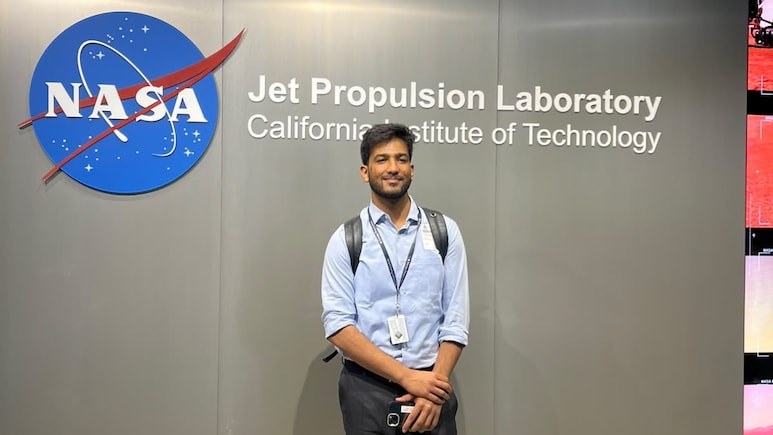
NASA's Jet Propulsion Laboratory (JPL) in California is working on some of the most ambitious missions in space exploration, from operating the Perseverance rover on Mars to developing technologies that could improve how scientists monitor natural disasters on Earth.
Its work also offers a window into the growing technological partnership between the United States and India. One of the clearest examples is NISAR, the NASA-ISRO Synthetic Aperture Radar mission.
Launched in July 2025, the joint Earth-observation satellite is designed to track changes in the planet's land, ice and vegetation, helping scientists study earthquakes, volcanic activity, landslides and other natural hazards.
Also Read | Layoffs Are Rising In Tech, But These Skills Are Helping People Unlock Better Pay
Its radar can detect subtle movements of the Earth's surface, while its data is being made freely available to researchers and the public worldwide.
READ | Four Astronauts, One Dragon, 237 Days Later: Crew-12 Prepares To Head Home
In an interaction at JPL, Jason Hyon, the laboratory's chief technologist, discussed the role of India-US collaboration in advancing space technology. NISAR represents a significant milestone in that partnership: NASA contributed the L-band radar, while ISRO developed the S-band radar and supplied the spacecraft bus and launch vehicle. The two agencies also share responsibility for mission operations.
Beyond planetary exploration and Earth observation, JPL is also investigating technologies that could shape future missions. The Cold Atom Laboratory aboard the International Space Station allows scientists to study quantum phenomena in microgravity. The Quantum Gravity Gradiometer Pathfinder, meanwhile, is exploring new approaches to measuring subtle variations in gravity.
Inside NASA's Jet Propulsion Laboratory, the nerve centre behind some of the world's most ambitious space missions. @Rish_Bhat takes us inside the mission control room explores frontier technologies and looks at how quantum mechanics and quantum physics could shape the next frontier of space exploration. #RishabhBhatnagar
— NDTV Profit News (@NDTVProfit) September 26, 2026
At JPL's Microdevices Laboratory, researchers develop miniature sensors and electronic components for spacecraft, where equipment must function reliably in extreme conditions and often cannot be repaired once deployed.
The exploration extends to robotics at Caltech's Center for Autonomous Systems and Technologies. Researchers at the AMBER Laboratory are developing walking robots capable of maintaining balance and navigating challenging terrain, which are capabilities that could prove valuable for future exploration in environments where direct human control is difficult.
From Mars to Earth-monitoring satellites and autonomous machines, JPL's work illustrates how advances in space technology increasingly depend on collaboration across scientific disciplines and national boundaries.
READ | Taking AI To Orbit: Space Tech Startup Satlyt Raises $8M To Build Computing Cloud Across Satellites
Essential Business Intelligence, Sharp Market Insights, Practical Personal Finance Advice, Daily Fuel, Gold and Silver Prices and Latest Stories — On NDTV Profit.