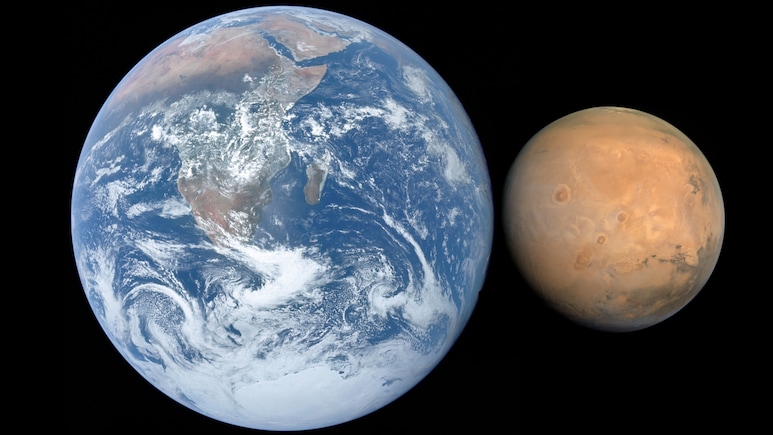
Earth and Mars were born from the same rotating cloud of gas and dust that eventually formed the Solar System about 4.5 billion years ago. Yet the two neighbouring planets appear to have followed markedly different paths during their formation and evolution, according to a study by researchers at the Globe Institute, University of Copenhagen.
The study, published in Nature Astronomy, suggests that the planets formed through different proportions of two major planetary-growth processes: the accumulation of kilometre-sized planetesimals and the accretion of smaller particles known as pebbles.
Researchers found that at least 75% of Earth's mass appears to have originated from two young planetary bodies, or protoplanets, which themselves grew by accumulating pebbles. Planetesimals may have contributed up to the remaining 25%.
Also Read | Layoffs Are Rising In Tech, But These Skills Are Helping People Unlock Better Pay
ALSO READ | First Radio Signal From A Planet Beyond Our Solar System Detected - No, It's Not Aliens
Mars followed a contrasting pattern. Roughly 75% of its mass appears to have come from planetesimals, while about a quarter was contributed through pebble accretion.
Planetesimals are solid bodies formed from cosmic dust and can measure several kilometres across. Protoplanets are larger planetary embryos that can range from approximately Moon-sized to Mars-sized. Both play important roles in the formation of rocky planets.
To reconstruct the planets' early histories, the researchers examined chemical signatures preserved in their crusts and mantles. They paid particular attention to volatile elements such as sodium, zinc and potassium, which can evaporate at relatively high temperatures. Their presence and abundance can therefore provide clues about the conditions under which planetary material formed.
Planetary growth is thought to involve two major mechanisms, either separately or in combination: planetesimal accretion, in which larger bodies collide and merge, and pebble accretion, in which growing planetary bodies gather smaller particles from the surrounding disc.
The researchers used computer models to compare different formation scenarios with the chemical evidence preserved in Earth and Mars. Their findings support a hybrid model in which both planetesimal accretion and pebble accretion contributed to the formation of rocky planets, although their relative importance differed between Earth and Mars.
ALSO READ | When Will Monsoon End In Mumbai? IMD Withdrawal Date, October Heat And India's Rainfall Outlook
The different formation histories may also help explain why Earth and Mars evolved so differently despite forming in the same Solar System. Mars is considerably smaller than Earth, and its smaller size meant that its interior cooled more rapidly.
The findings provide new evidence about how rocky planets formed and evolved, while offering insights into why some worlds develop conditions capable of sustaining atmospheres and surface water.
Essential Business Intelligence, Sharp Market Insights, Practical Personal Finance Advice, Daily Fuel, Gold and Silver Prices and Latest Stories — On NDTV Profit.