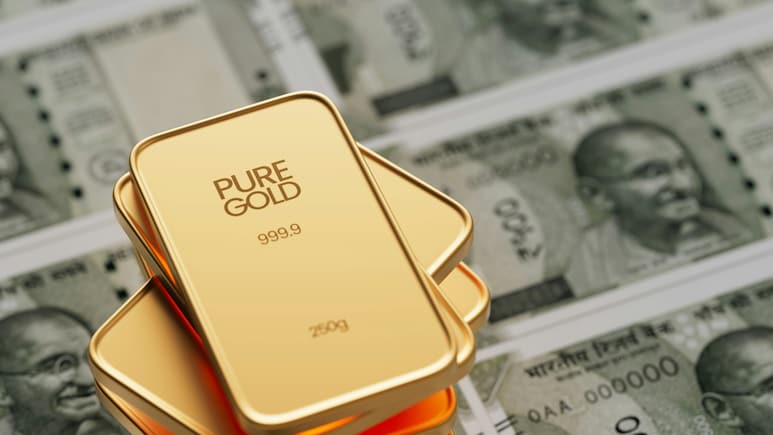
The precious metals, gold and silver, have exhibited spectacular sheen in the last couple of years. Last year, i.e. calendar year 2025, gold and silver posted a stellar 75% and 167% absolute return, respectively.
In 2026, as well, the dream run for gold and silver continues, rising over 18% and 14%, respectively, in Indian rupee terms (as of Feb. 26), against the backdrop of geopolitical tensions in the Middle East, US-Iran nuclear deal, and Trump 2.0's tariff tantrums, among a host of other factors.
In the last five years, gold and silver have posted meteoric gains of nearly 240% and 280%, respectively, in rupee terms, considering the MCX spot gold prices as of Feb. 26.
Also Read | Layoffs Are Rising In Tech, But These Skills Are Helping People Unlock Better Pay
Gold has played its role of a safe haven, while silver has gained due to industrial demand. If you bought gold and silver, sold in the financial year, whether in the form of ETFs, a fund of fund scheme, or in physical form (bars and coins), it is likely that you made a profit and there are tax implications.
The profits or gains booked will be subject to capital gain tax. The taxation will depend on the period of holding, i.e. short-term or long-term, and in what form the gold and/or silver was held.
Let's understand for each case how capital gain tax will be taxed.
1) Gold and Silver ETFs
These exchange-traded funds investing in gold and silver are classified as non-equity oriented for tax purposes. When you book profit in these, the capital gain tax will depend on the holding period.
If the holding period is less than or equal to 12 months, it is treated as Short Term Capital Gain (STCG) and taxed as per your income-tax per your income tax-slab.
Now, in case you have bought and sold gold and silver ETFs on the same day, i.e., indulged in intra-trading, to benefit from the upswing in prices, this will be treated as speculative business income and taxed as per your tax slab.
Whereas if you invested in gold and silver ETFs for the long-term, i.e. held units for over 12 months before selling them at a profit, it will be considered as Long Term Capital Gain (LTCG). It will be taxed at 12.5% flat rate, without any indexation benefit.
Note that since gold and silver ETFs are classified as non-equity-oriented schemes, the Rs 1.25 lakh exemption for LTCG is not available (as in the case with equity funds).
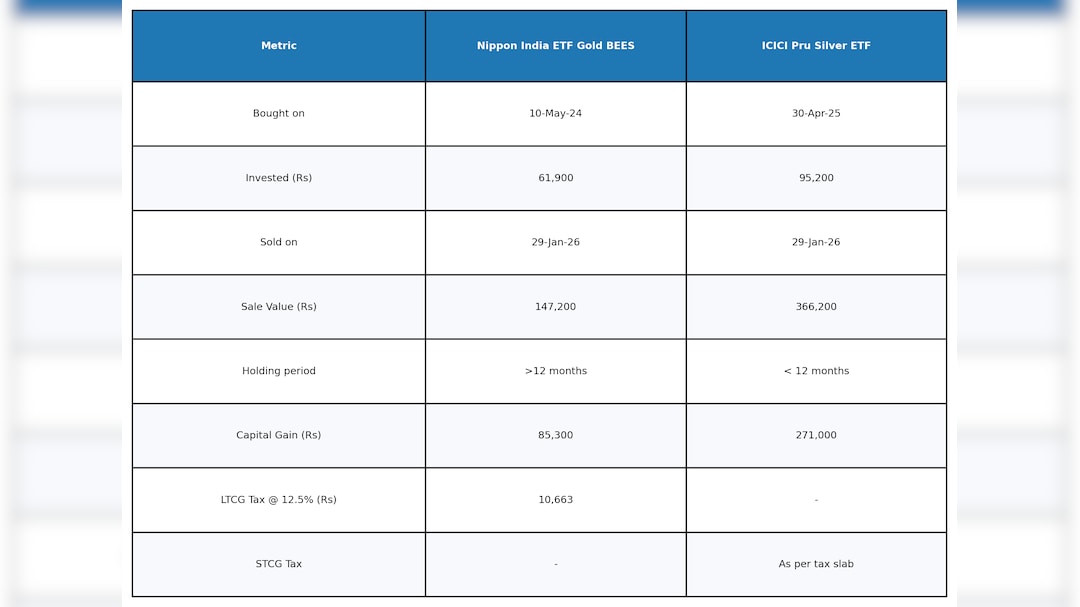
Example: Say you purchased 1,000 units of Nippon India ETF Gold Bees on May 10, 2024 at Rs 61.90 on Akshaya Tritiya day, and ICICI Prudential Silver ETF 1,000 units at Rs 95.2 on April30, 2025 (again on Akshaya Tritiya day), and sold both these completely on Jan. 29 2026, at Rs 147.20 and Rs 366.20, respectively, here's how the capital gains will be taxed.
ALSO READ: Salaried Employees In These Cities May Soon Get 50% HRA Exemption — Is Yours On The List?
2) Gold and Silver Fund of Funds
These are ETF fund of funds that are passively managed and invest in the underlying gold ETF and silver ETF, which in turn benchmark their performance against the physical prices of gold and silver.
The tax rule here is slightly different. Here, if the holding period is less than 24 months, it is considered STCG, which will be taxed as per your income-tax slab. If you are in the high-income tax bracket, keep in mind you could end up paying more tax.
But if the holding period is 24 months or more in the case of gold and silver ETF fund of funds, it will be considered as LTCG and taxed at 12.5% flat (with no indexation).
Again, keep in mind that the LTCG exemption of Rs 1.25 lakh is not available, since these are non-equity funds.
3) Sovereign Gold Bonds
The government stopped issuing new sovereign gold bonds (SGBs) in February 2024, but the existing SGB series remain active until maturity or are redeemed before maturity. The interest of 2.5% p.a. paid on SBGs is taxable under ‘income from other sources' and taxed as per your applicable income-tax slab.
The capital gain tax implications on redemption depend on whether you hold till the maturity period of 8 years (from the date of issuance) or prematurely take the exit window via the RBI, which is available after completion of 5 years, or sell in the secondary market.
If you hold SGBs till maturity from the time of primary issuance by the RBI, the capital gains are fully exempt. The premature withdrawals after 5 years are also tax exempt, provided you are redeeming through the RBI's premature redemption window.
Since SGBs are listed on the exchange, if you sold them at a profit in less than or equal to 12 months, the STGC will be taxed as per your income-tax slab. If SGBs are sold in the secondary market/on the exchange after 12 months, LTCG tax at 12.5% without indexation benefit will be applicable.
ALSO READ: Fantastic Four: Mutual Funds That Every Senior Citizen And Retiree Should Consider
4) Physical Gold and Silver
This refers to gold & silver held in the form of bars, coins, jewellery, etc. If these are held for a period of 24 months or less before the sale at a profit, it will be considered as STCG, added to your income and taxed as per your income-tax slab.
If the holding period is more than 24 months before selling at a profit, it is considered LTCG and taxed at 12.5% flat, without any indexation benefit.
Note, the 3% GST paid during the purchase of physical gold/silver cannot be used to reduce the capital gains tax liability.
Capital Loss Situation
In case you have sold gold or silver at a loss, it can help reduce your overall capital gain tax liability. The Short Term Capital Loss (STCL) can be set off against both STCG and LTCG, as per the extant tax rules.
That being said, losses from intraday transactions can be set off only against speculative business profits. In other words, capital gains cannot be set off against speculative losses. If it is a Long Term Capital Loss (LTCL), it can be set off only against an LTCG.
In case you cannot set off the capital loss completely, the Income Tax Act, 1961, allows you to carry forward the net capital loss. The net capital loss can be carried forward for a period of up to 8 assessment years (relevant to the respective Financial Year) for both STCL and LTCL.
But make sure you are filing your Income Tax Returns (ITR) on time – before the due date – otherwise the tax department may disallow this benefit.
To conclude, when you are buying and selling gold and/or silver to benefit from price swings, make sure you are cognisant of the tax implications.
Avoid making rash investment decisions, which can result in a high tax outgo, and if you have made a loss, also don't forget to set it off to reduce the net capital gain tax liability
Happy investing and tax planning.
Disclaimer: The views expressed in this article are solely those of the author and do not necessarily reflect the opinion of NDTV Profit or its affiliates. Readers are advised to conduct their own research or consult a qualified professional before making any investment or business decisions. NDTV Profit does not guarantee the accuracy, completeness, or reliability of the information presented in this article.
Essential Business Intelligence, Sharp Market Insights, Practical Personal Finance Advice, Daily Fuel, Gold and Silver Prices and Latest Stories — On NDTV Profit.