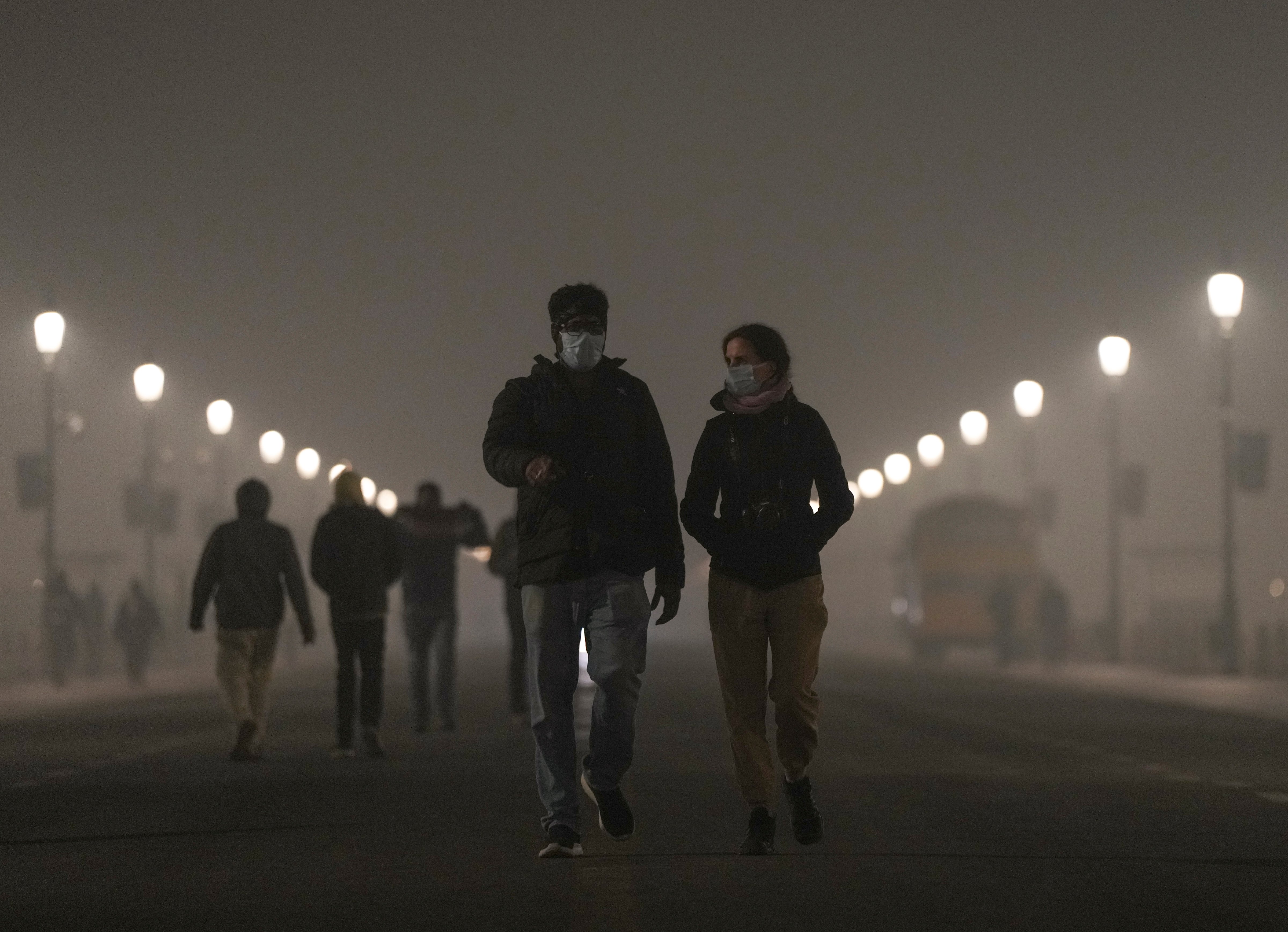
There is no conclusive data establishing a direct correlation between higher air quality index (AQI) levels and lung diseases, the government has told Parliament.
In a written reply in the Rajya Sabha on Thursday, Union Minister of State for Environment Kirti Vardhan Singh on Thursday, however, acknowledged that air pollution is one of the triggering factors for respiratory ailments and associated diseases.
Singh was responding to a question by BJP MP Laxmikant Bajpayee, who asked whether the government was aware that studies and medical tests have confirmed that prolonged exposure to hazardous AQI levels in Delhi-NCR is leading to lung fibrosis, an irreversible reduction in lung capacity.
Bajpayee also sought to know whether lung elasticity among citizens of Delhi-NCR has drastically reduced to almost 50% compared to people living in cities with good AQI levels.
The BJP parliamentarian further asked whether the government has any 'solution to save millions of residents of Delhi/NCR from growing deadly diseases like pulmonary fibrosis, COPD, emphysema, reduced lung function and continuously declining lung elasticity'.
In his reply, the minister said dedicated training modules have been developed in the area of air pollution for programme managers, medical officers and nurses, nodal officers, sentinel sites, frontline workers such as ASHA, vulnerable groups including women and children, and occupationally exposed groups like traffic police and municipal workers.
He said information, education and communication (IEC) materials targeting air pollution-related illnesses have been developed in English, Hindi and regional languages.
The National Programme on Climate Change and Human Health (NPCCHH) has also developed customised IEC materials for various vulnerable groups, Singh said.
He added that early warning systems and alerts for air pollution, along with air quality forecasts, are disseminated by the India Meteorological Department to states and cities to help prepare the health sector and communities, including vulnerable populations.
The minister said the Pradhan Mantri Ujjwala Yojana aims to safeguard the health of women and children by providing clean cooking fuel in the form of liquefied petroleum gas.
He also said the government's Swachh Bharat Mission seeks to clean streets, roads and infrastructure in cities, towns and rural areas, adding that 'Swachh Hawa' (clean air) is an integral component of the mission.
No PUC, No Fuel Drive: Delhi Blocks 570 Vehicles, Fines Over 3,700 But Air Remains ToxicEssential Business Intelligence, Continuous LIVE TV, Sharp Market Insights, Practical Personal Finance Advice and Latest Stories — On NDTV Profit.