- Morgan Stanley sets a base-case Sensex target of 89,000 by June 2027, up 16%
- Bull case sees Sensex at 100,000 if oil falls below $75 and growth rises
- Bear case expects Sensex to drop to 66,000 if oil exceeds $120 and growth slows
Global brokerage Morgan Stanley has thrown its weight behind an India bull case, setting a base-case target of 89,000 for the BSE Sensex by June 2027, an upside of 16% from current levels. The brokerage argues India is riding a "multi-quarter growth upcycle" that equity valuations are yet to fully price in.
In a report titled "A Long Way Up", dated September 4, 2026, Morgan Stanley's India equity strategists Ridham Desai and Nayant Parekh said the 89,000 level implies a trailing price-to-earnings (P/E) multiple of 23.5 times, ahead of the 25-year average of 22 times. The brokerage attached a 50% probability to this base case.
Bull And Bear Scenarios
Morgan Stanley also laid out two alternate scenarios. In its bull case, assigned a 25% probability, the Sensex could reach 1,00,000, an upside of 31%, if oil prices fall below US$75 a barrel and reflation policies push growth estimates higher. Sensex earnings would need to compound at 19% annually between FY26 and FY29 for this to play out.
In the bear case, also assigned a 25% probability, the Sensex could fall to 66,000, a downside of 14%, if oil prices average above US$120 a barrel, the Reserve Bank of India (RBI) is forced to tighten policy to protect macro stability, and global growth slows sharply. Under this scenario, Sensex earnings would compound at a slower 13% annually between FY25 and FY28.
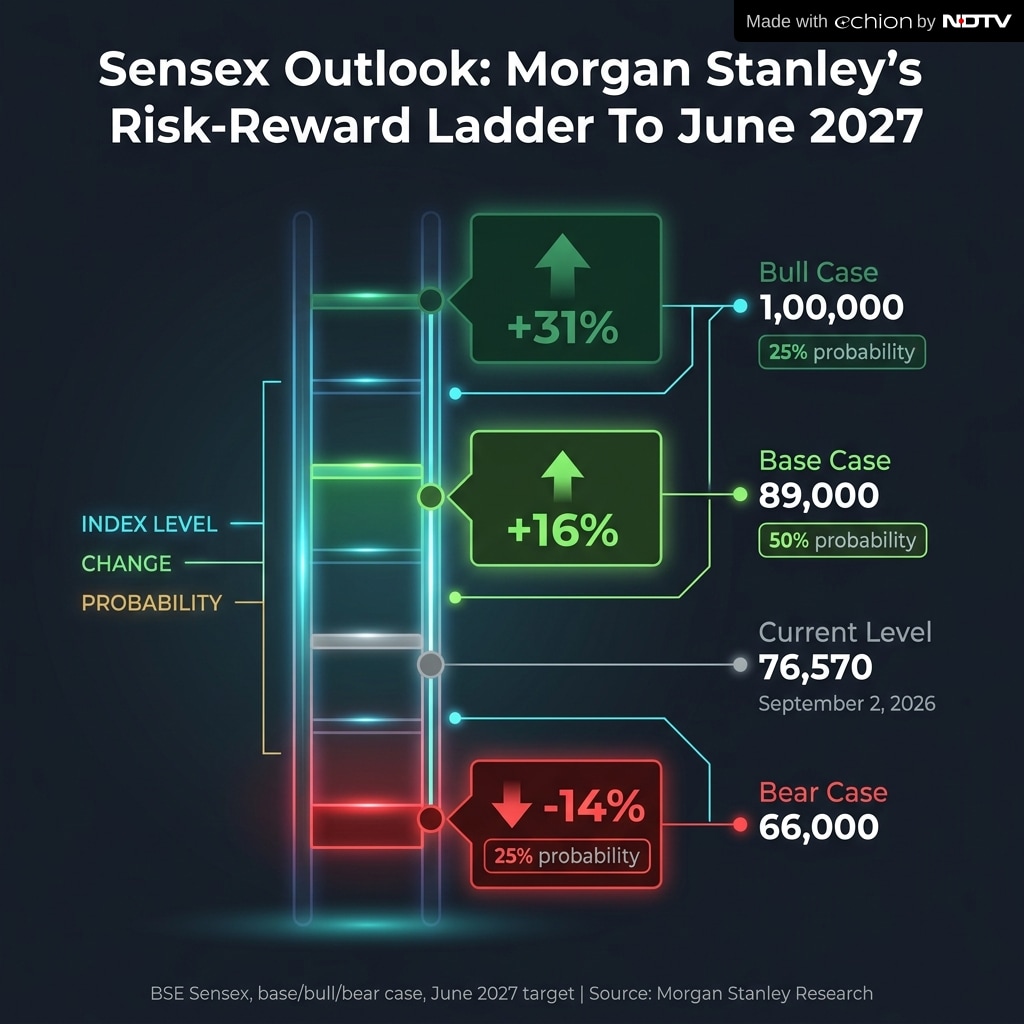
Where is the market headed? Morgan Stanley has a range.
Photo Credit: NDTV Profit
The brokerage's base case assumes continued gains in macro stability, a pickup in private investment, and a positive gap between real growth and real interest rates, along with steady global growth and a benign monetary policy stance from the RBI. It expects Sensex earnings to compound at 16% annually through FY29.
Morgan Stanley says India's biggest risks are largely external, including geopolitical tensions and a slowdown in global growth. Domestically, it flagged weak farm productivity, capacity bottlenecks in the judiciary, and the risk that "embodied AI" (AI built into physical systems and robotics) could weigh on labour markets over time.
Cyclical, Not Secular
A key argument in the report is around whether India's recent valuation de-rating is temporary or permanent. Morgan Stanley said the case for a secular, structural de-rating rests on the view that India's terminal growth rate is falling, either because of slowing fertility rates or because artificial intelligence (AI) could hurt India's large services and IT exports business.
ALSO READ: Emerging Market Currencies Rally For Longest Streak Since 2007
The brokerage said it viewed both concerns as overstated. It argued that slowing fertility, while narrowing India's long-term demographic advantage, does not represent an abrupt shift and could aid growth over the next two decades. On AI, it said the technology poses a near-term risk to India's services-export momentum, but could lift labour productivity from a low base over the medium term.
Morgan Stanley's conclusion is that the de-rating is cyclical, driven by a sharp negative gap between India's growth and that of the rest of the world. It said India's growth appears to have bottomed and is now trending higher, even though it continues to trail growth in economies more closely tied to the global AI capital expenditure (capex) cycle.
Sector Calls: Overweight Banks And Consumer Discretionary
On portfolio positioning, Morgan Stanley said it favours domestic cyclical sectors over defensive and externally facing ones. It is overweight Financials (+200 basis points), Consumer Discretionary (+300 basis points) and Industrials (+300 basis points), and underweight Energy (-200 basis points), Materials (-300 basis points), Healthcare (-200 basis points) and Utilities (-100 basis points). It has an equal-weight stance on Communication Services, Consumer Staples and Technology.
On Financials, the brokerage said net interest margins (NIMs) for banks are troughing, and that strong credit growth alongside benign credit costs should support a strong earnings cycle. On Industrials, it cited a pickup in private capital expenditure across energy, mining, defence, fertilisers, semiconductors and data centres as the key driver. On Consumer Discretionary, it expects strong consumption growth helped by lower interest rates, tax cuts and rising incomes.
Notably, Morgan Stanley flagged IT services as a potential "dark horse", saying the sector could benefit over the medium term as global companies turn to Indian technology firms to build AI applications, even though near-term multiples are being hurt by the broader AI debate.
ALSO READ: FCNR Deposits Beat Estimates, RBI To Pull Out Rs 6-7 Lakh Crore: Pranjul Bhandari
Essential Business Intelligence, Sharp Market Insights, Practical Personal Finance Advice, Daily Fuel, Gold and Silver Prices and Latest Stories — On NDTV Profit.