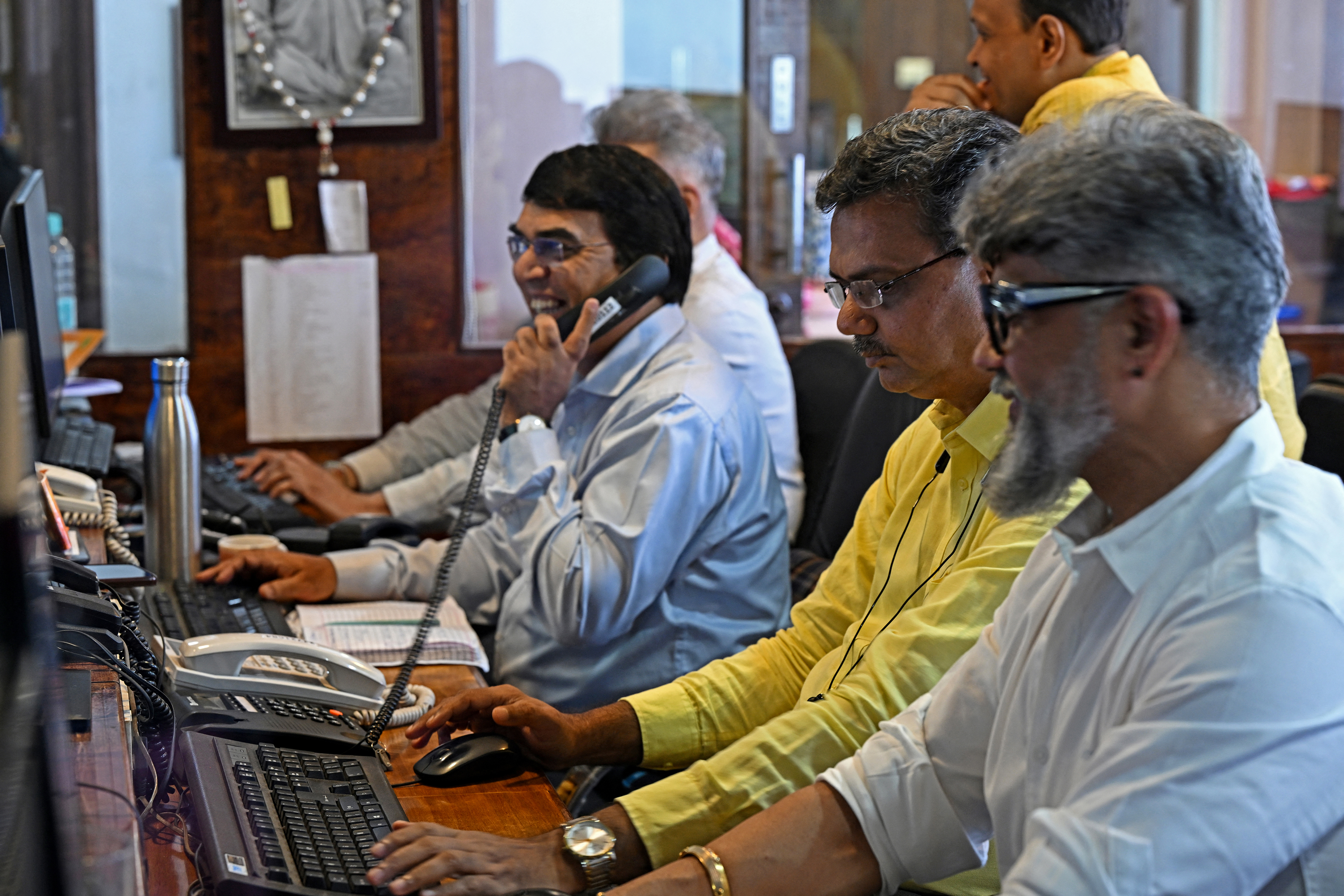
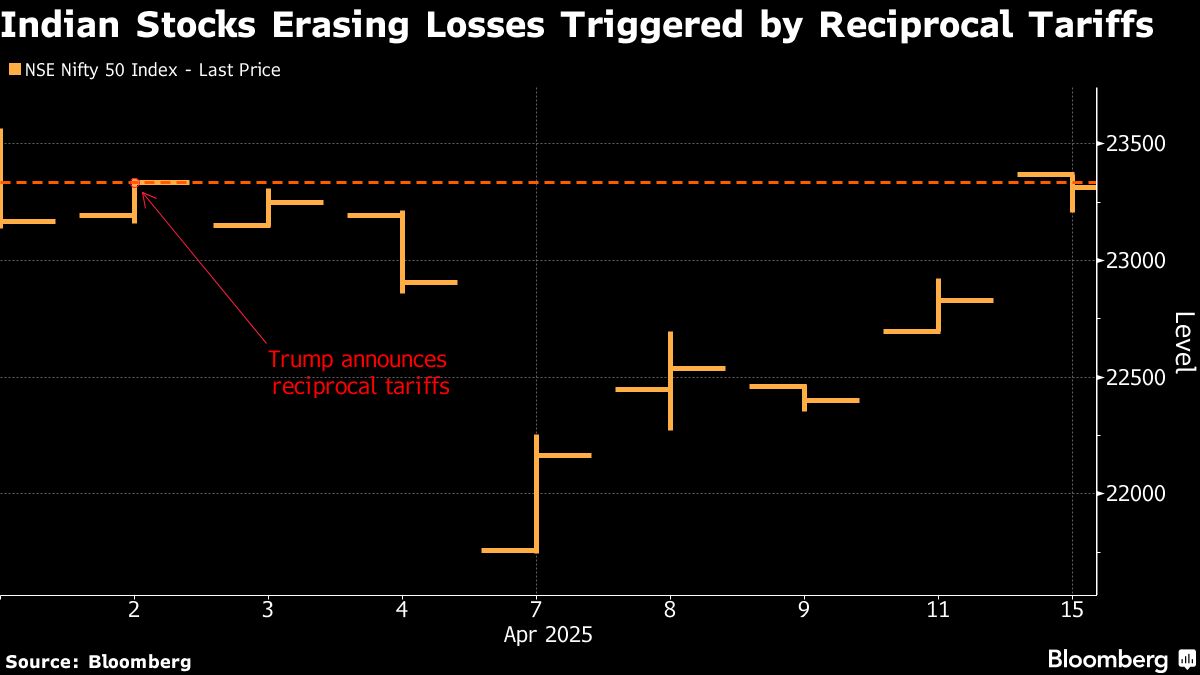
Indian stocks rallied as trading resumed after a long weekend, with the benchmark equity index erasing all the losses triggered by US President Donald Trump's reciprocal tariffs earlier this month.
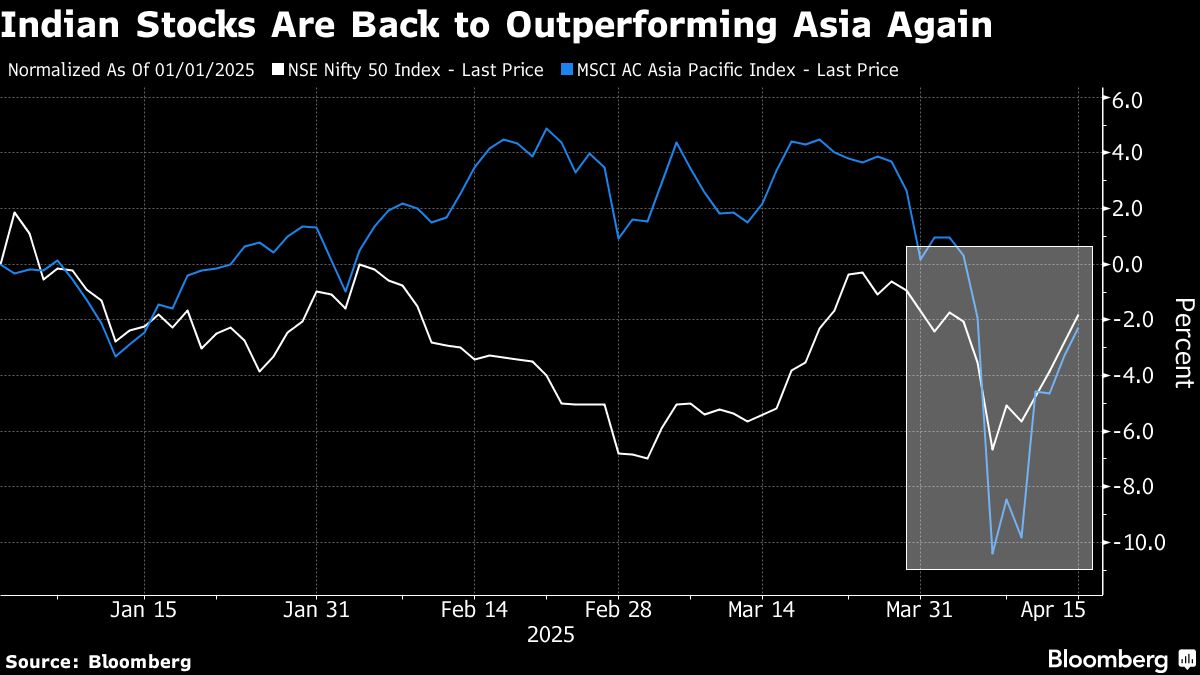
The NSE Nifty 50 Index climbed as much as 2.4% in Mumbai on Tuesday, surpassing its closing level on April 2. That made India the first major equity market globally to erase the tariff-induced losses. A broader gauge of Asian equities is still down more than 3% since the tariff announcements.
Investors are touting Indian markets as a relative safe haven amid the volatility sparked by US President Donald Trump's reciprocal tariffs. The nation's big domestic economy is seen able to withstand a potential global recession better than many peers, who face higher tariffs.
An intensifying Sino-American trade war is also shining a spotlight on India as an alternative manufacturing hub to China. In stark contrast to Beijing's retaliatory moves against US levies, New Delhi has struck a conciliatory tone and sought to reach a provisional trade deal with the Trump administration.
“We remain overweight India in our portfolios,” said Gary Dugan, chief executive officer of The Global CIO Office. Supported by good domestic growth and aided by a likely diversification of supply chains away from China, Indian equities are seen as a safer bet over the medium term, he said.
India's recent rebound follows a slump of almost 10% in the equity benchmark in the last two quarters. The selloff came amid concerns over slowing economic growth, high valuations and an exodus by foreign funds that is still continuing. Overseas funds have already sold more than $16 billion worth of local shares equities this year on a net basis. The most they have withdrawn in any calendar year is $17 billion in 2022.
Even so, relatively lower valuations and optimism that the central bank will aggressively cut interest rates to support the economy are reasons for some investors to turn positive. The falling price of crude oil — a major import — is also aiding sentiment.
The Nifty 50 benchmark is currently trading at 18.5 times its 12-month forward earnings estimate, compared to the five-year average of 19.5 times and a multiple of 21 times at its peak in late September, according to data compiled by Bloomberg.
“India is not insulated, but relatively better positioned amid the risk of a trade war given its low direct revenue exposure to US, particularly on the goods side,” said Rajat Agarwal, a strategist at Societe Generale SA. “Indian equities should also benefit if oil prices sustain at low levels.”
The South Asian nation accounted for just 2.7% of total US imports last year, compared with 14% for China and 15% for Mexico, according to data compiled by Bloomberg.
Essential Business Intelligence, Continuous LIVE TV, Sharp Market Insights, Practical Personal Finance Advice and Latest Stories — On NDTV Profit.