Vietnamese stocks may be poised to shake off a lackluster year after securing a bigger-than-expected weighting in FTSE Russell's semi-annual index review.
The index provider said Friday that 27 Vietnamese stocks will be added to its benchmarks including the emerging-market gauge effective Sept. 21, more than the 23 it indicated in April. The additions will give Vietnamese stocks a weight of 0.49%, according to Vietcap Securities JSC, above FTSE's earlier projection.
The Southeast Asian nation secured an upgrade to secondary emerging-market status last year, which was confirmed in April.
Also Read | Layoffs Are Rising In Tech, But These Skills Are Helping People Unlock Better Pay
"Given the increase in Vietnam's index weight, index flows can now reach $3 billion instead of $2 billion" previously, said Anthony Le, a director at Vietcap Securities. "We believe the market will react positively to this news in the upcoming week."
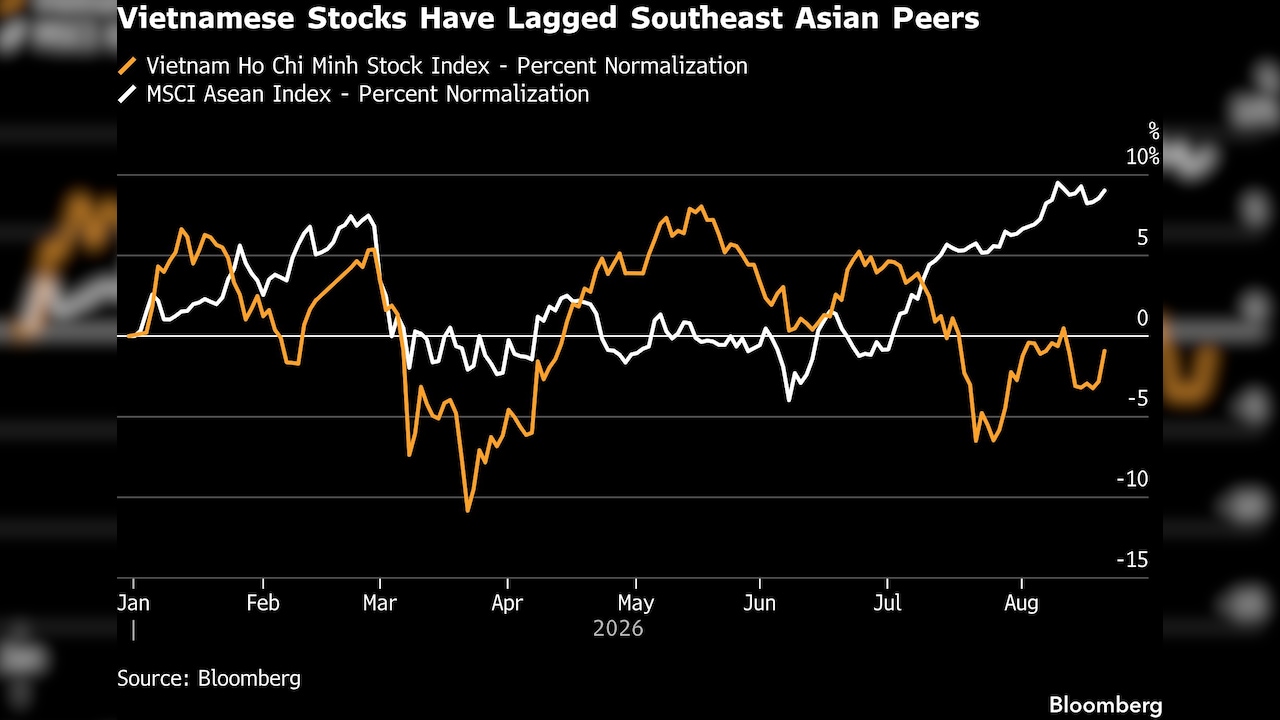
The boost comes at a key juncture for Vietnam, whose stock market faces the prospect of its first annual loss in four years. Persistent selling by foreign investors, totaling more than $3 billion this year, has left the VN Index trailing the MSCI ASEAN Index by the widest margin since 2022, even as Vietnam remains one of the world's fastest-growing economies.
FTSE said Vingroup JSC, Vinhomes JSC, Hoa Phat Group JSC, and Masan Group Corp. were among 27 stocks that will be added as large-, mid- and small-caps to its indexes. Additionally, another 90 stocks were earmarked for inclusion as micro-caps, though they will not be included in the widely tracked emerging-market gauge.
Vietnam's benchmark VN Index rose as much 1.4% on Monday to outperform MSCI's regional gauge. Shares of Vingroup jumped as much as 3.4%, while those of Vinhomes, Hoa Phat and Masan also rose.
The additions may support Vietnamese stocks in the near term, but their phased implementation through September 2027 means passive inflows are likely to build gradually rather than arrive in a single wave.
A resurgence in global oil prices due to tensions in the Middle East may weigh on the stock market given Vietnam is heavily reliant on imports. That alongside the fallout from a diamond scandal at the country's largest listed jeweler Phu Nhuan Jewelry JSC represents a key hurdle for Vietnamese stocks.
Still, investors expect the new market status to attract not only passive funds but also global emerging-market funds whose mandates previously prevented them from investing in Vietnam, which is targeting sustained annual growth of 10%.
"The more important effect of the upgrade is that it opens the door to active fund managers, who tend to bring larger, more durable inflows than passive trackers," said Marco Martinelli, a partner at Turicum Investment Management AG. "Combined with still-low valuations across much of the market, that's the more compelling reason for investors to buy now."
(This story has not been edited by NDTV staff and is auto-generated from a syndicated feed.)
Essential Business Intelligence, Sharp Market Insights, Practical Personal Finance Advice, Daily Fuel, Gold and Silver Prices and Latest Stories — On NDTV Profit.