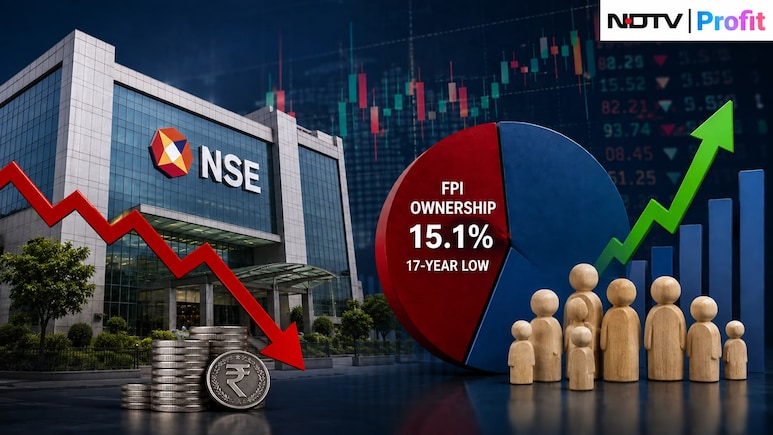
- Foreign portfolio investor ownership in Indian equities fell to 15.1% in June quarter
- FPIs recorded $15.1 billion outflows in April-June, lowest in over 17 years
- Domestic mutual funds ownership rose to 11.6%, total DII ownership reached 19.5%
Foreign portfolio investor (FPI) ownership in Indian equities declined to a 17-year low in the June quarter, while domestic investors continued to strengthen their presence in the market, according to the NSE Market Pulse Report for August 2026.
FPI ownership in NSE-listed companies fell to 15.1% in the June quarter, its lowest level in more than 17 years. The decline came amid record quarterly FPI outflows of $15.1 billion in the first quarter of FY27.
FPIs sold Indian equities worth Rs 1,43,150 crore, or around $15 billion, during the April-June quarter. So far in 2026, their net outflows from the Indian equity market have reached Rs 2,30,752 crore.
In contrast, domestic mutual fund ownership rose for the 12th consecutive quarter to a record 11.6%, taking overall Domestic Institutional Investor (DII) ownership to 19.5%. DIIs have now maintained a higher share of the Indian equity market than FPIs for seven consecutive quarters, a position last seen in 2003.
Also Read | Layoffs Are Rising In Tech, But These Skills Are Helping People Unlock Better Pay
ALSO READ: No TCS, Infosys Or Wipro: Citi Has Zero Buy Calls Across 11 IT stocks — Here's Why
The report also showed that direct individual ownership increased to 9.5%, while the combined ownership of individuals through direct holdings and mutual funds reached a record 19.3%.
Promoter Ownership
Promoter ownership in NSE-listed companies increased to 50.2% in the June quarter, while promoter ownership in Nifty 500 companies stood at 49.5%, the report showed.
Total promoter shareholding in NSE-listed and Nifty 500 companies rose for the second consecutive quarter, increasing by 21 basis points (bps) and 19 bps quarter-on-quarter (QoQ), respectively.
The increase was driven by higher holdings of private Indian and foreign promoters, partly offset by a decline in government ownership.
Private Indian promoter ownership rose by 29 bps to 32.1% across the overall listed universe, while foreign promoter ownership increased by 28 bps QoQ to 30.7% in the June quarter.
The trend was different among Nifty 50 companies, where promoter ownership declined by 42 bps QoQ to 40.4%, primarily due to lower holdings by Indian promoters, including both private and government promoters.
In value terms, promoter holdings in NSE-listed companies increased by a sharp 15.2% QoQ to Rs 235 lakh crore, reaching a seven-quarter high. This was the strongest sequential increase in promoter holdings in 22 quarters.
ALSO READ: Gold ETFs Glitter On Strong Global Cues: Which Are The Five Best Funds Based On Six-Month Returns?
Institutional Portfolios Shift Beyond Large Caps
The NSE report also highlighted a continued shift in institutional portfolios away from the largest companies.
Banks, financial institutions and insurance companies continued to have the highest concentration in Nifty 50 stocks. However, their allocation to the index declined by 2.5 percentage points (pp) QoQ to 62.6%, a fresh all-time low.
FPIs reduced their exposure to large-cap stocks even more sharply. The share of Nifty 50 companies in their portfolios declined by 3.6 pp QoQ to an all-time low of 57.4%.
Domestic mutual funds also cut their allocation to Nifty 50 stocks by around 3 pp QoQ to 51.4%, the lowest level in more than 18 years. Their Nifty 50 exposure is now 11.6 pp below the December 2019 peak of 63%.
Overall, the data point to a continued broadening of institutional portfolios beyond India's largest listed companies, alongside a sustained increase in the influence of domestic investors in the Indian equity market.
ALSO READ: New-Age Stocks To Watch: Citi Picks Eternal, Info Edge, And More — Check The Top Bets
Essential Business Intelligence, Sharp Market Insights, Practical Personal Finance Advice, Daily Fuel, Gold and Silver Prices and Latest Stories — On NDTV Profit.