- Large-cap Indian stocks have stagnated while broader markets grow, per fund managers' views
- Nifty 50 turnover is low, reflecting mature companies with limited growth potential
- Views diverge on AI impact; some see structural AI growth, others dismiss AI as distraction
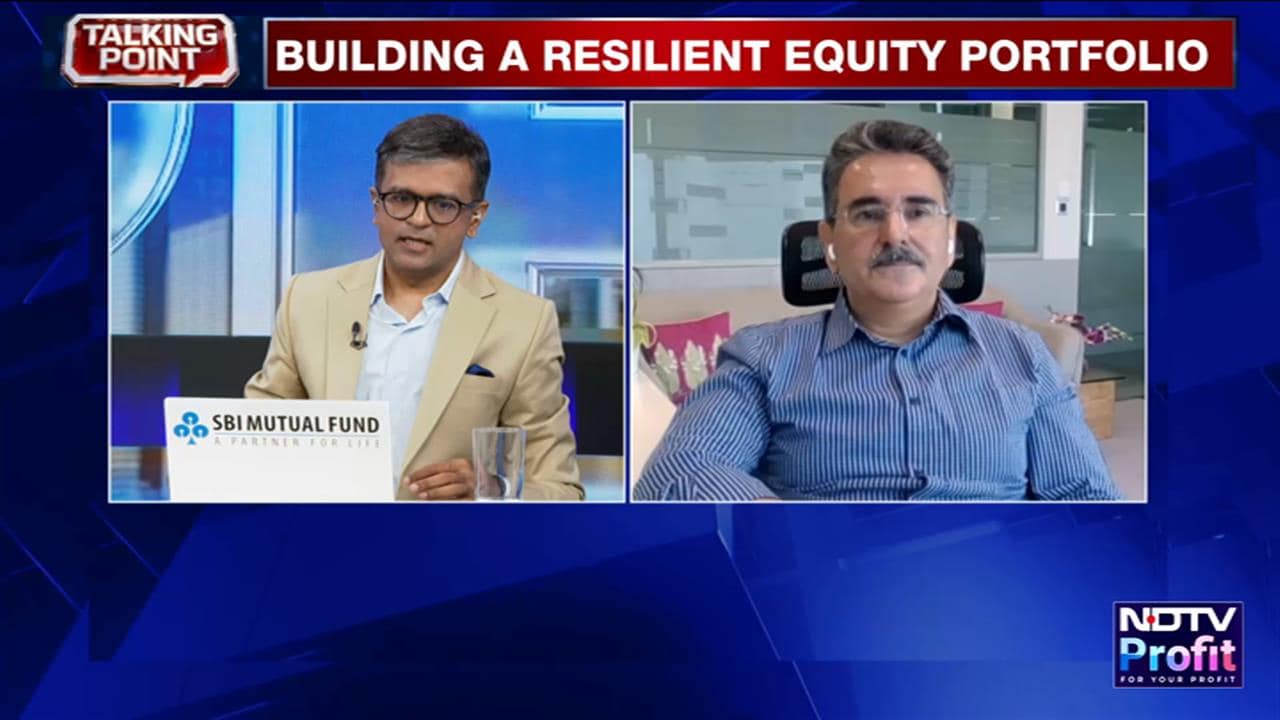
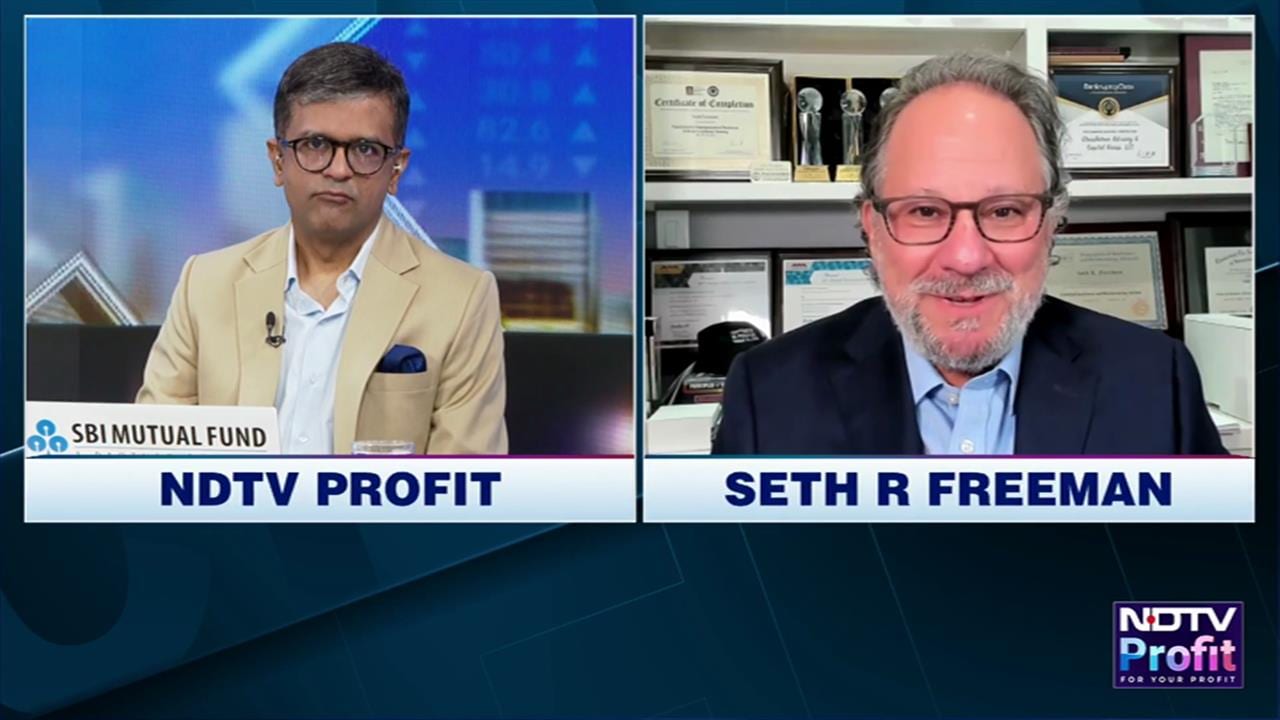
Three fund managers, three separate interviews with NDTV Profit this week, one uncomfortable question hanging over all of them: why have India's largest stocks gone nowhere while the rest of the market runs?
Samir Arora of Helios Capital, Shankar Sharma of GQuant Investech and Nilesh Shah of Kotak Mahindra Asset Management weren't in the same room and weren't responding to each other. But laid side by side, their answers point to the same fault line in Indian equities: the problem sits with the country's biggest companies, not with India itself, and not primarily with the AI trade that tends to get blamed for pulling money away.
The large-cap stagnation, in their own words
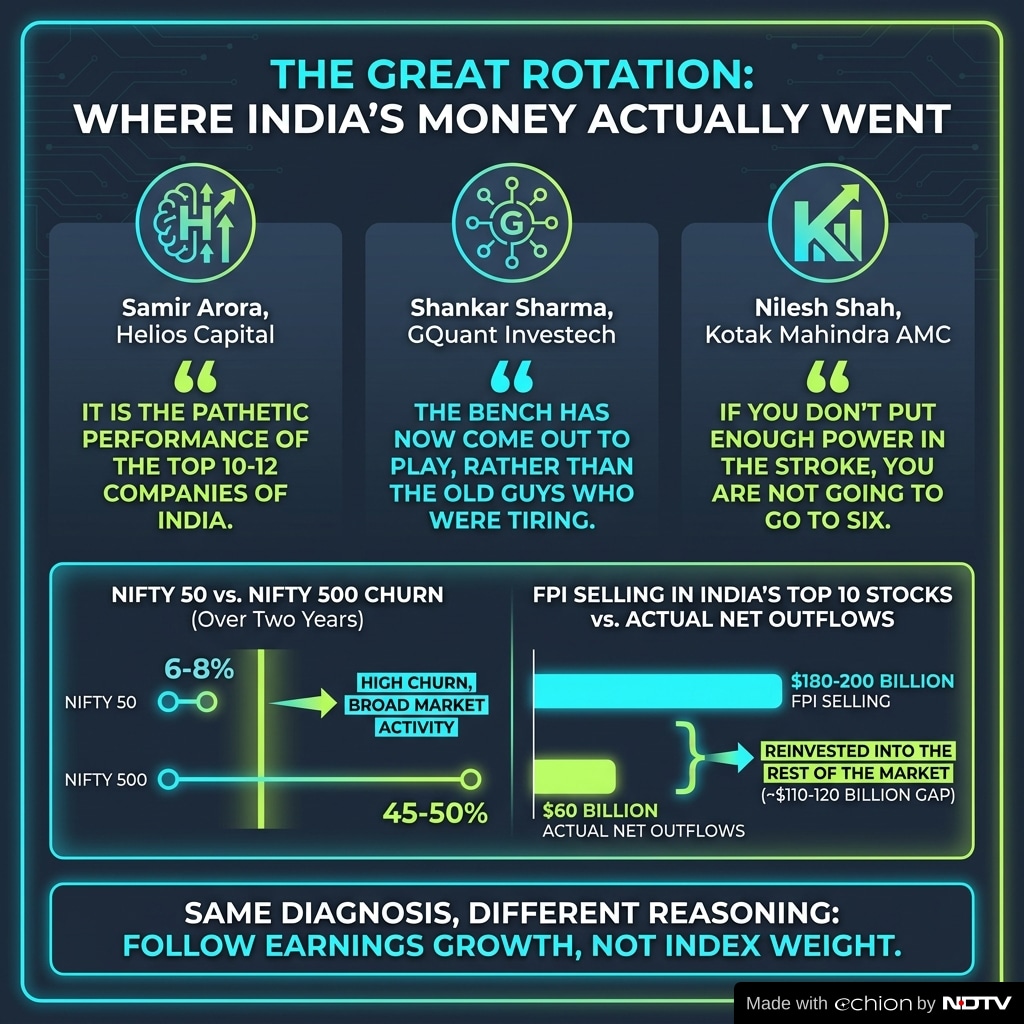
The data point that frames the whole conversation came from Sharma. Constituents of the Nifty 50 have barely changed in two years, by his own estimate only 6-8% of the index has turned over, compared with roughly 45-50% churn in the broader Nifty 500. "The bench has now come out to play," he said, "rather than the old guys who were tiring." His explanation is structural: the Nifty's entry bar of market capitalisation and track record means a company only qualifies once it has already matured, by which point its best growth is usually behind it.
Also Read | Layoffs Are Rising In Tech, But These Skills Are Helping People Unlock Better Pay
Arora went further and named the problem directly. "The world has realised that what is holding back India is not India and it is not AI," he said. "It is the pathetic performance, fundamentally and in the stock market, of the top 10-12 companies of India." He pointed to consumer and IT majors specifically, arguing they protected what they had rather than innovating, and cited JPMorgan Chase chief Jamie Dimon's public envy of the UK fintech Revolut as an example of the kind of product Indian banks could plausibly have built themselves.
Shah's framing was less pointed but arrived at the same place through a cricket analogy. "Small and mid-caps growth is running at double the pace of large caps," he said. "If you don't put enough power in the stroke, you are not going to go to six." His explanation leans more on flows than on corporate performance: heavy foreign portfolio investor (FPI) selling in large-cap banking and IT stocks has kept valuations depressed even as the underlying businesses continued to perform. "Businesses kept on doing well," he said. "Selling continued, the valuation got de-rated."
The divergence: is this an AI story or an India story?
This is where the three views genuinely split, and the disagreement is worth preserving rather than smoothing over.
Shah leans toward the AI-trade explanation. Asked why Indian markets should deliver returns given elevated crude prices and fair-to-full valuations, he said India's re-rating will likely wait for the "anti-AI trade" to reverse elsewhere. "India doesn't have AI play as much as other countries have," he said, "and hence we'll have to wait for anti-AI trade."
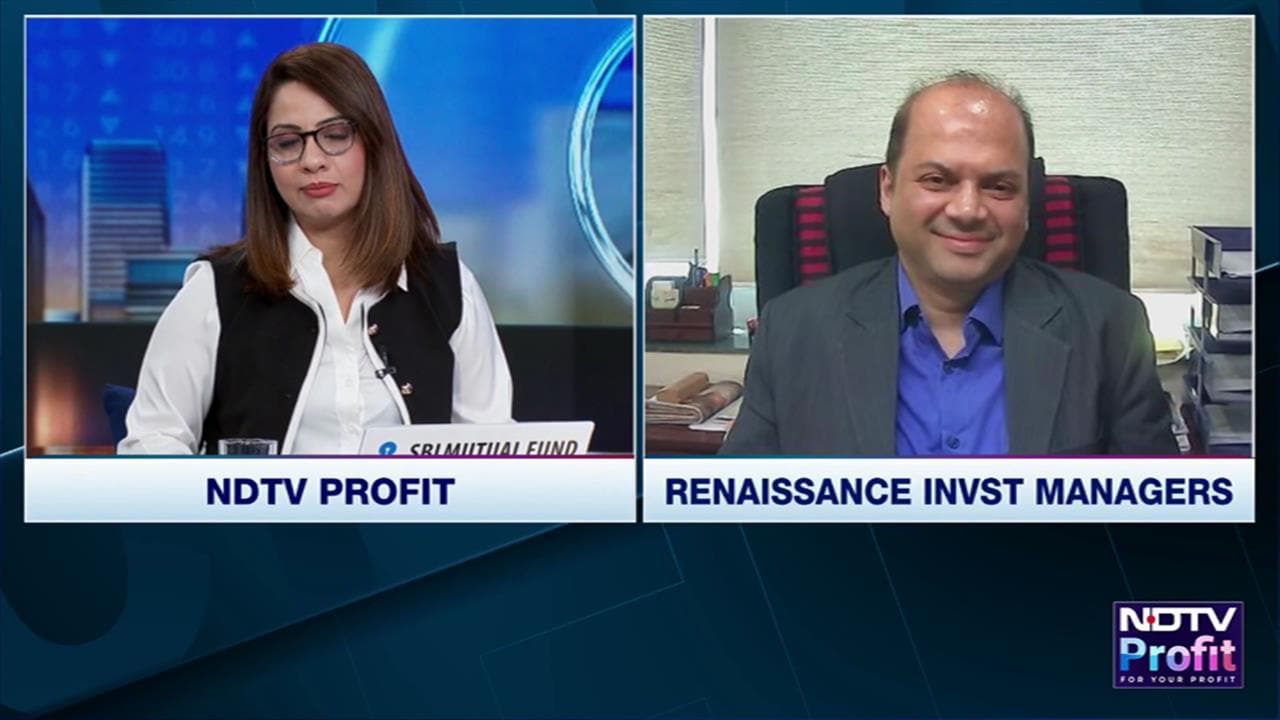
Where are largecaps headed? Samir Arora, Nilesh Shah and Shankar Sharma weigh in.
Photo Credit: NDTV Profit
Sharma disagrees with the premise that this is a trade waiting to reverse at all. He argues the AI and data-centre buildout is a structural, multi-year capex cycle rather than a one-time boom, pointing to the accelerating technology inside optical fibre alone, from simple fibre bundles to multi-core and hollow-core cables, as evidence that data centres will need repeated, not one-off, capital spending. He extends that logic to defend the Magnificent Seven's negative free cash flow, citing a rough 18-20% five-year internal rate of return (IRR) on data-centre investment against a cost of long-term borrowing of around 7-8%. "The promoters or the founders of these companies... are the best management in the world," he said. Crucially, he sees Indian small caps supplying components into this global buildout, in cabling, electrification and industrial supply chains, as direct beneficiaries of the AI trade rather than casualties of it.
ALSO READ: Hyperscalers, Make Room: Nvidia's $40 Billion Neocloud Boom Puts India On The AI Infra Map
Arora rejects the AI framing altogether as a distraction. His argument is that Indian investors have grown "jealous" of AI-linked companies for being loss-making while ignoring that nearly every major global AI company, from OpenAI to Anthropic, operates at a loss too. "All the companies that you feel jealous about, that India does not have and the world has, they're all loss-making companies," he said. To him, the more useful comparison isn't India versus the AI trade at all, but India's stagnant incumbents versus its own newer, faster-growing companies, structurally the same rotation Sharma and Shah describe, just without any reference to artificial intelligence.
Where the money is actually going
All three, in different ways, described the same redeployment happening underneath the headline index numbers.
Arora offered the clearest figures. Citing an ICICI Securities report, he estimated that foreign investors sold in the region of $180-200 billion worth of stock in India's then-11 largest companies between March 2022 and March 2026, yet net foreign outflows from India over the same period totalled only around $60 billion. By his own arithmetic, that implies roughly $110-120 billion was not pulled out of the country at all but reinvested into Indian stocks outside the top 10, largely through initial public offerings (IPOs), qualified institutional placements (QIPs) and preferential allotments in newer, less-owned names. "That's why you see people buying IPOs," he said, pointing to sentiment around recently listed consumer-tech and new-age companies as evidence.
Shah's read of foreign flows adds a domestic dimension: even as FPIs sold large-cap banks and IT, more than 100 small and mid-cap companies now sit at all-time-high FPI ownership. Meanwhile, he said, domestic mutual funds have grown powerful enough to absorb large secondary-market blocks that used to go entirely to foreign buyers. "The entire block was taken by DIIs only," he said, describing domestic institutional investors (DIIs) as now large enough to compete directly with FPIs for allocation.
Sharma's own portfolio decisions track the same shift. He said he had "almost tripled" his capital since calling small caps "the place to be" in a March 11 tweet, and described actively rotating into small-cap suppliers tied to the data-centre and electrification themes rather than waiting for a reversal in large-cap banks such as HDFC Bank, which he called a "no-go area" following the leadership transition after long-serving chief executive Aditya Puri's departure.
The takeaway
Strip away the differences in emphasis, AI sceptic versus AI structuralist, flows-driven versus fundamentals-driven, and the same practical advice survives all three interviews: don't chase India's historically largest stocks on the assumption that big names must eventually revert to leading the market again. Nifty 50 membership itself is not a growth signal; if anything, Sharma's churn data suggests the opposite.
The more durable approach these three managers converge on, however differently they arrive at it, is to follow earnings growth and sector-level winners wherever they sit in the market, rather than defaulting to index weight as a proxy for quality.
ALSO READ: Jefferies Bets On Gold Boom, Adds Manappuram, Hindustan Zinc To Model Portfolio
Essential Business Intelligence, Sharp Market Insights, Practical Personal Finance Advice, Daily Fuel, Gold and Silver Prices and Latest Stories — On NDTV Profit.