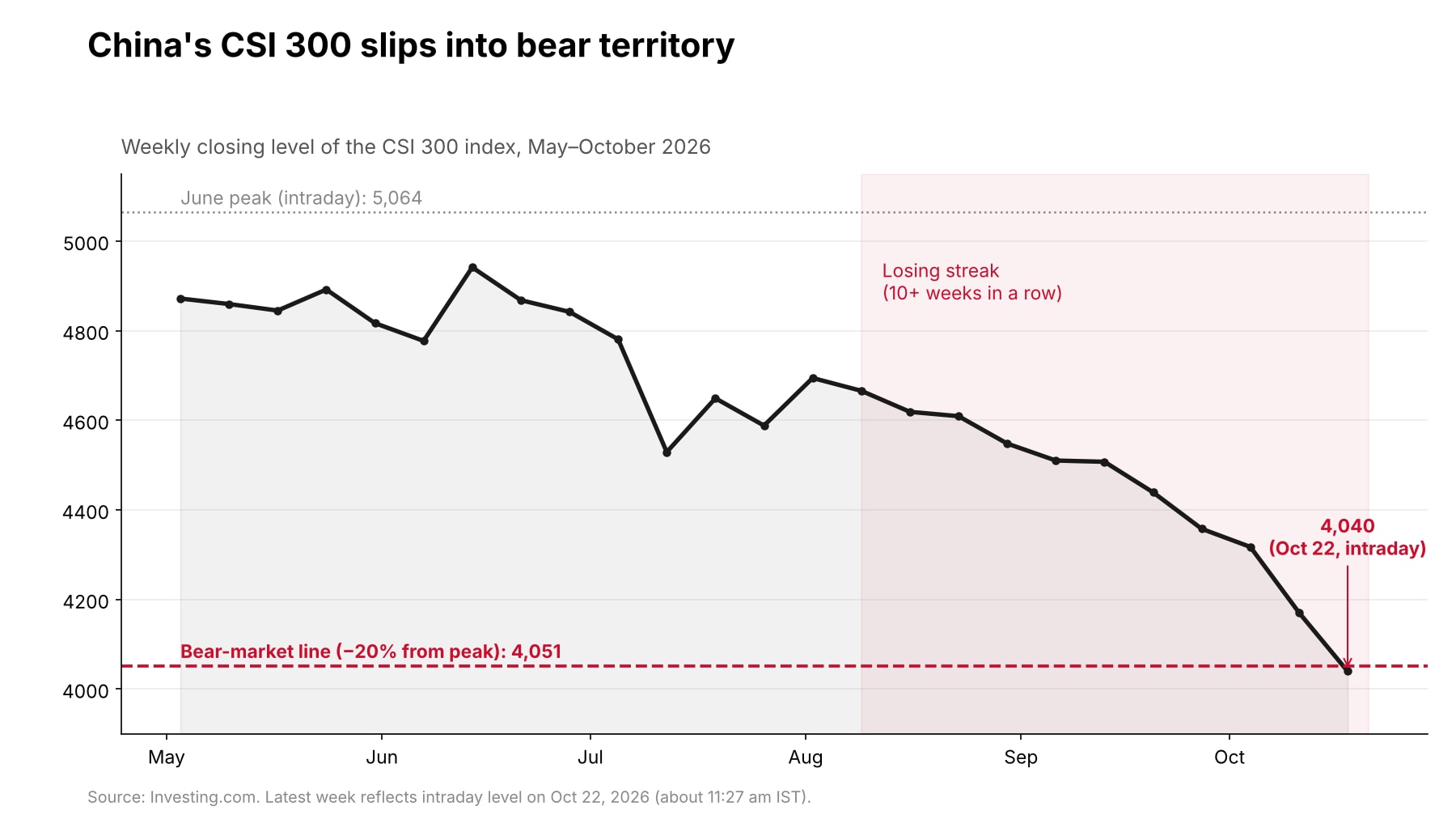
- China's CSI 300 equity index entered a bear market after dropping 20% from its June high
- Stronger-than-expected GDP growth reduced stimulus hopes, disappointing investors
- CATL's profit miss and margin pressure weighed heavily on the market and related sectors
China's equity slide turned into a bear market on Thursday as CSI 300 dropped 20% from the high it hit in June. The benchmark index, which tracks the 100 biggest companies listed in Shanghai and Shenzhen, has now fallen for ten weeks in a row, and it has lost nearly 3% in the current week alone.
The pain went beyond the mainland as Hong Kong's Hang Seng was also among Asia's worst performers on Thursday.
As of 1:36 pm local time (11:06 am IST), the selling had picked up. The CSI 100 was down 2.2% at 3,844.46, or 86.53 points lower. That is its lowest level in 52 weeks and about 23% below its 52-week high of 4,968.89. Hong Kong's Hang Seng index was hit even harder, down 3.12%, or 738.35 points, at 22,913.52. The CSI 300 itself was down 2.04% at 4,028.02.
Also Read | Layoffs Are Rising In Tech, But These Skills Are Helping People Unlock Better Pay
The fall is notable because it comes days after China reported better-than-expected growth numbers. Here are the three main forces behind the sell-off.
1. Weakened Case For Stimulus
Normally a strong growth reading would lift stocks. This time it may have hurt them. China's economy grew 4.5% year-on-year in the July–September quarter, faster than 4.3% in the previous quarter and ahead of the 4.4% analysts expected. Growth over the first nine months came to 4.6%, which is within Beijing's 2026 target band of 4.5–5%.
That puts Beijing comfortably on track, which leaves it with little reason to act. Some analysts believe the strong figures reduce the need for aggressive stimulus in the final quarter. Beijing has also kept to small, targeted support measures instead of the large fiscal packages global investors were hoping for. For a market that had been trading on stimulus hopes, this has been a disappointment.
The headline growth number also hides weak spots. Retail sales grew just 1.1% in September, which shows households are still cautious about spending.
ALSO READ: Hedge Or Hostage? Indian IT's Strange New Role In The AI Story
2. A Profit Squeeze, Led By CATL's shock
The second trigger is corporate earnings, and the biggest blow came from battery maker CATL.
CATL's Shenzhen-listed shares closed Wednesday down 12.03%, and its Hong Kong shares fell more than 11%. The problem wasn't sales. Revenue rose 58.6% year-on-year to 165.2 billion yuan, but net profit grew only 14.5% to 21.2 billion yuan and was 5.8% lower than the previous quarter.
That result fell well short of the roughly 41% profit growth analysts had forecast, according to an LSEG-compiled estimate. CATL blamed the margin pressure on a shift in its product mix, the return of a battery consumption tax and lower export tax rebates. The damage has been building for a while. At Wednesday's close, the stock was about 50% below its May 6 peak of 460 yuan.
CATL is not an isolated case. Chinese companies across sectors have seen profit growth slow as fierce competition eats into margins, and industrial profits grew at their slowest pace of the year in September. Because CATL is such a heavily weighted stock in the index, its fall pulled down battery, energy-metals and new-energy stocks on both mainland exchanges.
3. AI Jitters, And A Retail-Driven Market
The third factor is investor mood, both global and local. Shaun Rein, managing director of China Market Research Group, expects more selling, blamed geopolitical uncertainty, fears of an AI bubble and falling consumer confidence for the downward market trend, while speaking to CNBC. Oil prices also rose on Thursday after reports of renewed US and Israeli military planning against Iran, which added to the risk-off mood.
The structure of China's market makes these swings sharper. HSBC data shows retail investors account for about 90% of daily trading in China, compared with roughly 20–25% on the New York Stock Exchange. Individual investors tend to sell faster when uncertainty rises, so a decline can quickly turn into a rout.
Is A Bounce Possible?
Not everyone is bearish for the long term. Rein thinks the selling has gone too far. He points to resilient exports and early signs of property prices recovering in China's biggest cities. He called the current mood “a crisis of confidence right now not a crisis in the economy” and expects a strong rebound in 2027.
State Street's Daniel Gerard was reported as saying by CNBC that China's growing AI capabilities could eventually attract global investors back, even before earnings recover.
For now, though, the market needs one of following three things to change: bigger stimulus from Beijing, better corporate earnings or a return of consumer confidence. Until then, the bears are likely to stay in control.
ALSO READ: AI Trade's Weak Link Isn't Chips, It's Debt: Who Is Most Exposed If Yields Keep Climbing
Essential Business Intelligence, Sharp Market Insights, Practical Personal Finance Advice, Daily Fuel, Gold and Silver Prices and Latest Stories — On NDTV Profit.