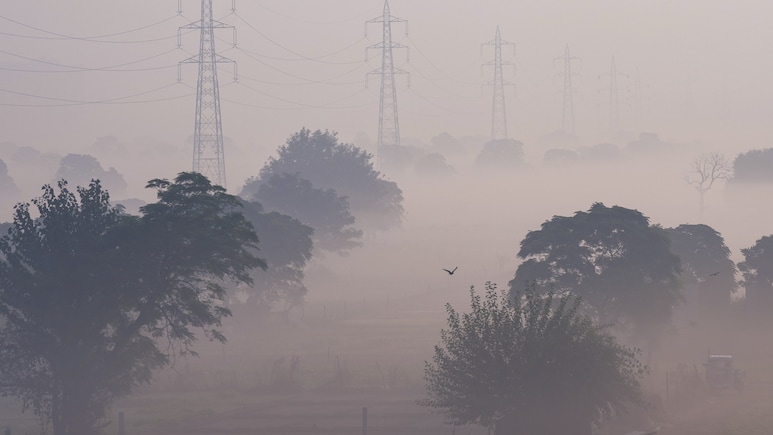
Delhi witnessed a marginal improvement in air quality on Tuesday, November 10, as the average Air Quality Index (AQI) dropped and entered from the 'very poor' to the 'poor' category. Pick-up in wind speed helped disperse heavy Diwali pollutants, pushing the city's air quality index down to 299.
According to Central Pollution Control Board (CPCB) data, Delhi's average AQI reading was 376 on Monday, placing it in the 'very poor' category. The capital also recorded its most polluted Diwali in five years, due to excessive firecracker emissions, vehicular pollution, stubble burning and unfavourable weather conditions contributing to deteriorating air quality.
Despite the improvement, pollution levels remained high across several neighbourhoods. Of the 57 monitoring stations reporting data, 23 continued to record 'very poor' air quality. Pusa registered the highest AQI at 385, followed by Chandni Chowk at 381.
Also Read | Layoffs Are Rising In Tech, But These Skills Are Helping People Unlock Better Pay
According to the CPCB, an AQI between 0 and 50 is classified as 'good', 51 and 100 as 'satisfactory', 101 and 200 as 'moderate', 201 and 300 as 'poor', 301 and 400 as 'very poor', and 401 and 500 as 'severe'.
On Tuesday, 23 monitoring stations in the city recorded 'very poor' air quality, with Pusa Road recording the highest AQI at 385, followed by Chandni Chowk at 381. AQI readings were available for 57 of Delhi's 59 monitoring stations. Safdarjung, Delhi's base weather station, recorded a minimum temperature of 15.7 degrees Celsius.
The India Meteorological Department (IMD) has forecast moderate fog during the day and the maximum temperature is likely to settle at 28 degrees Celsius.
Most Polluted Diwali
The national capital on November 8 recorded its most polluted Diwali in five years, exposing glaring enforcement failures and raising serious concerns over the health risks faced by Delhiites. The average AQI (Air Quality Index) was recorded at 376 on Sunday at 4 pm -- the highest for a Diwali day since 2021.
The instantaneous AQI stood at 371 at 10 pm on Sunday, after the deadline for bursting crackers had passed, as a thick layer of smog enveloped the city.
Delhi recorded an average PM2.5 concentration of 257 micrograms per cubic metre on Diwali --- more than four times the national 24-hour standard of 60 micrograms per cubic metre and over 17 times the World Health Organisation's 24-hour guideline of 15 micrograms per cubic metre.
Despite the restrictions, firecrackers continued to be burst well beyond the permitted hours (8 pm to 10 pm), with enforcement agencies failing to effectively curb the violations in many parts of the city.
(with inputs from PTI)
ALSO READ | Delhi's Diwali Pollution Worst In 5 Years, AQI Stays 'Very Poor' Next Morning
Essential Business Intelligence, Sharp Market Insights, Practical Personal Finance Advice, Daily Fuel, Gold and Silver Prices and Latest Stories — On NDTV Profit.