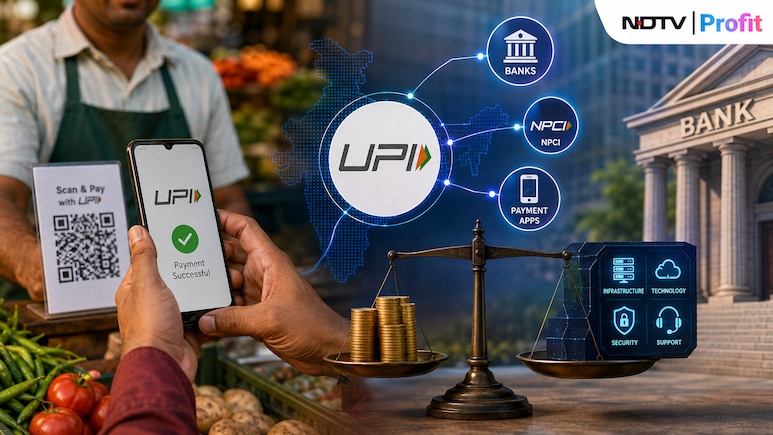
- UPI transactions currently have zero Merchant Discount Rate (MDR) fees, benefiting users and merchants
- Banks and payment platforms absorb costs under the zero-MDR rule implemented in January 2020
- A parliamentary report and legal amendment propose allowing RBI to set MDR fees on transactions. An explainer.
Every time someone scans a QR code to pay a vegetable vendor, a cab driver or a large retail chain, that transaction moves through UPI at zero cost to everyone involved. No fee for the customer, no fee for the merchant, no fee shared between the banks and apps that make the payment happen instantly. That is by design, and it is the single biggest reason UPI has grown into the backbone of Indian retail payments, handling person-to-merchant transactions worth roughly Rs 8 lakh crore a month.
But someone still pays for the plumbing. Banks, NPCI (the body that runs UPI) and payment apps such as Paytm, PhonePe and Google Pay all bear real costs, technology, infrastructure, customer support, fraud and risk management, to move that money instantly and securely. Under the zero-MDR rule in place since January 1, 2020, none of them are allowed to recover that cost directly from a transaction fee, the way a bank or network does on a debit or credit card swipe.
A Merchant Discount Rate, or MDR, is exactly that: the fee a merchant pays each time a customer uses a card or digital payment method, typically split between the bank that issued the card, the bank that serves the merchant, and the payment network. On UPI, that fee has always been nil.
Also Read | Layoffs Are Rising In Tech, But These Skills Are Helping People Unlock Better Pay
ALSO READ: UPI Fees Could Drive 50% Of Users Back To Credit And Debit Cards, Survey Finds
For years, industry voices have argued this is unsustainable, that a payments business cannot keep processing tens of lakhs of crores in transactions every month for free forever. The government has resisted, treating UPI's zero-cost model as a public good central to financial inclusion. That standoff may finally be shifting.
A new parliamentary committee report, a change in official rhetoric and a proposed amendment to the law governing payments have combined to make MDR on UPI look more plausible than at any point since the zero-MDR policy began.
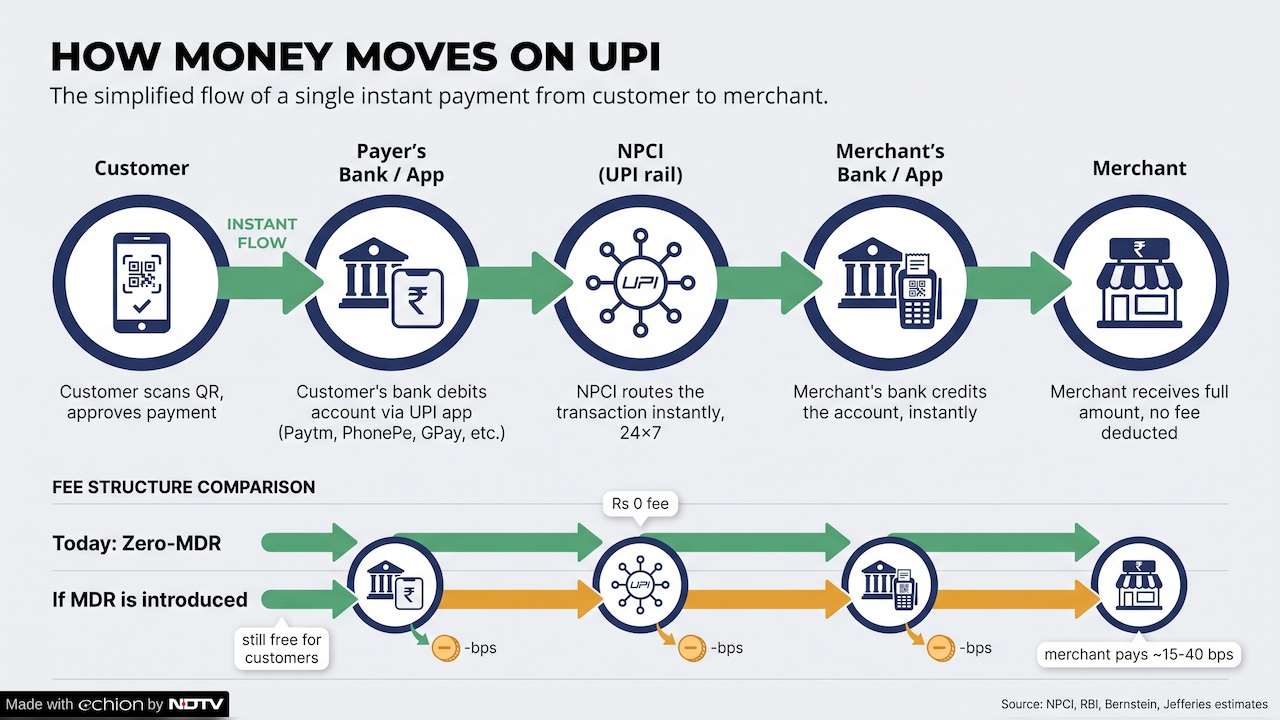
A simple flowchart of the UPI payment process
Photo Credit: NDTV Profit
Why it matters: If UPI transactions start carrying even a small fee, it would mark the first time in six years that India's payment platforms earn direct revenue from the product they have spent that time scaling. For companies such as Paytm and Pine Labs, that is a potential earnings inflection point running into thousands of crores. For the roughly 60 crore Indians who use UPI, the change would likely be invisible, since any fee under discussion would apply only to merchants, not to what consumers pay.
The big picture: The zero-MDR framework was a deliberate policy choice from 1 January 2020, designed to drive mass adoption of digital payments and curb India's cash economy. It worked. But it also left banks, NPCI and payment platforms absorbing the full cost of the infrastructure, with the government subsidising only a fraction of it.
Driving the news: A parliamentary committee report has revived the debate. Why this may be different from earlier ones?
- Unlike a previous instance when the finance minister explicitly ruled out charges on UPI, calling it a public utility, there has been no similarly firm denial this time.
- A Department of Financial Services advisor has instead spoken of a "balanced approach" rather than a blanket zero-MDR stance.
- Most significantly, the government has moved an amendment to the Payment and Settlement Systems Act that would hand RBI the power to decide MDR on UPI. That still needs to clear both houses of Parliament before any change in fee structure follows, plus industry negotiation on how the fee gets split.
ALSO READ: 'Spreading A Canard': Sitharaman Rebuts Claims Of MDR Resulting In UPI Fees For End Users
UPI by the numbers:
- UPI P2M (person-to-merchant) transactions above Rs 2,000 make up only about 4% of volumes but roughly 67-70% of transaction value, based on NPCI data cited across broker notes.
- Bernstein estimates a 15bps MDR on P2M transactions above Rs 2,000 could unlock a revenue pool of nearly Rs 8,300 crore; its later analysis, based on a 30-40bps MDR with a 5bps retention for platforms, puts the profit pool for payment platforms at roughly Rs 3,000 crore.
- Jefferies pegs the number higher: a 15-30bps MDR could generate Rs 5,000-10,000 crore in FY28 revenue for the industry, with platforms retaining most of it given the sector's push toward profitability.
- RBI's own cost estimate for a UPI transaction is about 25bps, versus 72bps for a debit card transaction. Debit cards currently cost merchants 0.4-0.9%; credit cards cost 1-2%.
What they are saying: Both Bernstein and Jefferies frame this as a genuine inflection point rather than a rerun of past false starts, though they differ on why. Bernstein points to the absence of political pushback as the tell. Jefferies points to the legislative mechanics: shifting MDR-setting power to RBI is a structural first step that earlier rounds of debate never had.
The other side: There is a credible case for leaving UPI alone. Bernstein's analysis (from its July webinar) shows the costs of running UPI, at roughly 30bps, have historically been more than offset by benefits worth over 50bps spread across the ecosystem:
- Banks have gained from a roughly 50% decline in ATM transactions per capita.
- The government has saved on currency printing costs, which have fallen by about half as a share of consumption expenditure.
- Merchants have gained formal credit access and lower cash-handling costs.
That is the argument for keeping the framework exactly as it is.
Between the lines: Nobody expects a blanket MDR. Every analyst view converges on the same design: fees confined to P2M transactions, with small merchants and low-value payments exempted, mirroring the precedent already set by MDR on RuPay credit cards routed through UPI. Even at 30-40bps, UPI would remain the cheapest payment rail in India, well below debit cards and a fraction of credit card costs.
Who wins: Paytm and Pine Labs stand out as the biggest beneficiaries, given their skew toward larger, higher-ticket merchants that already pay for card-based terminals.
- Bernstein estimates a 5bps net take rate for Paytm on qualifying UPI P2M transactions could lift FY28 PBT by roughly 27%.
- Jefferies' sensitivity analysis puts the FY28 EBITDA and PBT upside for Paytm at 15-35%, depending on the final MDR band.
- For Pine Labs, Jefferies sees a 10-23% lift to FY28 EBIT.
Who loses, or at least pays more: Small merchants. Bernstein estimates an MDR could add about Rs 150 a month in costs per merchant for those using UPI payment devices, two to three times the device's own subscription fee. That could paradoxically help newer entrants trying to win merchant acquisition, since a fee-based model makes device subsidies more sustainable.
What's next: The PSS Act amendment needs parliamentary approval before RBI can act. Even then, the actual MDR band, its scope and how it is split between issuing banks, acquirers, app providers and NPCI will need to be negotiated. Both Bernstein and Jefferies expect a 15-40bps range to be the eventual landing zone, well short of debit or credit card costs.
Bottom line: MDR on UPI is not in anyone's base case yet, but for the first time in years, the odds are shifting from "unlikely" to "plausible." A modest fee on high-value transactions would barely register for most Indian consumers and merchants. For payment platforms starved of a monetisation lever on their core product, it would be transformative.
WATCH: Will UPI Stay Free? RBI, Experts & Consumers Debate The Future
Essential Business Intelligence, Sharp Market Insights, Practical Personal Finance Advice, Daily Fuel, Gold and Silver Prices and Latest Stories — On NDTV Profit.