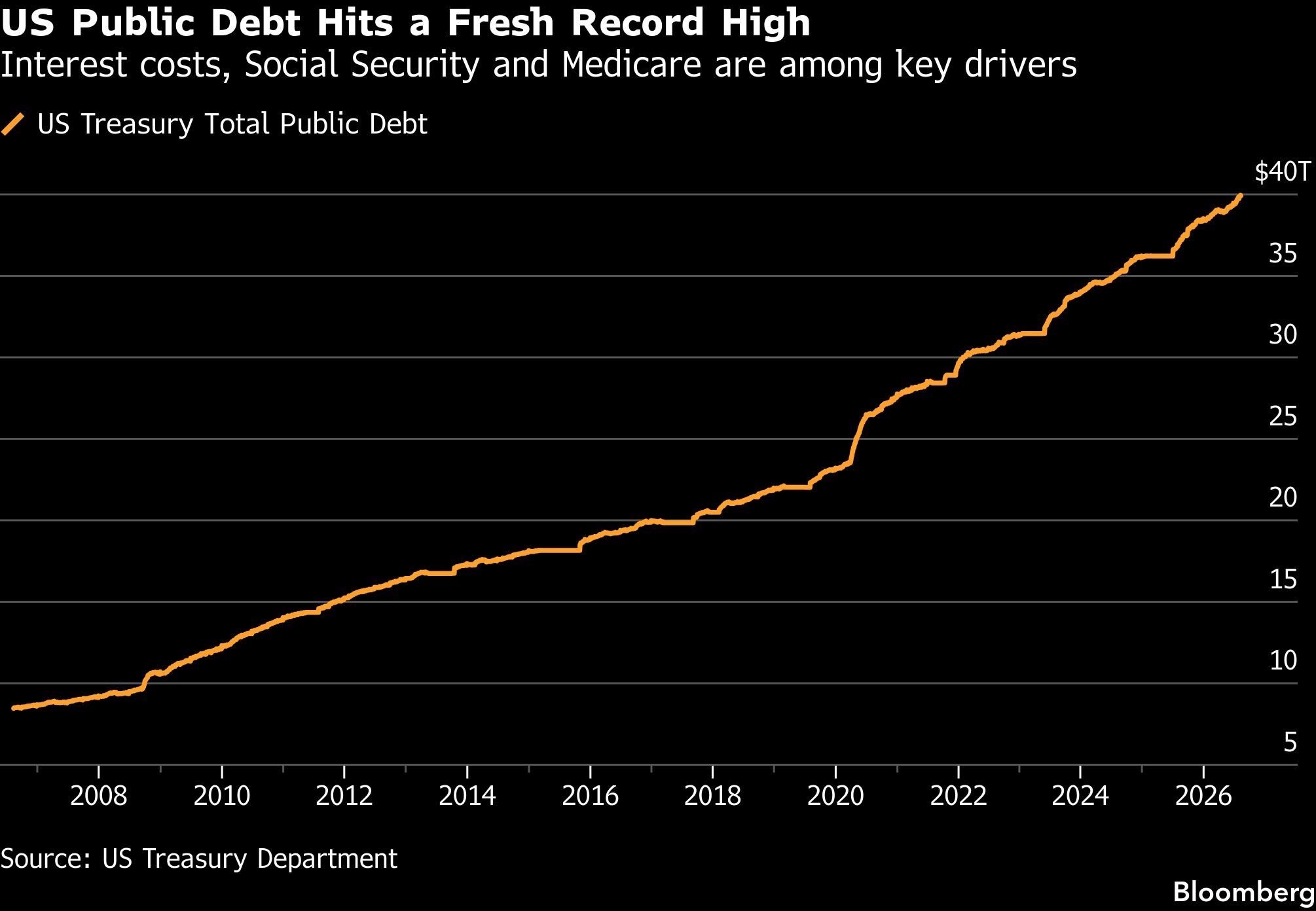
Total US public debt surpassed $40 trillion for the first time, and has now surged by a third in less than five years, as US lawmakers continue to shrug off calls to contend with historically wide fiscal deficits.
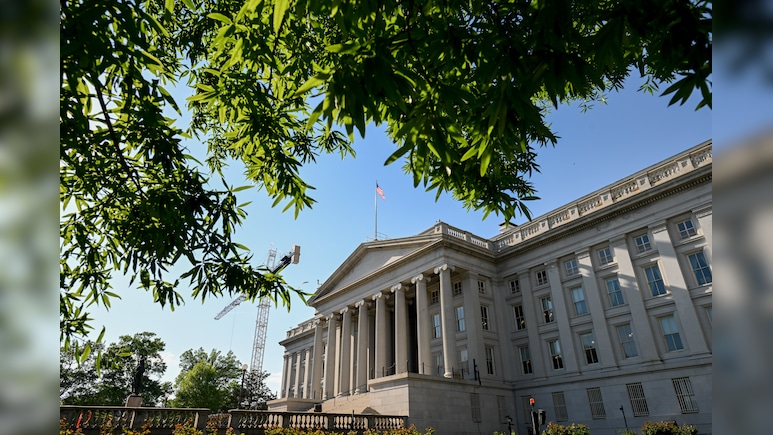
Public debt outstanding stood at $40.05 trillion as of the close of business Tuesday, a Treasury Department release on Wednesday showed.
The news came hours after Treasury Secretary Scott Bessent made a fresh attempt to rein in long-term borrowing costs from multi-year highs — a notable component of the growth in debt. The Treasury said it's ramping up a buyback program for longer-dated securities, in an announcement that sent yields lower.
Also Read | Layoffs Are Rising In Tech, But These Skills Are Helping People Unlock Better Pay
The crossing of the $30 trillion mark only dates back to January 2022, illustrating the rapid growth in federal borrowing needs. And there's no end in sight.
Republicans have long opposed revenue-raising tax increases, while both parties have been loath to sign on to politically toxic cuts to healthcare and retirement benefits for seniors. Many observers anticipate Congress and the administration of the day will only act if forced by a financial-market disruption.
That's not for lack of talk about the issue in Washington. Bessent, for one, said a key reason he got involved in politics was to help tackle deficits running at a pace unprecedented for times outside of major wars, pandemics or depressed job markets.
Yet economists, the Congressional Budget Office and Wall Street all see little or no progress in coming years for the deficit-to-gross domestic product ratio.
“Optically, I'm sure crossing thresholds like $40 trillion will focus attention on the issue in the near term,” said Matthew Luzzetti, chief US economist at Deutsche Bank AG. “But it does not represent a magical threshold for debt dynamics, and projections have anticipated this outcome for some time.”
More important, Luzzetti said, is the climb in US Treasury yields, which is steadily increasing the cost of servicing the record debt load. Last Thursday, the department's latest 30-year bond auction resulted in the costliest such sale in a quarter century. A 10-year auction a day earlier drew the highest financing cost at that tenor since 2007.
As buyers demand higher yields, that in turn drives up the Treasury's borrowing needs. With two months left to go in the fiscal year, the government's tally for interest costs so far for 2026 is $1.17 trillion — a 15% increase on the same period a year before. That in turn adds to the debt, potentially fueling further investor calls for higher rates, in a pattern known as a “doom loop.”
Interest costs are now the third-largest part of the budget, after healthcare and Social Security.
The public debt figure includes both the marketable Treasuries that investors focus on and “intragovernmental” debt — which reflects items such as past surpluses in the Social Security system that were parked into specially issued Treasuries.
“The federal budget is the enemy within,” Douglas Holtz-Eakin, president of the American Action Forum and a former director of the CBO, wrote in a note Monday. “It is the greatest threat to the foundations of economic progress, U.S. international economic standing, and national security. The only reason for optimism should be material actions to rein in the sea of red ink. There are no such material actions.”
The rise in US debt accelerated during the punishing economic downturns tied to the global financial crisis and the Covid pandemic. During those periods, revenue slid as tax-paying workers lost jobs, and assistance payments jumped.
Analysis compiled by Deutsche Bank economists shows policy measures by administrations over time also contributed notably:
- George W. Bush administration tax cuts in the early 2000s are estimated to have reduced revenues by $3.3 trillion through the mid 2010s.
- President Donald Trump's tax cuts passed in 2017 reduced revenues by at least another $1.5 trillion over the first decade.
- On the spending side, the wars in Iraq and Afghanistan cost taxpayers over $1.6 trillion through the mid-2010s.
- The debt impact of President Barack Obama's passage of the Affordable Care Act is more uncertain, with some official estimates showing a reduction in deficits but others arguing that it added ~$500 billion to US debt over the first decade.
- President Joe Biden's 2021 American Rescue Plan Act was estimated to increase deficits by $1.8-to-1.9 trillion over a decade, excluding interest costs.
Bessent came into office in 2025 touting a budget deficit target of around 3% of GDP by the end of President Donald Trump's second term, which concludes in January 2029.
It's not clear how that may yet happen. The ratio was 6% in July, according to data compiled by Bloomberg.
Trump, seeking to galvanize support ahead of the November midterm elections, is eyeing new tax-cut promises in addition to increases in defense spending. Meanwhile, the Elon Musk-led 2025 Department of Government Efficiency effort, which sought to slash discretionary spending including on contracts and government buildings, failed to cut outlays as much as DOGE's own estimates projected.
The government is now getting ever closer to the statutory debt ceiling of $41.1 trillion. Hitting that marker is expected to trigger another in the series of partisan showdowns in Washington over the years to head off a potentially devastating US payments default.
The ceiling will be reached in mid-2027, Fitch Ratings estimates. The agency on Aug. 13 affirmed the country's AA+ credit rating, while adding to warnings about the current borrowing trajectory.
“The government has not taken meaningful actions to address the large general government fiscal deficits,” Fitch said. “Spending pressures will mount over the next decade due to an aging population.”
The country will be “vulnerable to future economic shocks” as debt levels increase, the rating company said.
“Hitting this big round number will hopefully send a wake up call throughout Washington,” said Michael Peterson, who chairs the Peter G. Peterson Foundation, a research group, in regard to the $40 trillion. “It will hurt everyday affordability across the country if we don't get our debt under control,” he said.
Continued outsize borrowing “will put upward pressure on interest costs, which will make everyone's mortgage car loans and credit card bills even higher.”
(This story has not been edited by NDTV staff and is auto-generated from a syndicated feed.)
Essential Business Intelligence, Sharp Market Insights, Practical Personal Finance Advice, Daily Fuel, Gold and Silver Prices and Latest Stories — On NDTV Profit.