Scan to Download
By end of June, the RBI's new card storage rules will kick in. Under the new rules, merchants cannot store card details and must store a token instead.
The progress is satisfactory, said deputy governor T. Rabi Sankar. About 16 crore tokens have been created, he said. Some new issues have come to the fore, which will be addressed, he said, without detailing what these issues are.
When asked what would be the preferred steps to manage borrowings, Governor Das said that the RBI continues to have a number of tools. 'Operation twist' is one such option, Das said, adding that the central bank is holding enough securities to sell short term bonds to buy longer term securities. Das was, however, quick to say that this is just one that could be employed if needed.
In his comments, RBI governor Shaktikanta Das said that the central bank's approach "underscores a commitment to move towards normal monetary conditions in a calibrated manner."
What does the central bank see as "normal" monetary conditions? Das said normal conditions would be when the overnight inter-bank rate is aligned with the policy rate.
The RBI's inflation projections mean that the central bank will be seen to have failed in its inflation objective for the first time under the new framework. Failure under the framework is defined as inflation staying above the 4 (+/-2)% for three consecutive quarters.
We will deal with it as and when the situation arises, said Das when asked about this. "The law is very clear and the RBI will act accordingly," said Das. "I would not like to speculate," he said.
At the post-policy press conference, Das said that the stance had been reworded to give greater clarity to the markets. The central bank is now completely focused on withdrawal of accommodation, Das said.
Closing the June policy announcement, Das said that the central bank's actions must demonstrate the commitment to keep inflation in check.
The RBI will allow the linking of credit cards to the UPI platform, starting with Rupay cards.
To facilitate recurring payments, the limit is being enhanced from Rs 5000 to Rs 15,000.
Limits for individual housing loans extended by urban and rural cooperative banks revised upward by over 100%.
Rural cooperative banks allowed to extend finance for residential housing projects, within the limit of 5% of their total assets.
Urban cooperative banks have been allowed to extend doorstep banking services.
While not listing out any specific steps, Das said that the central bank would ensure the orderly implementation of the government's borrowing program. The RBI is watching the government securities market, he said.
The RBI sees inflation at 6.7% in FY23 with risks evenly balanced. The inflation projection pegs inflation at 7.5% in Q1, 7.4% in Q2, 6.2% in Q3 and 5.8% in Q4.
The projections mean that the RBI will, for the first time, have to explain a failure of its monetary policy under the new framework.
The inflation forecast assumes a normal monsoon and an average oil price of $105 per barrel.
About 75% of the upside in inflation can be attributed to food group, said Das, adding that the forecasts don't take into account the impact of monetary policy actions.
GDP growth is expected to broadly evolve around the outlook provided at the time of the April review, said Governor Das.
The real GDP growth for FY23 is retained at 7.2% with risks broadly balanced. The forecast includes growth of 16.2% in Q1, 6.2% in Q2, 4.1% in Q3 and 4% in Q4.
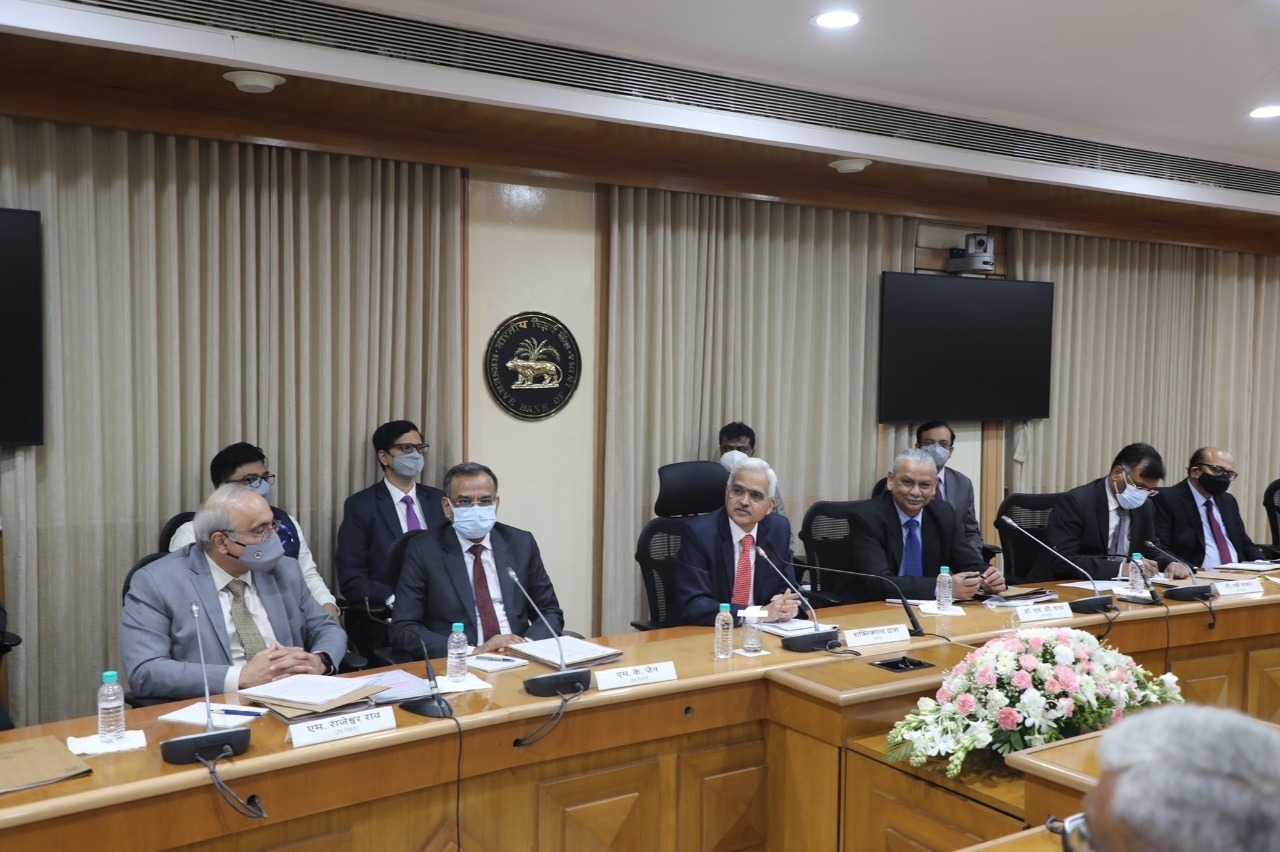
The Monetary Policy Committee has raised the repo rate by 50 basis points to 4.9%.
The MPC remains focused on "withdrawal of accommodation" to ensure that inflation remains within the target while keeping a watch on growth, said Governor Shaktikanta Das. The guidance statement makes a subtle shift by dropping its commitment to remain accommodative.
The MPC is committed to move towards normal monetary conditions in a calibrated manner, Das said.
Essential Business Intelligence, Continuous LIVE TV, Sharp Market Insights, Practical Personal Finance Advice and Latest Stories — On NDTV Profit.