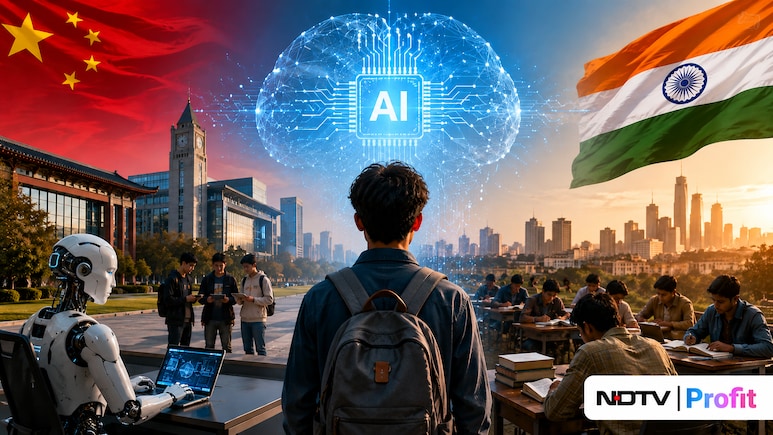
China has carried out the most sweeping university overhaul in the past five years. It has eliminated 12,200 undergraduate programmes and introduced 10,200 new ones. The changes touched more than 30% of all Chinese university courses.
The discontinued programmes share a common thread: arts, humanities, foreign languages, general management. Fields Beijing believes will have no demand in future economy. The replacements are mostly in artificial intelligence, robotics, advanced computing, and quantum technologies.
Top Chinese universities now offer degrees in embodied intelligence, the science of how AI interacts with the physical world. For children as young as six, algorithm literacy is now taught alongside reading and arithmetic.
Also Read | Layoffs Are Rising In Tech, But These Skills Are Helping People Unlock Better Pay
We in India need to sit with this news for a moment.
ALSO READ: There Are Two Sides To China's Economy — Both Need An Overhaul | The Reason Why
The disruption in jobs and economic value is no longer speculative. AI, machine learning, robotics, and quantum computing are already restructuring industries, compressing skill cycles, and redrawing the map of what human labour is worth. India's own Economic Survey 2024-25 acknowledged the double edge: AI will automate economically valuable tasks at scale, and the workers most exposed are those in the middle and lower wage brackets. Precisely the cohort that the university system is meant to uplift.
The challenge India faces is not simply unemployment. It is something more corrosive: mass unproductivity. A structural mismatch between what tens of millions of young Indians are trained to do and what a rapidly evolving economy will pay them to do. The World Economic Forum estimates that 63% of India's workforce will require significant upskilling and reskilling by 2030 to adapt to AI and advanced automation.
The demographic dividend India prizes so highly is not a guaranteed asset. Handed to an underprepared workforce, it becomes a liability.
History has already run this experiment. India rode the IT wave of the 1990s because it had a critical mass of English-speaking engineering talent when the world needed it. It became pharmacy to the world because health sciences had been quietly nurtured over decades. Every economic wave India has successfully caught was preceded, years earlier, by an education system that produced the right skills at the right moment. The AI wave is cresting now.
China has done this at far bigger scale. In 1985, under Deng Xiaoping's Four Modernizations, Beijing restructured its education system around a single purpose: industrialisation. Vocational enrolment surged from 5% in 1978 to 36% by 1985, redirecting large numbers of high school students into technical training.
University admissions were state-directed to produce engineers, scientists, and technicians. The factory of the world that swept global markets in the 1990s was not built in Shenzhen. It was built in Chinese classrooms a decade earlier.
In 1991, when India launched its own economic reforms, the two countries were roughly comparable in GDP and per capita income. Today, India is a $4.1 trillion economy. China is $19 trillion, nearly five times larger. That divergence was partly engineered through a long-term bet on human capital.
China is making a similar bet again. In 2024, its gross R&D spending reached $785 billion, positioning it at the forefront of global innovation investment. That is more than ten times India's total outlay. Meanwhile, India's R&D spending has remained anchored at less than 1% of GDP.
This column is not an exercise in self-flagellation. The IITs and IIMs have produced world-class talent. India's space programme is a genuine point of national pride. The National Education Policy of 2020 is a serious document. Its emphasis on multidisciplinarity, computational thinking, and early technology exposure reflects real intent. India plans to roll out AI curriculum across all schools from Grade 3 beginning 2027. The government has announced a Centre of Excellence in AI for Education.
But a framework is not real-world transformation. Intent is not implementation. The NEP's ambitions are being tested against a baseline that, in large parts of the country, is still fighting for basic literacy. Introducing algorithm literacy where reading literacy is absent is a Himalayan task.
The private sector deserves scrutiny here. India's private universities and schools have expanded aggressively for two decades on the promise of employability. How many have genuinely restructured their programmes for the AI era, not merely rebranded them? How many are still offering the same outdated engineering syllabi, the same general management degrees, dressed in new prospectus language? Regulatory and accreditation bodies must ask harder questions. Autonomy should be a privilege earned through demonstrated relevance.
What India needs is a genuine convergence of policymakers, industry, research institutions, and academia, operating at a speed this sector has never attempted. Industry must stop being a passive consumer of educational output and become an active co-designer of it. The gap between what engineering colleges teach and what technology companies need has been a challenge for decades. In the AI era, it becomes dangerous.
ALSO READ | Analysis: X Was Seen As Elon Musk's Ego Project. SpaceX Listing Reveals His Grand Plan
Policymakers must match ambition with action. China's current reforms are backed by a planned $300 billion commitment to AI infrastructure and a mechanism to track how AI creates and displaces jobs in real time, so that education policy can respond dynamically, not retrospectively. India needs an equivalent instrument suiting our domestic realities and economic planning.
The decisions made now on curriculum, R&D investment, and the rationalisation of what we teach and why, will determine whether India participates in the AI economy as an innovator or as a vendor of cheap labour with an expensive degree.
China made its education bet in 1985 and collected its dividend for thirty years. It is placing its next bet right now, with a clarity of purpose.
The question for India is not whether it has noticed. It is whether it has the institutional will to act at the required scale and the required speed.
(Vinay Sarawagi is Chief Content Officer at NDTV Network.)
Essential Business Intelligence, Sharp Market Insights, Practical Personal Finance Advice, Daily Fuel, Gold and Silver Prices and Latest Stories — On NDTV Profit.