- Neelkanth Mishra defends India's revised GDP series against criticism from Subhash Chandra Garg
- Mishra calls nominal GDP comparison with old base flawed and misleading
- GDP revision mainly adjusted informal sector recovery and shifted economic composition
Neelkanth Mishra, India's Executive Director at the World Bank, has hit back at criticism of the government's revised Gross Domestic Product (GDP) series, describing some of the pushback as "ill-educated and egregiously wrong" and pointing out that his own team had flagged the revision months before it became a talking point.
The comments were aimed chiefly at former Finance and Economic Affairs Secretary Subhash Chandra Garg, who has questioned whether India's headline GDP growth of 7.8% for the April-June quarter (Q1 FY27) properly reflects the pace of economic activity.
Garg argued that GDP should also be assessed in current prices, that is, before adjusting for inflation. Using the previous year's base for the same quarter, he said, nominal GDP growth works out to under 2.5%, against the 10.3% nominal growth implied by the government's revised numbers.
On the other hand, Mishra, who moved from Axis Bank to the World Bank in June 2026, dismissed the comparison as flawed. In a post on X, he said fiscal headwinds are fading and monetary headwinds, namely slowing credit growth through the first half of FY26 (April 2025-March 2026), are turning into tailwinds as credit growth accelerates. That, he said, should push consensus trend-growth estimates toward 7% and above, with the economy capable of registering 7.5% growth even under a neutral fiscal and monetary policy stance.
Also Read | Layoffs Are Rising In Tech, But These Skills Are Helping People Unlock Better Pay
ALSO READ: India's GDP Growth: SBI's Soumya Kanti Ghosh Flags Misleading Claims Based On Old Series
"I was shocked to see the ill-educated and egregiously wrong claims made by some that if the 'original' base of the June-2025 quarter was used, growth in the June-2026 quarter would be much lower," Mishra wrote, adding that he had tracked this data "for a living" until he joined the World Bank 45 days earlier.
What changed in the new series
The new GDP series, introduced in February 2026, revised down India's nominal GDP by about 4%, driven almost entirely by a downward revision to services, particularly trade, hotels, transport and communication. Financial services were revised up, reflecting wider coverage of private Non-Banking Financial Companies (NBFCs), while public administration and defence spending was revised down after an adjustment to pension payments. Officials and independent economists have broadly described the changes, including a shift to double deflation, as a methodological clean-up rather than a data manipulation.
The revision shifted the composition of the economy:
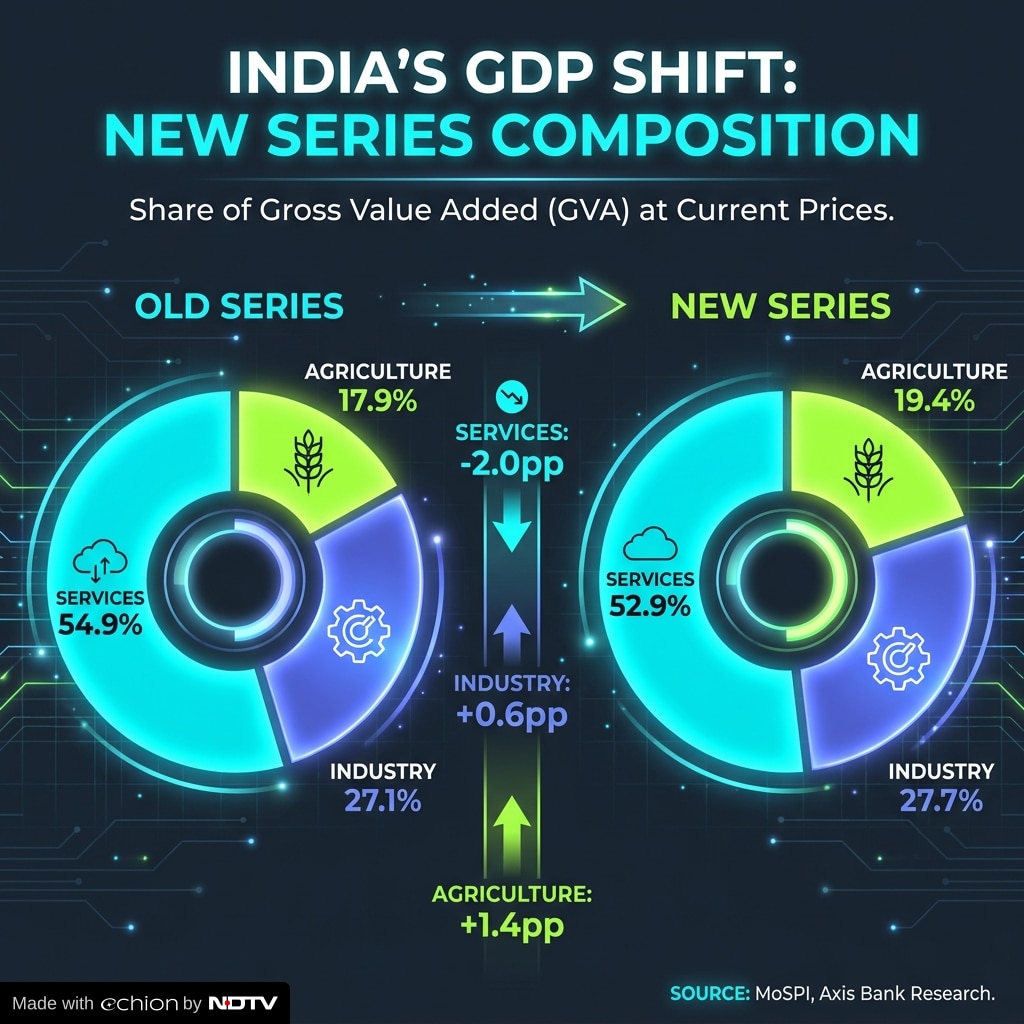
How the GDP calculation has changed after the changes.
Photo Credit: NDTV Profit
Crucially, Mishra's rebuttal is backed by a paper trail. A note published by Axis Bank's economics team, which he headed at the time, on March 1, 2026, had already flagged the downward revision, attributing it largely to an overestimation of the informal economy's post-Covid recovery in FY23 (April 2022-March 2023) rather than any weakness in current growth.
That note said the real GDP cut, of roughly 7 percentage points, was concentrated mostly in FY23, and that growth in Gross Fixed Capital Formation (GFCF, or investment) and Private Final Consumption Expenditure (PFCE, or consumption) was notably stronger for FY26 in the new series than in the old one. Axis Bank had maintained an above-consensus FY27 (April 2026-March 2027) growth forecast of 7.5% at the time, a call Mishra has now reiterated with the benefit of fresher data.
The nub of the disagreement
The dispute ultimately turns on a distinction between real and nominal growth, and it is one where Mishra's framing holds up better under scrutiny. Garg's sub-2.5% figure is a nominal, current-price comparison using the old GDP base; the 7.8% headline print is a real, inflation-adjusted number on the new base. Comparing the two, as Mishra argues, conflates a base-year methodology change with an actual slowdown, when the underlying data, flagged in Axis Bank's research well before the print landed, point the other way.
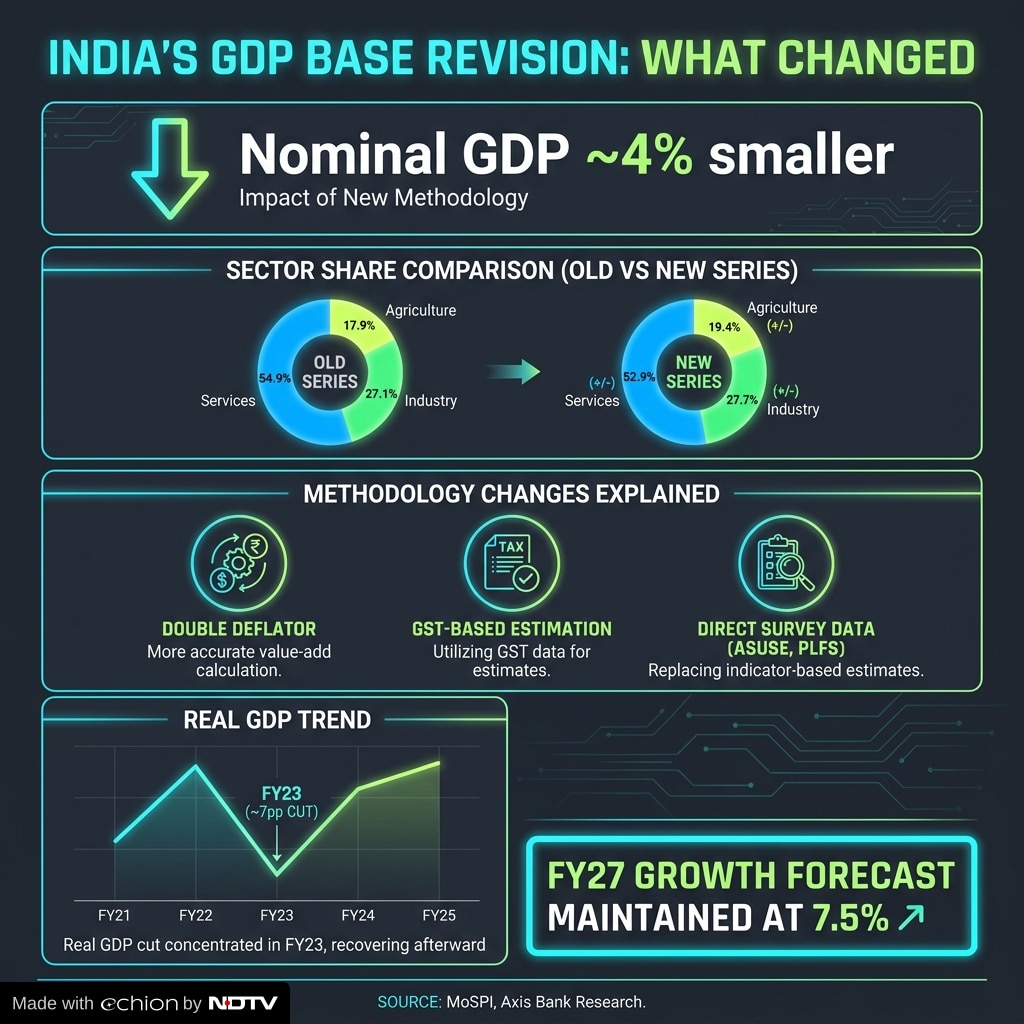
GDP new series explained.
Photo Credit: NDTV Profit
ALSO READ: Q1 GDP Explained: Govt Answers Six Questions On Manufacturing, Mining And GDP Revisions
Essential Business Intelligence, Sharp Market Insights, Practical Personal Finance Advice, Daily Fuel, Gold and Silver Prices and Latest Stories — On NDTV Profit.