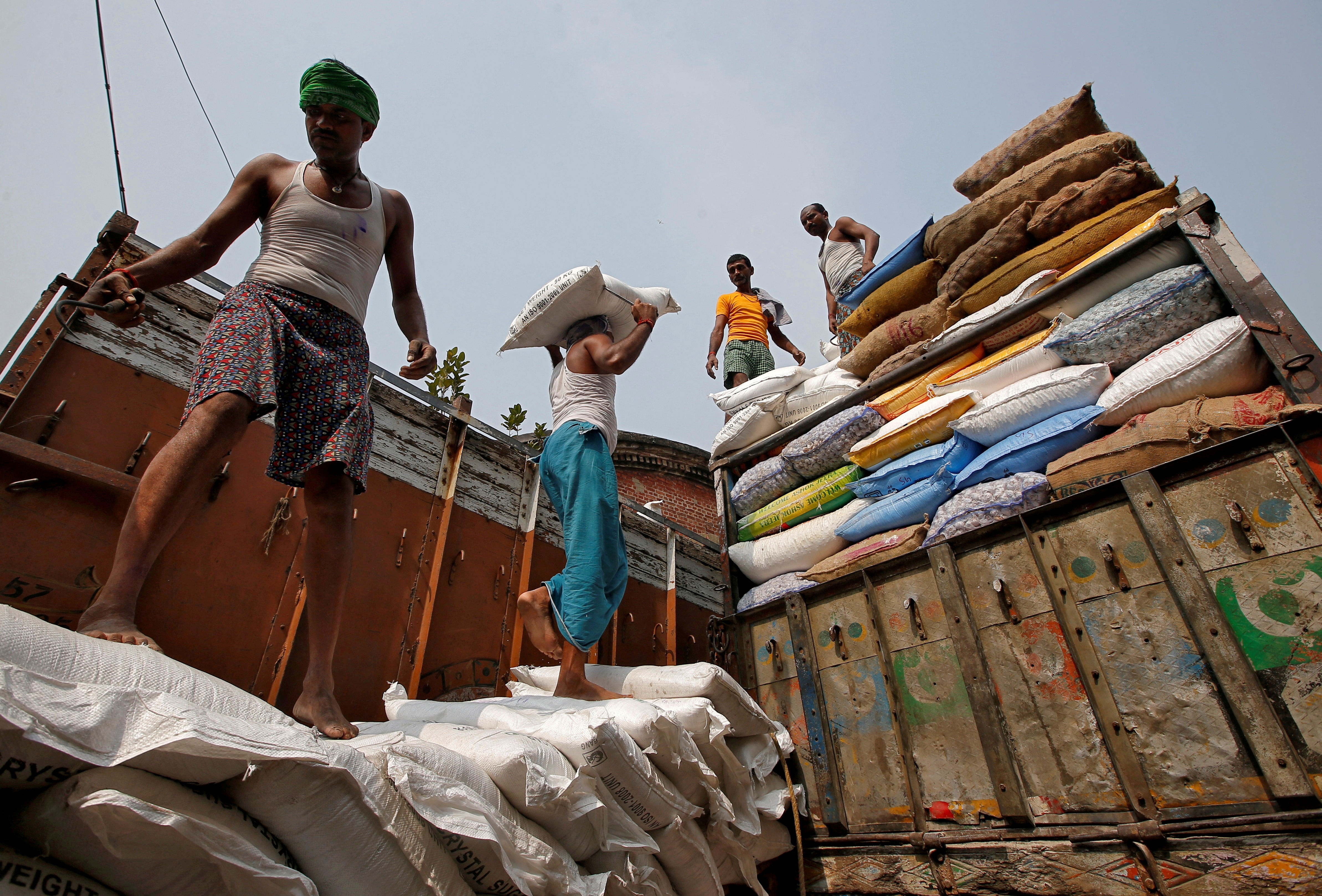
Jobs still below pre-pandemic levels, greater dependence on agriculture and informal sector, and the elevated demand for work under the rural jobs guarantee plan all point to an anemic recovery in India's labour market.
Jobs, while close to pre-pandemic levels are still below it, said Mahesh Vyas, managing director and chief executive of the Centre For Monitoring Indian Economy, in an interview with BQ Prime. "We were at about 408 million jobs in 2019-20, and we are still below 400 million jobs. We did touch 405-406 million, but we have not reached 409 million again."
Wage growth is also anemic, despite high inflation. "We have employment not growing, wages not growing, inflation rising, and now interest rates rising."
"Investments, investments, investments" is what will push up the pace of job creation, said Vyas. According to him, the animal spirits that led to rapid job creation in the 1990s or the early 2000s remain absent in the Indian economy.
Watch the full interview here:
Edited excerpts from the interview:
The month of June saw employment fall by 13 million, CMIE data shows. What led to this?
Mahesh Vyas: In the month of April and May, employment saw a good increase. About 8 million jobs were added in April and May, and it looked like the economy was coming out of this big problem and that we will recover back to pre-Covid times. But June was disappointing. We did expect June employment to be weak because it's a seasonally problematic month. If the rains get delayed, then employment does suffer in rural India and that's exactly what happened. But it is a bigger fall in employment than we had anticipated. Thirteen million jobs lost, almost all of them in rural India, was rather disappointing.
What about the urban job numbers? Are they extending a trend of repair?
Mahesh Vyas: Urban India did not see so much deterioration. It did not show any loss of jobs; it saw a very small increase in jobs. But urban India is still not generating enough jobs, it did not do great. It just generated 0.1 million jobs, even though we have many more people coming into the labour market.
So, urban India and India as a whole needs to generate a lot more jobs. But there's so much pain, or so much disappointment in rural India that overshadows the small gain that we have in urban India.
Were there other disappointing aspects to the June jobs report?
Mahesh Vyas: Not much. So, June did see a big fall in agricultural employment, but there were falls even in the industrial sector and the services sector. These were small falls, but nevertheless, there were declines in all the major segments and major sectors of the Indian economy. We expected industry and services sector to continue to grow, to provide more employment but that did not happen.
Over a slightly longer period of time, has the pace of job creation caught up with the pre-pandemic times?
Mahesh Vyas: I would say that the catch-up to where jobs were before the pandemic is not too bad. But we need to grow beyond that. We have still not reached the employment level that we were at before the pandemic hit us.
We were at about 408 million jobs in 2019-20, and we are still below 400 million jobs. We did touch 405-406 million, but we have not reached 409 million again.
Post the lockdown, we saw informal jobs come back but beyond that the recovery has been sluggish. We are not able to go back to where we were.
If one looks at the government's Periodic Labour Force Survey, it shows that the reliance on agriculture, on the informal sector has risen. That also suggests the labour market is still weak.
Mahesh Vyas: I will say that the labour market tells you a story which is more comprehensive than any other indicator of the economy. A household survey that the PLFS does or the CPHS survey the CMIE does, covers the entire country.
So, whether it is informal, formal, organised, unorganised—all those workers stay in houses, and we do a household survey. So, the most comprehensive indicator with regards to the Indian economy is one which is based on a very large sample, which goes across to all segments of the Indian economy, and that, whether it is PLFS or CPHS, shows that the recovery has been sluggish.
Now, what is happening is that the informal sector is not growing fast enough. It has taken a big hit. The formal sector, the organised sectors are doing well, and therefore, the stock markets are booming and Indian listed companies have record profits.
So, the organised sectors are doing quite well but the informal sector is not doing well and, therefore, people are moving into agriculture and that's just disguised unemployment.
Do any of these indicators give us a sense of wage growth at all?
Mahesh Vyas: We do have wages data. So, when we go and collect data on employment, we also get data on wages. We do know whether households are earning income from wage labour or from transfers from government or private transfers or from business profits. So, we do collect a lot of information on wages and what comes out from there is that the wage growth is as slow as the growth in employment, so we are not doing better on wages.
Households are taking a hit on both fronts—wages and employment.
So there is no sign of wage inflation yet, even though inflation is high. That is a double whammy of sorts...
Mahesh Vyas: More than that, so we have employment not growing, wages not growing, inflation rising, and now interest rates rising.
Not a pretty picture. A couple of other indicators Mr. Vyas, again from your essay and your data. The labour force participation rate is something you have been writing about and that seems like it's not picking up very consistently either. It fell in June too?
Mahesh Vyas: We shouldn't read too much into the June fall because I think this will get repaired when the rains come back as they seem to have. Employment in agriculture will push up the labour participation rate, which will get back to close to 40% but that's where we are—40%.
We were at 44-45% before the pandemic. So, in the last five to six years, labour force participation rate has fallen from 44-45% down to around 40%. That is not good enough.
What will it take us to sort of inch it back at least towards 44% or so?
Mahesh Vyas: Three things—investments, investments, investments. We just require investments to pick up and investments need to pick up in the private sector in a big way. Just a few projects coming up here and there in infrastructure is not good enough.
For example, a lot of the investments which are happening recently are in roads. So, you build a road, you will employ people to build the road but then it doesn't employ any more people. You build a factory that produces steel, cement, textiles or something, there are people who build that factory and then run the factory. So, we require investments to happen in the manufacturing sector and the services sector. Right now, most of the investments are in infrastructure sector; that doesn't help much.
CMIE also collects data on new project announcements. Is that giving us a glimmer of hope that there is a pick-up on the private investment side?
Mahesh Vyas: On the face of it, it looks like there were good investments happening in the quarter ended June. But when I looked at the numbers in detail, I found that most of the investments were of Indian entrepreneurs going to Davos to meet state governments and over there announcing projects in India.
So, it's more optics. I am being sceptical but pardon me for that. That's not the kind of investments we were seeing in the 1990s or even in the 2004-08 era, when people were falling over each other to set up steel plants and cement plants. We require that, we need to reach that mad pace of investments.
Is low capacity utilisation still holding back private investments or is it global uncertainties, interest rates and other such factors?
Mahesh Vyas: It is largely capacity utilisation. Other factors are there, global uncertainty, etc., but the biggest factor, in my opinion, is low capacity utilisation. Many sectors, steel particularly, has seen groups, like JSW, invest a lot into new steel capacities. There have been new capacities in cement as well. But for the rest of the economy, there isn't much and even the ones which are there in steel and cement are not big.
Are the government's capex investments paying dividends?
Mahesh Vyas: The public finance data for April and May show that the government did spend a lot of money on capex. They did get good money from taxes and they did spend money on capex. They have promised repeatedly that they will spend a lot more money on capex. I think that's very good.
But I think that's inadequate. That's not going to support the private sector to start investments. That's unlikely to happen. So, if the government, for example, says that they are going to spend a lot of money into road building, then some infrastructure companies will get those projects and it looks like some capex is happening. But that's not going to move the economy.
For the economy to move, we require demand to pick up a lot more. We require entrepreneurs to feel enthused to take big risks, to go and produce goods and services for the competitive markets, not infrastructure, which is covered by the government.
You measure consumer sentiments as well at CMIE. What can you tell us about how the consumption economy is looking from a sentiment viewpoint right now?
Mahesh Vyas: Of all the indicators in the Indian economy, the consumer sentiments has been the slowest to recover.
Whether you look at the RBIs Consumer Confidence Survey or the CMIE's Consumer Sentiment Survey, both of them tell us that the recovery in sentiments has been far more sluggish than the economy as a whole. We are growing at 7% or maybe 8%, but sentiments are still lower than they were in the pre-pandemic times when you look at the RBI survey or CMIE survey. That's because employment is not good enough and wages are not good enough. So, perceptions regarding households' income is not good enough.
What has happened in the recovery process, in the last three months or so, is that households have become unusually negative or less optimistic regarding their own future.
One interesting thing is that during the pandemic, households said that 'We are battered, we are in a bad shape, but we are hopeful tomorrow will be better'. So, the answer to the question—do you expect your incomes to be better a year from now or five years later—was always better than what they are today. That has flipped.
Households are not as optimistic about their own future, although their current income has improved. This is very intriguing, disappointing, and I think it requires action. Why are people not as optimistic or as hopeful as they were six months ago, in the last three months or so? They have become less optimistic about the future.
That's very interesting. So, then that should manifest itself perhaps in more savings and less spending?
Mahesh Vyas: Yes. I think we need to worry about the sentiment, something has flipped. The recovery was slow, and then their optimism of the future has taken a beating. So, we require to build perceptions, we require to build a story of the Indian economy, which is more promising, which is more growth-oriented and more aspirational.
One place where optimism was coming from was the start-up story. More jobs, higher salaries... But that too has taken a beating?
Mahesh Vyas: That's very disappointing, extremely disappointing because many of those startups did create lots of jobs, all kinds of jobs. But if those jobs also start drying up, then you see what has happened in June.
If the start-up world is imploding, for the want of a better word, and if the government says we are not going to hire as many army men as we were hiring in the past, the middle class will be in a bad shape. They were aspiring for these kinds of jobs, and they are seeing these jobs not necessarily happening.
We saw protests stem from the government's announcement on change in the nature of military employment. Where do you think that came from? The share of government jobs in overall employment is low, but perhaps it shows the premium attached to those jobs?
Mahesh Vyas: I have learned a lot about this from the insightful essays written in the media. What I take away is that there are pockets, and in those pockets, army jobs are very important. These are people who are not going to go to college and do an MBA course. These are not the people who have adequate land. These are not people who have other sources. These are people whose best bet in life is an army job. So, in those small pockets, and they are mostly in the northern belt, these jobs are extremely important. When those jobs go away, it takes away the hopes of an entire large neighbourhood.
There was a parallel, although separate announcement, that the government will accelerate filling up job vacancies. Does that move the needle in any way?
Mahesh Vyas: If it happens, it will. So, if I remember this right, it is a million jobs to be filled in one-and-a-half years, that's big if they could do that, and these are government jobs. So that's going to move the needle in a big way. So, I hope that happens.
While there are a lot of uncertainties economically, what does the year look like to you?
Mahesh Vyas: It's not an easy thing to predict. There are too many uncertainties. Russia-Ukraine is not the only one—interest rates, overseas inflation are all uncertain. The employment scenario in the world is weird.
So, the world is a lot more complex in a completely new way and that skews the situation over here. The employment situation is predicated on the investment scenario, which isn't moving much. So, I think India will still continue to grow by around 7% or thereabouts. But I don't think the living conditions of Indians are going to change much.
Essential Business Intelligence, Sharp Market Insights, Practical Personal Finance Advice, Daily Fuel, Gold and Silver Prices and Latest Stories — On NDTV Profit.