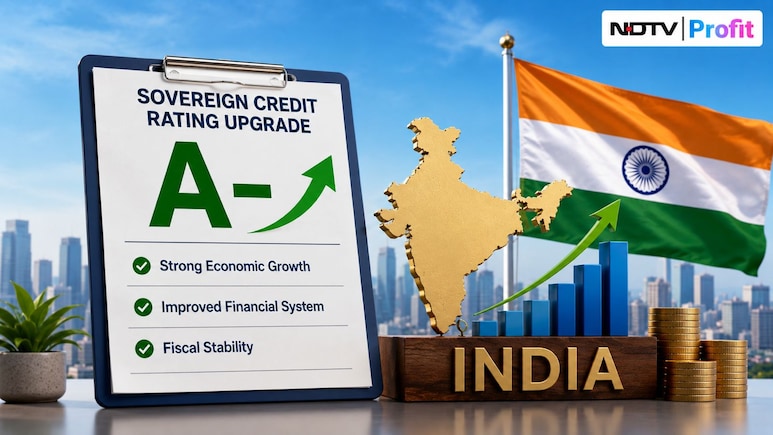
The Japan Credit Rating Agency (JCR) has upgraded India's sovereign credit rating by one notch to A- from BBB+, citing the country's solid economic growth and the improved soundness of the financial system. JCR has assigned a Stable outlook to both India's foreign currency and local currency long-term issuer ratings.
The rating agency noted that the Indian economy has maintained a high growth rate of around 7%, supported by robust private consumption and public investment.
It highlighted the government of India's growth and economic development-oriented policies, including the development of digital public infrastructure and the implementation of the goods and services tax (GST), which have strengthened the country's economic foundations as compared to the past.
Also Read | Layoffs Are Rising In Tech, But These Skills Are Helping People Unlock Better Pay
Meanwhile, the banking sector's nonperforming loan ratio has declined to below 2%, helped by the establishment of the Insolvency and Bankruptcy Code and the Reserve Bank of India's (RBI) strengthened financial supervision and macroprudential policies.
JCL also said that the financial foundation of the non-banking financial sector has also strengthened, contributing to a significant improvement in the soundness of the financial system in recent years.
ALSO READ: Steel Margins Under Siege: Why Is JPMorgan Is Backing JSW Over SAIL? Five Key Reasons
“Considering India's solid economic growth, the effectiveness of economic policies that strengthen the foundations for growth, and the improved soundness of the financial system, JCR has upgraded the Republic of India's Foreign Currency and Local Currency Long-term Issuer Ratings by one notch to ‘A-‘,” said the rating agency.
JCR has also raised the country ceiling by one notch to “A.”
JCR considers that India faces structural challenges that tend to keep fiscal deficits at elevated levels due to complex intergovernmental fiscal relations; fiscal transfer arrangements aimed at reducing disparities among states; and fiscal management that is susceptible to electoral cycles.
The agency noted that in recent years, the quality of fiscal expenditure has improved. In FY2026, the central government fiscal deficit narrowed to 4.4% while maintaining capital expenditure at a high level. The central government debt-to-GDP ratio stood at 56.1% in FY26 and is expected to decline gradually.
However, the general government debt, including those of state governments, and the associated interest burdens remain high. JCR will continue to monitor whether government capital expenditure can induce private investment and reduce the economy's dependence on government spending while sustaining economic growth
India continues to register a trade deficit amid its robust domestic demand. However, its current account deficit stays contained, supported by a surplus in the services balance.
JCR believes India's foreign exchange reserves are ample and significantly exceed its short-term external debt, providing the country with strong resilience to external shocks.
ALSO READ: Catch Stock Market Live Updates Here
Essential Business Intelligence, Sharp Market Insights, Practical Personal Finance Advice, Daily Fuel, Gold and Silver Prices and Latest Stories — On NDTV Profit.