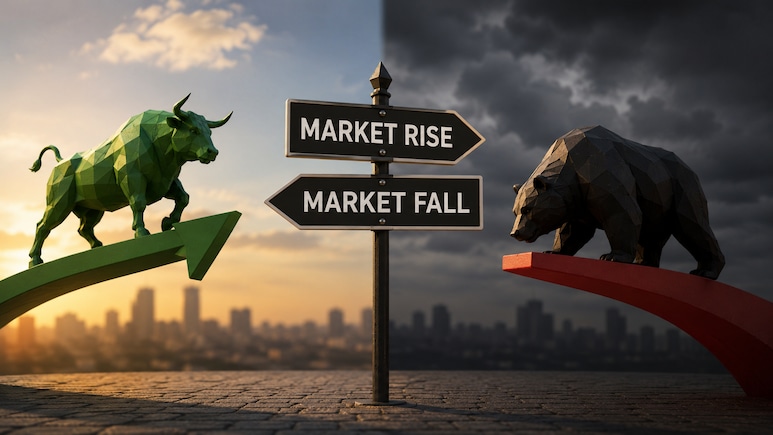
Have you noticed this trend among major finfluencers and financial advisors? They start talking about risks when the music stops.
When markets are surging, they bring demographic dividend, China+1, manufacturing growth and the power of compounding every day. The stock market is presented as the elixir for any financial goal. They spend hours on social media trying to convince us that investing in fixed deposits, recurring deposits, and gold is old-fashioned. But when the markets collapse, they are the first to call out that diversification is the key and that having some portion in debt or gold was common sense.
Calling them dishonest will be far-fetched and wrong. Most of them are not. The problem is far more subtle. It is the way incentives, psychology and the business of wealth management work together.
Also Read | Layoffs Are Rising In Tech, But These Skills Are Helping People Unlock Better Pay
The Business Of Optimism
"Incentives matter." Economists love using this cliché to explain anything.
Financial advisors, fund managers, and sell-side equity researchers tell you to invest in stocks all the time. Pick any point in the market cycle, and you will find some brokerage report arguing for another 20% upside and that now is the right time to buy that stock. Buy recommendations grab headlines, while the sell calls receive less attention and are sidelined. It's no surprise that most brokerage houses have 'Buy' ratings on a majority of the stocks they cover.
My favourite finance writer, Vivek Kaul, calls them "OPM wallahs"- people who manage other people's money (OPM). They either invest on behalf of clients or advise them where to invest. Their earnings are linked to assets under management (AUM), portfolio performance, or the number of investors they bring into a scheme.
ALSO READ: Saving For Retirement Isn't Enough | The Reason Why
Secondly, mutual fund distributors earn higher trail commissions on equity-oriented schemes than on debt schemes. Unsurprisingly, equity becomes the default recommendation.
No one is deliberately misleading anyone. But the incentive structure is such that keeping money flowing into the market remains the major objective, and optimism becomes the default language. Jeremy Grantham, founder of GMO, says, "You will not receive the advice from investment advisers to get your tail out of the market, ever. It is not good business for them to do that."
The Psychological Problem
But incentives alone aren't enough. They work because investors themselves want optimistic stories.
The first problem is recency bias - our tendency to give too much importance to recent events while ignoring history. If markets have delivered strong returns over the last four or five years, we assume that this is how markets normally behave. We begin to believe that 20% annual returns are normal rather than exceptional.
This is reinforced by denialism - our tendency to avoid information we don't like. High valuations, slowing earnings and market cycles challenge the ongoing optimism, slowly disappearing from our conversations.
ALSO READ: It's Never Just About Money | The Week in Whys
Bull markets make it worse. When almost every portfolio is making money, everyone starts believing that their strategy is working. A few profitable trades convince people that they are experts.
Social media amplifies this further. Every bull market creates a new generation of finfluencers. We are naturally drawn to people who speak with certainty and mistake confidence for competence. That's why a video titled "This stock will give 40% returns" attracts far more attention than one discussing valuations, business cycles and uncertainty. Again, nobody is trying to mislead anyone. As Vivek Kaul writes, "The best finfluencers deceive themselves first and then deceive others." Once they believe the optimistic story, selling it becomes effortless.
The Young Blood With Little Patience
This problem is starker for those who entered the market after the pandemic. For them, markets have mostly moved in one direction - up - until September 2025.
This matters because India's investor base has changed. The number of unique investors on the NSE increased from 3.1 crore in March 2020 to 11.3 crore by March 2025 and 13.1 crore by May 2026. More than half of new investors are under 30 every year. In March 2020, 235 out of every 1,000 investors were under 30. By May 2026, that number had risen to 381.
Therefore, a generation of investors has entered the market expecting 20-30% as normal returns. As markets corrected, many stopped investing.
ALSO READ: Credit Card Rewards Are Addictive; Banks Know It | The Reason Why
Diversification Advice That Comes Late
Recently, many finance experts discussed the basics of investment, mainly risk appetite and diversification. Fixed deposits, gold, silver, and overseas investments - all are gaining attention. Their intentions may be genuine, but the timing isn't.
Today, many of these assets have already had a strong run. Shifting from one expensive asset to another will not give investors stability and true diversification. True diversification is built before markets become euphoric.
Final Take
SEBI's Investor Survey 2025 found that while 97% of respondents struggled to understand risk and uncertainty before investing, 93% became inactive because of poor portfolio performance afterwards. Nearly 45% admitted they had expected quick riches.
The gap, therefore, isn't just about return expectations. It's also about understanding risk, one's own risk appetite, market cycles, valuations, and diversification. That's the biggest omission in India's retail investing discourse. Financial advisors and finfluencers must talk about these issues more often and at the right time.
Disclaimer: The views expressed in this article are solely those of the author and do not necessarily reflect the opinion of NDTV Profit or its affiliates. Readers are advised to conduct their own research or consult a qualified professional before making any investment or business decisions. NDTV Profit does not guarantee the accuracy, completeness, or reliability of the information presented in this article.
Essential Business Intelligence, Sharp Market Insights, Practical Personal Finance Advice, Daily Fuel, Gold and Silver Prices and Latest Stories — On NDTV Profit.