- India's current account deficit may rise to $88 billion in FY27, warns Bank of America
- Crude oil prices surged 72% in 2024, intensifying India's import costs and inflation risks
- Rupee depreciated 5.1% against the dollar, worsening the external balance pressures
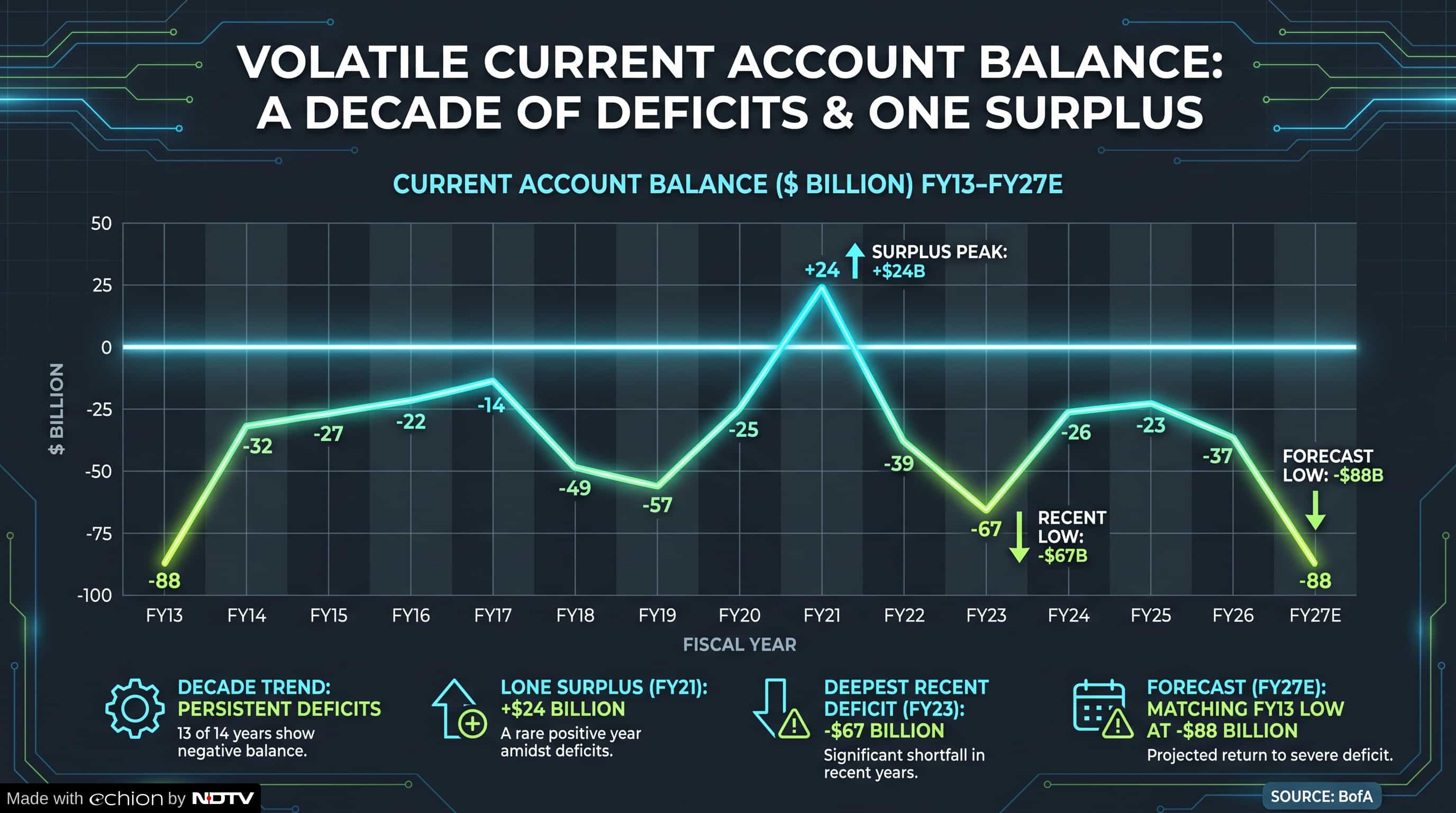
A sharp rise in crude oil prices and a weakening rupee are combining to put renewed pressure on India's external balances, with Bank of America warning that the country's current account deficit (CAD) could widen to levels last seen during the 'Fragile Five' era.
In 2013, Morgan Stanley coined the term 'Fragile Five' to refer to a group of emerging market economies—India, Brazil, South Africa, Turkey, and Indonesia. They are characterised by high current account deficits, heavy reliance on foreign investment, and vulnerability to capital outflows during the US Fed's 'Taper Tantrum'. These nations experienced severe currency depreciation, inflation, and economic instability during this period.
According to BofA, India's CAD may expand to $88 billion in FY27, equivalent to 2.1% of GDP, assuming Brent crude averages $95 a barrel. That would mark a steep jump from an estimated $37 billion in FY26 and would bring the deficit close to FY13 levels, when India's CAD had also touched $88 billion.
Also Read | Layoffs Are Rising In Tech, But These Skills Are Helping People Unlock Better Pay
The warning comes at a time when crude prices have surged 72% so far this year, while the rupee has depreciated 5.1% against the dollar, magnifying the cost of India's oil imports.
Why Oil Matters So Much For India
As the world's third-largest oil importer, India remains highly sensitive to swings in crude prices. BofA estimates that every $10-per-barrel increase in oil prices widens the current account deficit by 0.4% to 0.5% of GDP.
The inflation impact is equally significant. If higher fuel costs are passed through to consumers, consumer price inflation could rise by 30 to 50 basis points, while wholesale inflation may increase by as much as 80 basis points. Economic growth could also take a hit, with GDP potentially slowing by around 15 basis points.
Despite the headline comparison to FY13, BofA does not believe India is facing the same level of vulnerability it did more than a decade ago, when concerns over twin fiscal and external deficits triggered sharp capital outflows. Still, the brokerage cautioned that financing a much larger deficit will require closer scrutiny of India's capital account and its ability to attract stable foreign inflows.
Essential Business Intelligence, Sharp Market Insights, Practical Personal Finance Advice, Daily Fuel, Gold and Silver Prices and Latest Stories — On NDTV Profit.