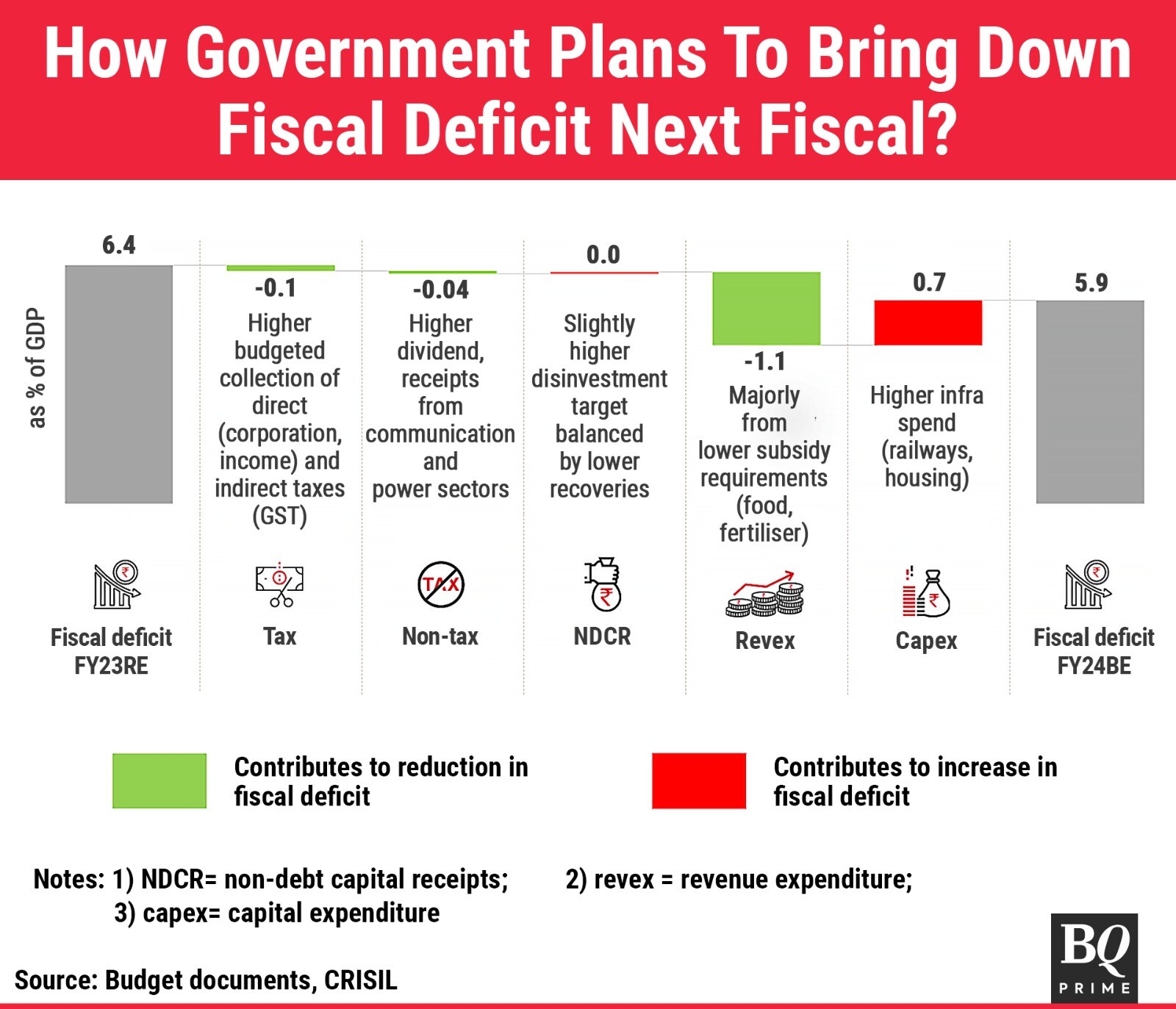
The Union Budget for fiscal 2024 has adhered to the planned fiscal consolidation path, budgeting a reduction in the fiscal deficit to 5.9% of gross domestic product in fiscal 2024 from a revised estimate of 6.4% this fiscal.
This puts the deficit on a glide path to below 4.5% of GDP by fiscal 2026.
But the trillion-rupee question is, how did the government manage to do so while still giving a major impetus to capital expenditure and growth, and foregoing some revenue with tax rebates?
The answers emerge from an assessment of the budget based on transparency, the realism of assumptions, and possible risks to these assumptions.
Like the past few budgets, this one scores highly on transparency.
The government has continued to make greater provisions for capex directly through the budget while keeping dependence on the resources of central public sector enterprises, CPSEs (or internal and extra-budgetary resources or IEBR) low compared with the pre-pandemic average. This helps get a clearer picture of the government's true fiscal situation and, in turn, supports financial stability.
Now, for the assumptions.
#1 The Budget Is Premised On A Nominal GDP Growth Assumption Of 10.5% For Fiscal 2024
This, in our assessment, is realistic.
With inflation, especially at wholesale prices, declining fast and real growth facing multiple headwinds, nominal GDP growth would slide to these levels from a high of 15.4% estimated for this fiscal.
#2 It Assumes A Gross Tax Buoyancy Of 1.0 For Fiscal 2024, Compared With 0.8 As Per Fiscal 2023RE
The assumed decline in direct tax buoyancy appears to be fair. But the expectation of an uptick in customs and excise tax buoyancies appears a tad optimistic.
For instance, in the likely scenario of an import slowdown, achieving greater customs duty buoyancy could prove to be challenging. At the same time, a sharp fall in wholesale price index inflation could hinder the targeted goods and services tax collections next fiscal. A continued focus on improving compliance would, therefore, be needed to achieve overall tax buoyancy.
#3 Non-tax Revenues Are Budgeted To Rise To Rs 3.02 Lakh Crore Next Fiscal From Rs 2.62 Lakh Crore This Fiscal.
This is premised on a sharp uptick in revenue from spectrum sales next fiscal (Rs 0.89 lakh crore vs. Rs 0.68 lakh crore in fiscal 2023RE) that would need monitoring. Dividends from scheduled commercial banks could also face some headwinds, with their margins coming under pressure from rising deposit rates.
#4 The Disinvestment Target Of Rs 51,000 Crore For The Next Fiscal Is Comparable With This Year's
But it would still need to be watched closely, as this is one head under which the government has consistently fallen short.
Now turn to the expenditure side.
The more important aspect of this budget is the ‘restructuring' or ‘switching' of expenditures.
Unlike this fiscal, when a revenue surprise saved the deficit target, this budget has placed its bets on axing revenue expenditures—mainly subsidies—to fuel capex.
Effective capex (i.e., budgetary capex plus grants-in-aid for the creation of capital assets) for fiscal 2024 is budgeted at 4.5% of GDP, up from 3.9% this fiscal.
At the same time, effective revenue expenditure (total revenue expenditure minus grants-in-aid for the creation of capital assets) is budgeted to reduce to 10.4% of GDP from 11.5% this fiscal.
The thrust within revenue expenditure is on cutting food and fertiliser subsidies, which had shot up this fiscal year due to the extended Pradhan Mantri Garib Kalyan Anna Yojana and a spurt in international natural gas and fertiliser prices, respectively.
Total subsidies are budgeted at Rs 4.03 lakh crore in fiscal 2024, down 28% from this fiscal.
To be sure, a part of the savings from lower subsidy bill is being used to offset higher interest payments (3.6% of GDP in fiscal 2024 vs 3.4% this fiscal).
In sum, the fiscal deficit target is not out of reach but rests a lot on getting the assumptions right. The caveat of course remains — that geopolitics could swing commodity and crude prices in a major way.
Dharmakirti Joshi and Adhish Verma are Chief Economist and Senior Economist, respectively, at CRISIL
The views expressed here are those of the author and do not necessarily represent the views of BQ Prime or its editorial team.
Essential Business Intelligence, Sharp Market Insights, Practical Personal Finance Advice, Daily Fuel, Gold and Silver Prices and Latest Stories — On NDTV Profit.