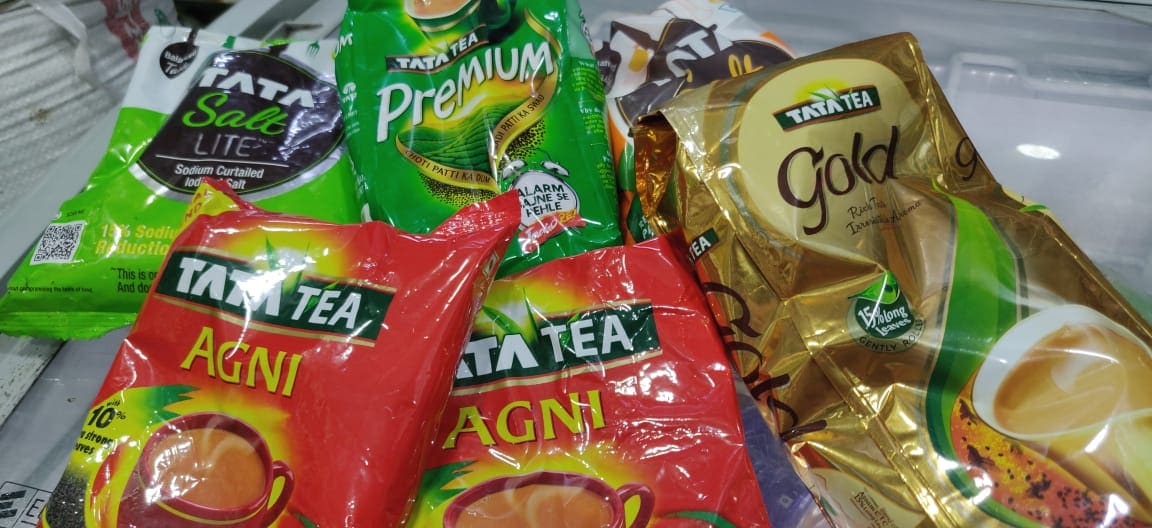
Tata Consumer Products Ltd.'s quarterly profit rose and margin expanded as tea inflation tapered off.
Net profit attributable to shareholders of the maker of Tata Tea and Tata Salt rose 21% over the preceding year to Rs 265.05 crore in the quarter ended December, according to its exchange filing.
Key Highlights (YoY)
Revenue rose 5% to Rs 3,208.38 crore.
Operating profit rose 25% to Rs 461.66 crore.
Margin widened to 14.4% from 12%.
Revenue in the India food and beverages segment rose 16.13% and 1%, respectively, during the quarter.
International business revenue fell 4.3% to Rs 896.62 crore.
Non-branded business increased 26.7%.
Advertising and promotion spend was up 17%.
For the quarter, the domestic packaged beverages business recorded a 6% volume growth, while the food business saw 4% volume growth.
India Business
Sequential volume growth for tea stood at 5% in Q3.
On a year-on-year basis, however, the branded tea growth was driven by pricing as volume declined 1.6%.
It recorded market share gains of 89 basis points in branded tea and 476 basis points in salt business.
Coffee volumes grew 65% year-on-year, albeit on a small base.
Salt portfolio recorded double-digit growth.
Tata Salt Shuddh, a solar salt, was launched in select markets in the south to strengthen its mid-tier portfolio. This also marked the first new brand launch from the Tata Salt stable in a decade.
Tata Sampann was led by broad-based growth across pulses, besan and poha. It also entered a new category with the pilot launch of its dry fruits range of premium cashews, almonds, pistachios and raisins.
NourishCo saw 91% revenue growth, led by growth across geographies.
“Both tea and salt recorded market share gains. With tea inflation tapering off, we have seen a significant expansion in India beverages margin,” Sunil D'Souza, managing director and chief executive officer of Tata Consumer Products, said in a statement.
Persistent inflation in freight, packaging and key raw materials along with additional investment in new businesses such as Soulfull and Tata Q, however, have impacted food margin, the company said.
International Business
Volume growth for the U.S. coffee business fell 2%, while international tea volume dropped 7%.
The international business was impacted as the spike in home consumption of tea and coffee last year bottomed out.
Regular black tea category witnessed decline in the U.S. and the U.K., while non-black tea (fruit and herbal, specialty, decaf, cold infusions, etc.) declined in the U.K. and Canada.
On inflation, it said, Kenya tea prices and Arabica and Robusta coffee prices continued to soar amid global cues. In the U.S. coffee business, it plans to take price increases to mitigate commodity inflation.
Other Highlights
Tata Starbucks, the company said, recorded revenue growth of 60% in Q3 on a relatively low base of last year that was impacted by reduced mobility.
Its revenue grew 37% when compared to the same period in FY20, it said.
It opened 13 new stores between October and December and entered two new cities- Trivandrum and Siliguri.
Outlook
The company said there has been a sequential recovery in revenue since the opening up after the second wave of Covid, but the third wave is posing some operational challenges.
“We are hoping for a fast economic recovery this time, but Inflation remains a concern,” it said in its presentation. As far as the international business is concerned, it expects the demand environment in key markets like the U.S., the U.K. and Canada to remain volatile until the current wave subsides.”
Essential Business Intelligence, Sharp Market Insights, Practical Personal Finance Advice, Daily Fuel, Gold and Silver Prices and Latest Stories — On NDTV Profit.