In ‘Talking Points This Week', Niraj Shah studies how top business leaders and market makers are navigating the fast-changing financial landscape.
“Conditions for financial markets remain the inverse of Goldilocks. Stagflation appears to be ever more a reality while the world is now looking at the potential for the worst nuclear crisis since the Bay of Pigs invasion in 1961 and the subsequent Cuban Missile Crisis in 1962.”
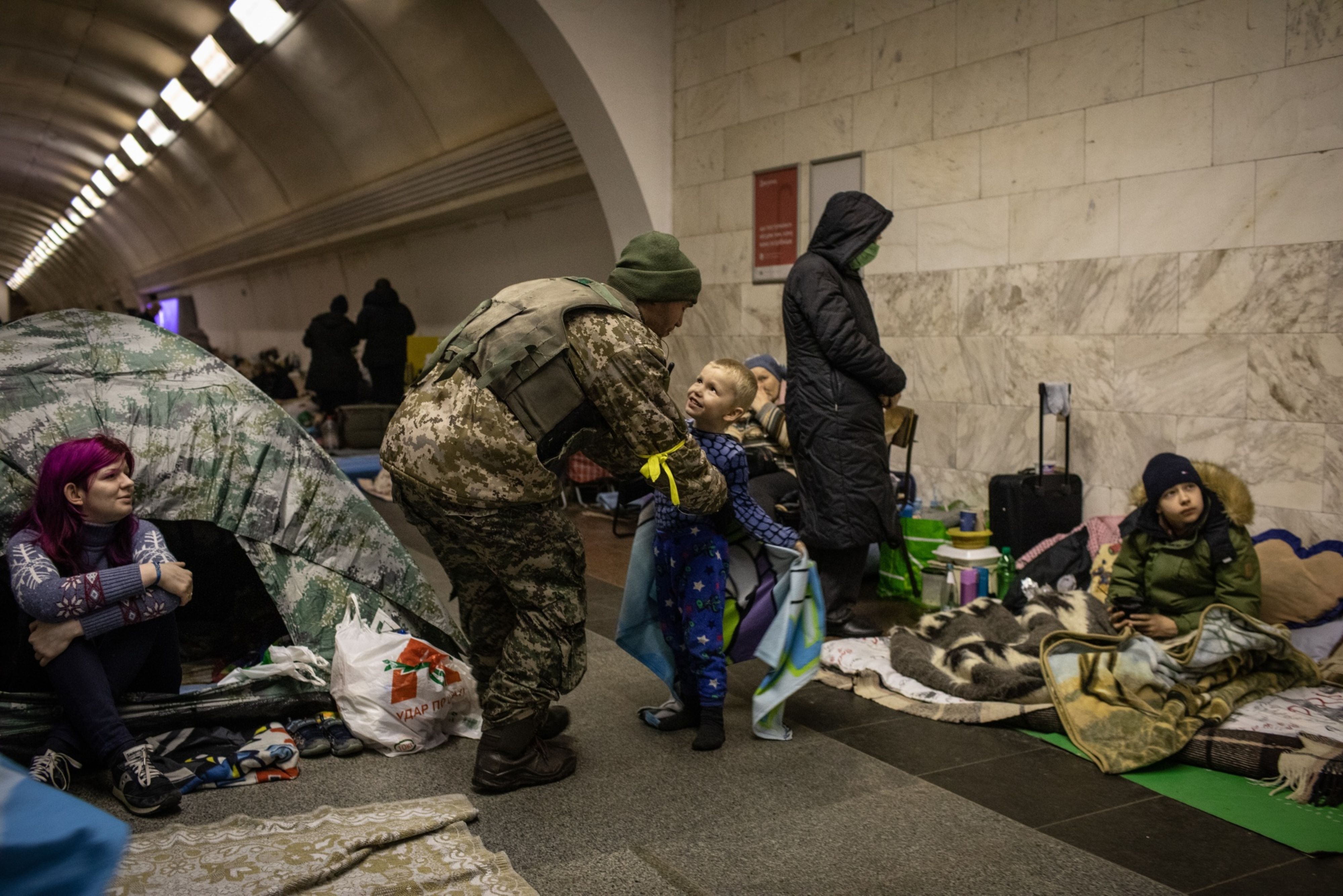
The setup appears to be more or less what Jefferies' Christopher Wood is summarising as. If the war was terrible news, the subsequent nuclear alert, the rising intensity of attacks from Russia in Ukraine, seem to be in have dominated and overtaken all other news. U.S. Federal Reserve Chairman Jerome Powell's ruling out a 50 basis points hike in March and instead nearly confirming only a 25 bps hike had little impact, and the world is terrified of the next moves in this conflict and the next moves in the commodity space. We spoke about needing hope and a prayer last week. The time has come for the little prayer to be replaced by a long and high-pitched prayer, first to bring an end to the spiraling human casualty count, and then for the pain suffered in the capital markets.
A New Template
As the world was watching the Ukraine situation closely, the initial wave of sanctions were not the sternest. Then, European countries along with the United States and Canada announced two financial measures against Russia last Saturday that taken together are landmarks – disconnecting some Russian banks from the SWIFT messaging network of the global payments system; and freezing Russian central bank assets. Shutting out a country's financial institutions and banks from SWIFT has been used as a tool in the past by western powers. But freezing central bank assets was done for the first time, leaving no past precedent or template for what follows. It hampers the Russian central bank's ability to use $643 billion in reserves to defend its currency. The ruble is in free fall, with capital controls in place limiting how much foreign currency can be exported. This, plus the targeting of Russian oligarchs might constrain the powers in Russia. But enough to force them to the table to talk about a truce? Time will tell.
Commodity Costs Spiral
Commodities extended their massive rally as Russia's invasion of Ukraine continues to roil global markets and fuel fears of supply crunches. Prices from crude to aluminum and wheat soared, as raw materials stage their stunning weekly surge since 1974 and the days of the 1970s oil crisis. Oil hit a decadal high this week, wheat was at its highest level since 2008, and metals had had a sharp uptick as well. As an impact, while India Inc.'s margins got squeezed in Q3FY22, they are likely to be hammered in Q4 with this sharp uptick. The overall impact on equities has been sharp as well. Since December, when the commodity complex first started inching higher, there has been a yawning gap in the performance of global equities versus the performance of commodities.
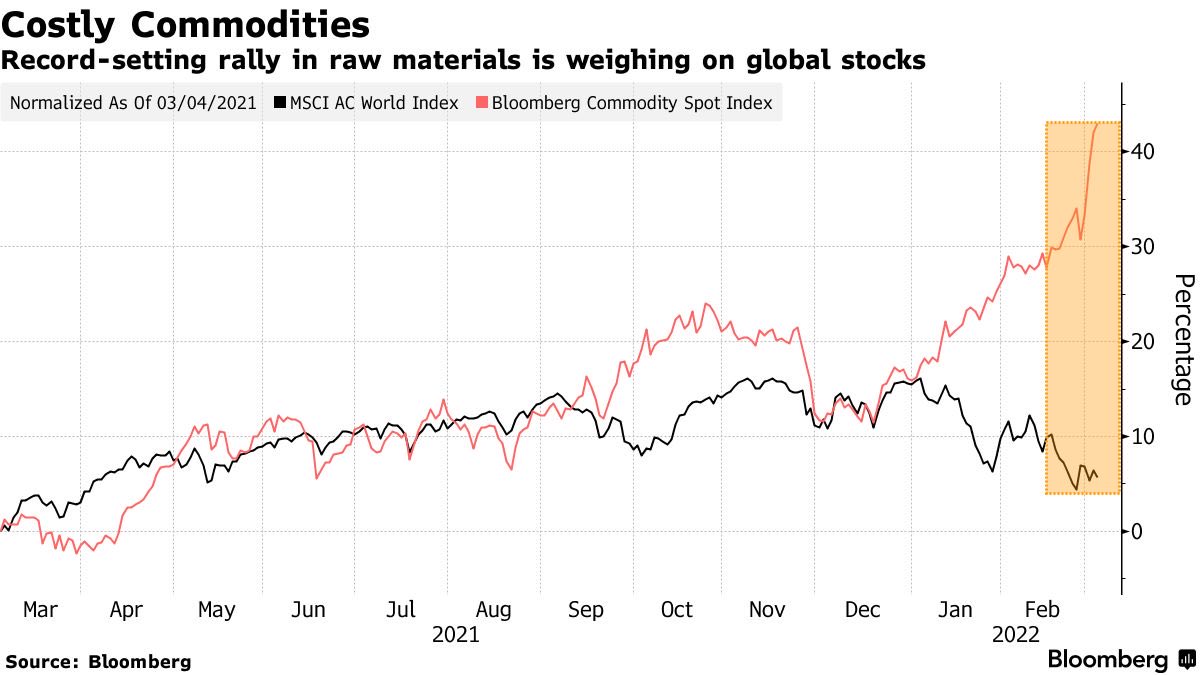
Emerging markets investor Ruchir Sharma goes on to say that there is a probable reversal in the fortunes of tech and oil. In a piece in the Financial Times, Sharma, now with Rockefeller International, says that “the world is underinvested in commodities, over-invested in technology, and the pattern of alternating decade-long cycles between the two is reasserting itself. In the 2010s, a popular tagline was that data is the new oil. Now we are beginning to hear about how oil is the new data.”
In The Slow Lane
We saw divergent volume trends across segments in February auto sales, with moderation in select segments. Truck wholesales grew about 15% year-on-year, passenger vehicle sales were flattish, and two-wheelers and tractors fell between 27-35% YoY. Tata Motors, Ashok Leyland, and Mahindra & Mahindra grew in wholesale dispatches even as Maruti Suzuki reported flat sales. TVS Motors was down 5%, but it looked rosy compared to the Eicher Motors/Bajaj Auto/Hero Moto decline of 15-29% YoY. For trucking, registrations were up 12% YoY while e-way bills rose 7% YoY in February, indicative of a continued improvement in freight and truck demand. Domestic commercial vehicle volumes grew 4% YoY for Leyland and 8% YoY for Tata, pulled down by some weakness in the small/light commercial vehicle volumes.
Despite optimism around chip shortage issues receding, they came to bite the passenger vehicle production, though one can argue that the constraints might be showing some signs of easing. February registrations were down 8% YoY.
Jefferies estimates show that while two-wheeler wholesales are down around 27% YoY, registrations are down 11% YoY... suggesting high channel inventories.
The tractor slowdown seems to be intensifying and had it not been for the open offer in Escorts, futures suggest that the stock would have been beaten down. While bulls are hopeful for a better showing after underperformance for the last many years, the trend seems to be divergent at best.
Awaiting State Elections Outcome?
Usually, the state election verdict in Uttar Pradesh is an event unto itself. There is always the belief that U.P. paves the way to the throne in Delhi, and markets gyrate to the ebbs and flows of the opinion polls and the result. However, such is the state of world markets currently, with all the uncertainties, that it seems that this time could be different with the U.P. election outcome not having an outsized impact. Conversely, if the incumbent BJP government fails to win in Lucknow, could the markets read it as yet more (geo)political risk to factor in? We will know by this time next week, so watch this space.
More Hope Against Hope, And Another Prayer
A New York Times piece says “senior White House officials designing the strategy to confront Russia have begun quietly debating a new concern: that the avalanche of sanctions directed at Moscow, which have gained speed faster than they imagined, is cornering President Vladimir Putin and may prompt him to lash out, perhaps expanding the conflict beyond Ukraine.”
Bloomberg quotes financier and anti-Putin activist Bill Browder as saying “Putin doesn't do humiliation well. His response is scorched-earth carpet-bombing with massive civilian casualties as a way of showing everybody he's not a guy to be messed with.”
One only hopes that these fears don't come true. On the back of a wretched 2020 and 2021 for people's lives and livelihoods, the last thing we need is a wrecked 2022. Hope, and a very big prayer.
Niraj Shah is Markets Editor at BloombergQuint.
Essential Business Intelligence, Sharp Market Insights, Practical Personal Finance Advice, Daily Fuel, Gold and Silver Prices and Latest Stories — On NDTV Profit.