- India's prepaid and postpaid mobile spending gap shrank from Rs 160 in 2020 to Rs 5 in 2025
- Prepaid users now spend Rs 194 monthly, close to postpaid users' Rs 199 average revenue per user
- Tariff hikes narrowed the price gap, pushing prepaid users closer to premium postpaid pricing levels
India's telecom market is undergoing a structural shift as the long-standing pricing divide between prepaid and postpaid mobile users narrows to its lowest level ever.
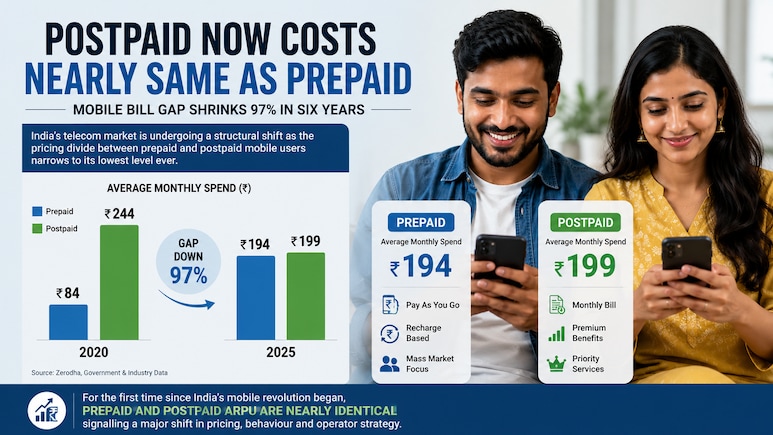
Data highlighted by Zerodha showed the gap between prepaid and postpaid monthly spending has collapsed from nearly Rs 160 in 2020 to just Rs 5 in 2025, a decline of about 97%.
Prepaid users now spend an average of Rs 194 per month, compared with Rs 199 for postpaid subscribers. In 2020, prepaid users spent around Rs 84 monthly, while postpaid users paid roughly Rs 244, according to government and industry data.
ALSO READ | Vodafone May Transfer Part Stake In India Unit To Shore Up Capital: Report
The sharp convergence suggests that successive tariff hikes have achieved what years of telecom marketing campaigns could not, pushing India's mass-market prepaid users closer to premium postpaid pricing levels.
For the first time since the country's mobile revolution began, prepaid and postpaid average revenue per user (ARPU) are nearly identical, signalling a broader transformation in telecom pricing dynamics, subscriber behaviour and operator strategy.
The gap between prepaid and postpaid in India was ₹160 in 2020. Today, it's ₹5.
— Markets by Zerodha (@zerodhamarkets) May 11, 2026
Tariff hikes did what years of marketing couldn't. pic.twitter.com/11x70WRs25
“Particularly, the narrowing gap in ARPUs could lead to a downward trend in terms of mobile number portability in the coming months, compelling operators to consider handsets to offer bundling or even put pressure on operators to take a closer look at their value-additions for postpaid services,” Faisal Kawoosa, Chief Analyst and Founder at Techarc, told BusinessLine.
Kawoosa attributed the trend largely to recent tariff hikes.
“In India, handset bundling never picked up because we had a substantial prepaid base. If the tariff is the same, then operators can raise awareness on this and invite more users to come to postpaid plans to see how handsets can be offered against contract,” he said.
ALSO READ | TRAI Extends Deadline For Feedback On Data-Free, Low-Cost Mobile Plans
TV Ramachandran, President at Broadband India Forum, said the trend could trigger migration from prepaid to postpaid plans as the cost advantage of prepaid weakens.
“Postpaid is fixed always. If the prepaid advantage of lower prices is not there now, they may switch to postpaid. However, the trend is unlikely to sustain for long. Postpaid customers don't mind paying a little more,” he said.
Analysts said prepaid and postpaid users continue to have different motivations despite the pricing convergence. While postpaid offers convenience by eliminating repeated recharges, prepaid continues to appeal to users seeking tighter spending control and transparency.
Essential Business Intelligence, Continuous LIVE TV, Sharp Market Insights, Practical Personal Finance Advice and Latest Stories — On NDTV Profit.