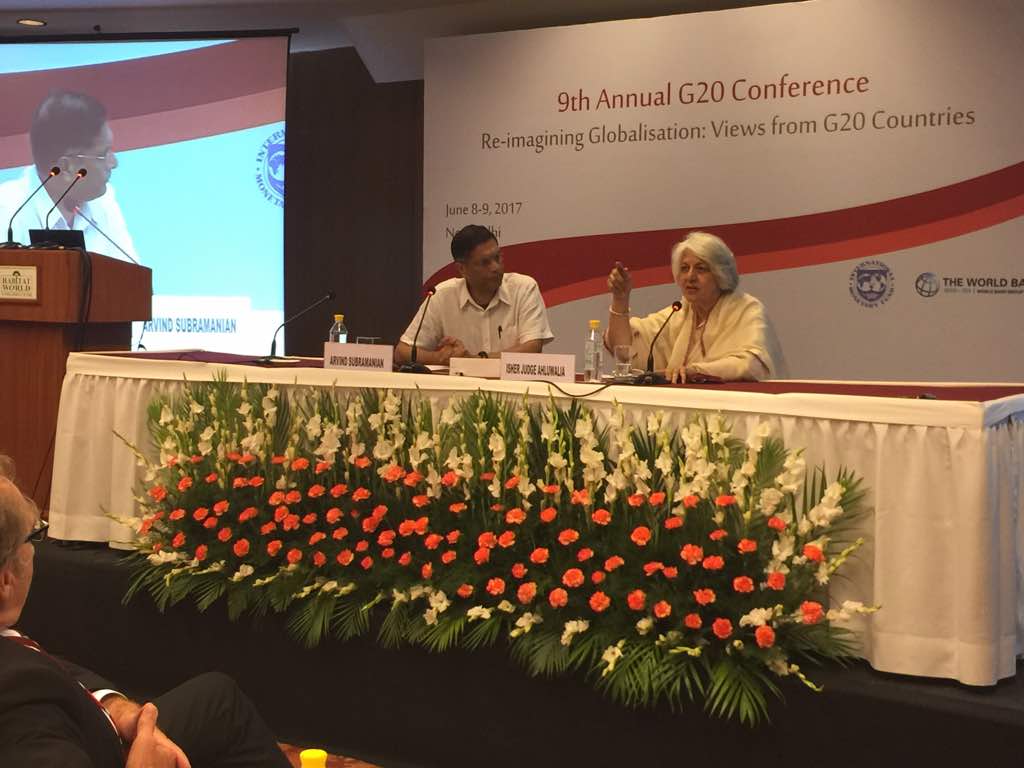
Chief Economic Adviser Arvind Subramanian on Thursday batted for open markets to enable India to sustain 8-10 percent growth in the wake of rising protectionist measures by the Donald Trump-led U.S. administration.
“I think we in India now have a much bigger role in ensuring that world markets remain open...At the very least, any reversal of globalisation is something that we should be very anxious about. If we want 8-10 percent growth, I think we need open markets,” he said at the ninth annual G-20 conference organised by Indian Council for Research on International Economic Relations (ICRIER) in New Delhi.
Middle income countries have been the biggest beneficiaries of the open market policy or globalisation and a continuation of that framework is in their interest, Subramanian said.
Also Read | Layoffs Are Rising In Tech, But These Skills Are Helping People Unlock Better Pay
The Trump administration has indicated that it wants to relook at trade agreements with countries where the United States buys more than it sells, including China, Japan, South Korea and Germany. Besides, Britain has also started the process of exit from European Union in another expression of a protectionist impulse.
Subramanian said, India has already taken several steps to attract foreign direct investments (FDI) and would continue to do more.
Speaking about ultra-loose monetary policy adopted by various advanced countries, the chief economic adviser said he was much less worried than the early indications of a pullout by the U.S. for a number of important but obvious reasons.
Differences With Rajan On Monetary Policy
Subramanian also agreed to having differences in views on loose monetary policy stance of advance economies with former Reserve Bank of India Governor Raghuram Rajan.
“My view always was that one, countries are going to take monetary policy in their own interest, two, nobody has told India or Brazil to open up their capital accounts as they did,” Subramanian said. He added that if emerging economies open their capital accounts, and expose themselves to capital flows, they will have to deal with the consequences.
Rajan had urged the International Monetary Fund (IMF) to play an active role in questioning the stimulus policies of developed economies and called on emerging markets to have a bigger voice in global debates.
Developed countries were adopting monetary policies without consideration for the negative impact they have on the global economy and he noted emerging markets were engaging in currency intervention that sparked competitive devaluations, Rajan, who was also the former chief economist of the IMF, had said.
With inputs from PTI.
Essential Business Intelligence, Sharp Market Insights, Practical Personal Finance Advice, Daily Fuel, Gold and Silver Prices and Latest Stories — On NDTV Profit.