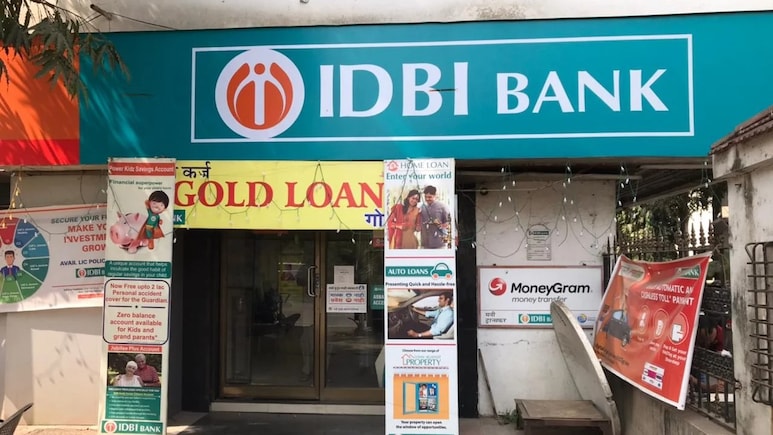
- Fairfax's acquisition of 60.72% stake in IDBI Bank was approved for Rs 52,878 crore
- Fairfax must merge CSB Bank with IDBI within two years, pending RBI and regulatory approvals
- Experts highlight leadership and culture as key challenges post-merger of IDBI and CSB
Fairfax has struck one of the most consequential deal wins in the Indian financial sector, with the government clearing its bid to acquire stake in IDBI Bank. But, the tougher tests for the Prem Watsa-led group lies ahead, two sector experts told NDTV Profit. One pointed to leadership and culture, and the other to the pressure of putting surplus capital to work.
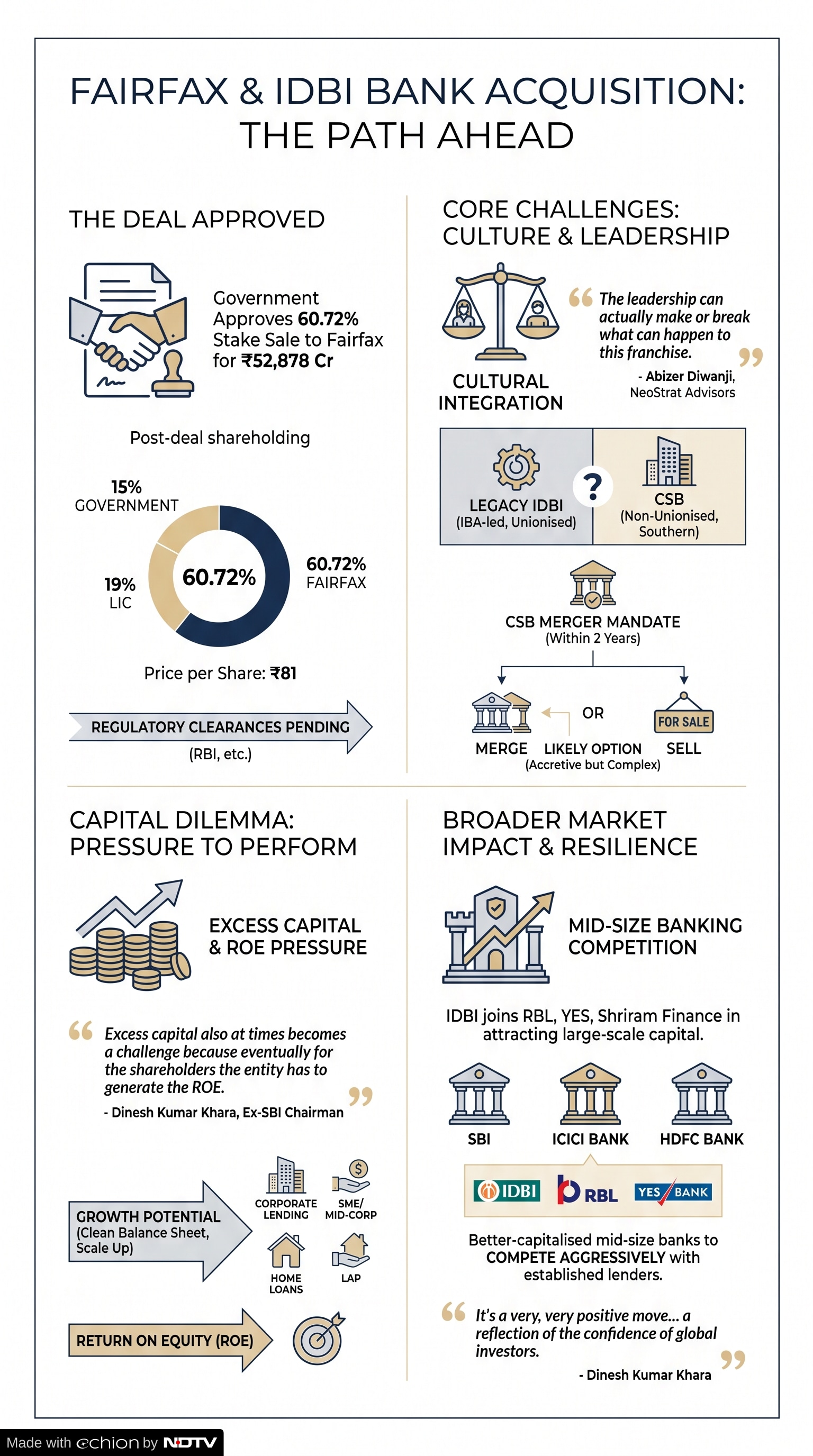
“The leadership can actually make or break what can happen to this franchise,” said Abizer Diwanji, founder of NeoStrat Advisors.
Dinesh Kumar Khara, former chairman of State Bank of India, raised a different concern. “Excess capital also at times becomes a challenge because eventually for the shareholders the entity has to generate the ROE,” he said. If returns are not at an acceptable level, he added, it could become a big issue.
Also Read | Layoffs Are Rising In Tech, But These Skills Are Helping People Unlock Better Pay
On Wednesday, the government approved the sale of a 60.72% stake in IDBI Bank to Fairfax for Rs 52,878 crore, at Rs 81 a share. After the deal, the government will keep 15% and LIC 19%. Fairfax must merge CSB Bank, the smaller lender it already controls, within two years. The transaction still needs the Reserve Bank of India's fit-and-proper assessment and other regulatory clearances.
A Test Of Culture
For Diwanji, the central challenge is people. If CSB is merged, it will be “a merger of two cultures and, very frankly, the person at the top of it is most important,” he said.
The shift will be hard even without a merger, he said, pointing to the transition facing IDBI's own employees. “You're on an IBA scale. You've been working at a particular pace over so many years... Now somebody asks you to pivot completely,” Diwanji said. He described the task as a confidence-building exercise, and said he expects strong leadership to emerge.
The CSB Question
Diwanji called a CSB merger an “optionality.” Over the two-year window, Fairfax could either sell or merge the bank, but there will have to be one entity at the end.
A merger would dilute Fairfax's stake, he said. By his numbers, Fairfax owns about 40% of CSB, which has a market capitalisation of around Rs 5,700 crore. It will own 60.72% of IDBI, valued at around Rs 97,000 crore. That would leave Fairfax with roughly 59% of a combined entity. He said a merger would also give it more headroom to bring in additional capital.
Integration will not be simple. Technology platforms will have to be combined, and Diwanji pointed to a culture gap between a legacy IDBI that is “IBA-led” and unionised and a CSB that is not. He said a merger could still be accretive, since CSB brings a southern franchise and a gold-loan business.
Diwanji said he had not seen an acquirer buy one bank and sell another. He leans towards Fairfax merging CSB over the two-year period.
Putting Capital To Work
Khara's caution about excess capital comes alongside an optimistic view of the bank's prospects. He said IDBI's balance sheet had been “cleaned up absolutely” and the bank was now “poised for significant growth.” With better capital adequacy, he said, the bank's existing levers can be activated and “the growth path can be very fast.”
He saw IDBI's corporate lending as a core skill that “cannot be undermined.” Referring to the roughly Rs 70,000-crore corporate book discussed earlier in the conversation, Khara said IDBI could scale up and possibly expand into SME and mid-corporate lending. He said those segments offer “much better margin, provided the underwriting can be of an acceptable level.” Home loans and loans against property also have room to grow, he added.
Diwanji, however, pointed out that IDBI's book no longer matches its name. By his estimate, corporate loans make up Rs 70,000–80,000 crore of the book, with large corporates accounting for just about Rs 25,000 crore. “IDBI is not really the industrial development bank as we know it,” he said. He noted that hardly 10% of the book goes to large corporates. Home loans and LAP form the largest part of IDBI's lending, he said, which makes both IDBI and CSB essentially retail franchises.
ALSO READ: Prem Watsa Just Wrote A Cheque Bigger Than His Entire India Fund
Neither expert questioned the deal itself. Khara called it “a very important” transaction for the financial sector and “a reflection of the confidence of the global investors as far as the Indian financial system is concerned.”
He noted that Fairfax already operates in Indian financial services through CSB Bank, Go Digit in insurance and IIFL in wealth management. IDBI's distribution network, he said, would let the group roll out all its financial products. He added that Fairfax's experience with CSB gives it a sense of how retail banking works in India.
In Khara's view, any holder with more than 10% is generally eligible for a board seat, so both the government and LIC may be able to secure board representation. He called the resulting ownership “the best of blend” of foreign investment and domestic institutions. “The overhang which was there for quite some time... it has concluded. So it's a very, very positive move,” he said.
Diwanji sees the deal as part of a broader shift. “Banking is about resilience. Your ability to have capital to survive a cycle,” he said. He cited RBL Bank, Yes Bank and Shriram Finance as institutions that have drawn, or are set to draw, large-scale capital, and said IDBI has now joined them. Better-capitalised mid-size banks, he said, will “compete very aggressively” with established lenders such as SBI, ICICI Bank, Axis Bank, Kotak Mahindra Bank and HDFC Bank. He expects “a lot more strategic transactions” in the mid-size segment.
Essential Business Intelligence, Sharp Market Insights, Practical Personal Finance Advice, Daily Fuel, Gold and Silver Prices and Latest Stories — On NDTV Profit.