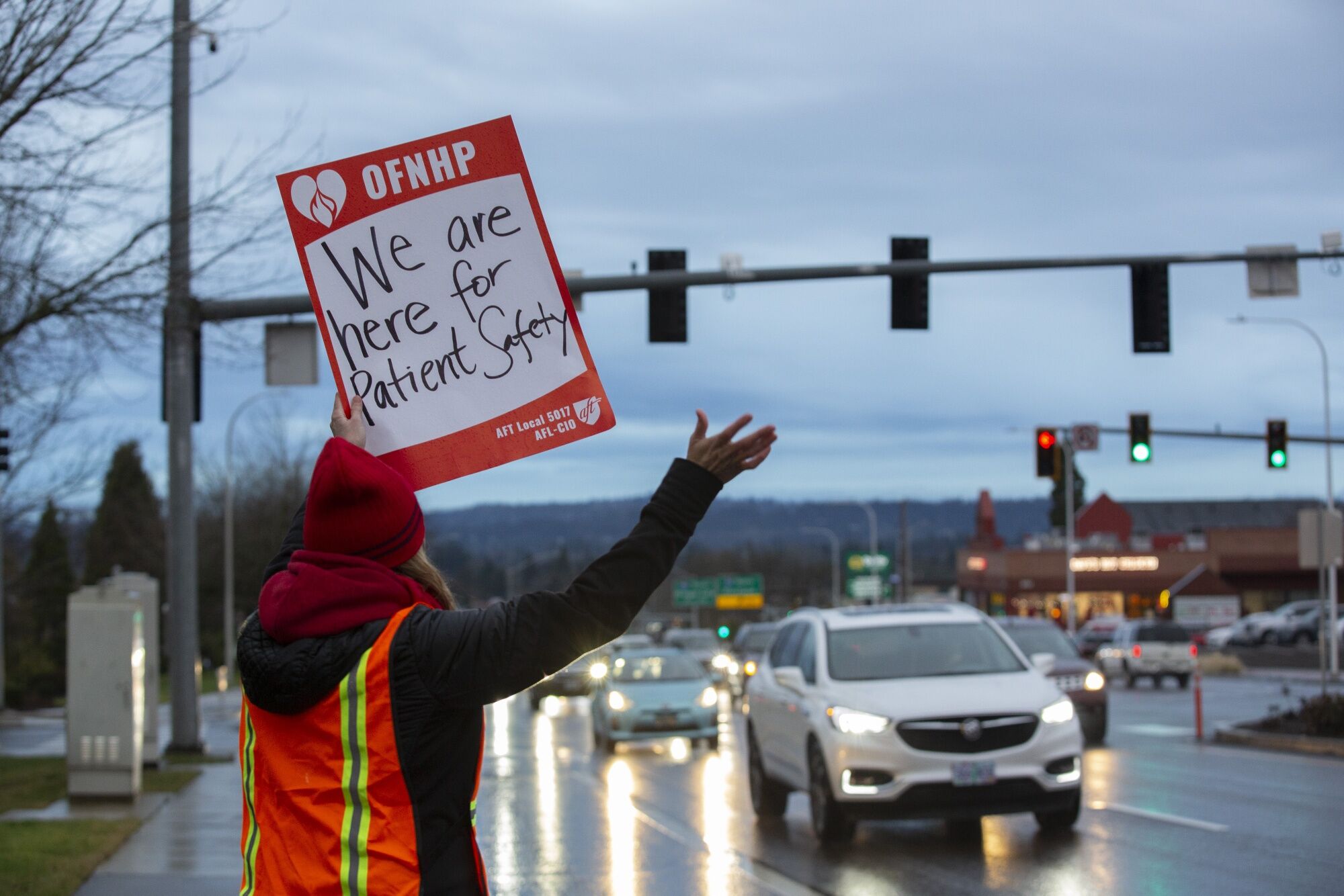
(Bloomberg) -- More than 75,000 Kaiser Permanente workers are slated to go on strike Wednesday morning, interrupting one of the nation's largest health care providers and adding to a months-long series of labor disruptions across US industries.
The three-day strike could stall services for nearly 13 million people in at least half a dozen states. It's expected to shut down nonessential services such as routine doctor's visits as radiology technicians, pharmacy technicians, dental assistants, optometrists, and hundreds of other support staff take to picket lines. Hospitals and emergency services will continue to function through a combination of staff reassignments and replacement workers, according to the company.
Strike lines will be set up at Kaiser Permanente hospitals and medical office buildings across the country, including California, Colorado, Washington, Oregon, Virginia and Washington, DC.
The strike shows how tension between health care companies and workers has only escalated since the onset of the Covid-19 pandemic, when scores of burned-out workers began leaving the field entirely. The Coalition of Kaiser Permanente unions has accused the company of cutting workers through attrition, creating an understaffed workforce that's incapable of looking after patients, it says.
The labor coalition complained to the National Labor Relations Board, saying Kaiser executives were bargaining in bad faith over fixing the staffing crisis.
The company has denied those claims, saying in a statement Monday it offered across-the-board wage increases of at least 12.5% over four years, and state-by-state minimum wages of $21 to $23 an hour. The two sides continued to bargain through Tuesday evening, but could not come to an agreement.
The coalition submitted a 10-day strike notice on Sept. 22, as health care unions are required to do under federal law. The advance notice gives providers a chance to develop contingency plans for patient care, but also can undercut the union's leverage.
“Patient care is how you win the war of public opinion,” said Dan Bowling, a labor and employment professor at Duke University. “Kaiser can make the argument that these people are abandoning their patients and they would win if the public agrees with that. It's much more complicated for the union to convince people that they're striking for patient care.”
The Kaiser strike is the latest in a string of high-profile labor disputes fueled by a tight labor market, high inflation and record corporate profits that has left workers both resentful and emboldened. The United Auto Workers has steadily expanded a strike against the Detroit automakers that started Sept. 14, demanding raises as high as 40% and the end of job tiers. The Writers Guild of America last week reached a tentative agreement to end a five-month strike over artificial intelligence and streaming pay, while SAG-AFTRA actors remain on the picket line.
And in Las Vegas, more than 50,000 hospitality workers could soon walk off the job over staff cuts and increased workloads—complaints that are not so different from the health care workers.
The Kaiser strike is the largest in the US by at least 20,000 workers, according to Bloomberg Law's database of work stoppages dating to 1990. The next-largest strike involved 54,000 workers at the University of California in 2018. Kaiser Permanente has been involved in five of the 15 largest strikes recorded.
--With assistance from William Jeremiah, Derek Wallbank, Aradhana Aravindan and Andrea Tan.
More stories like this are available on bloomberg.com
©2023 Bloomberg L.P.
Essential Business Intelligence, Sharp Market Insights, Practical Personal Finance Advice, Daily Fuel, Gold and Silver Prices and Latest Stories — On NDTV Profit.