(Bloomberg) -- Intel Corp. plans to turn its programmable chip division into a standalone business and sell shares to the public or seek an investor for it, part of Chief Executive Officer Pat Gelsinger's efforts to wring more value from the semiconductor company.
The division — called the Programmable Solutions Group, or PSG — will become an independent entity starting Jan. 1, Intel said in a statement Tuesday. The business, whose chips can be customized for different uses, was created out of the company's acquisition of Altera Corp. in 2015.
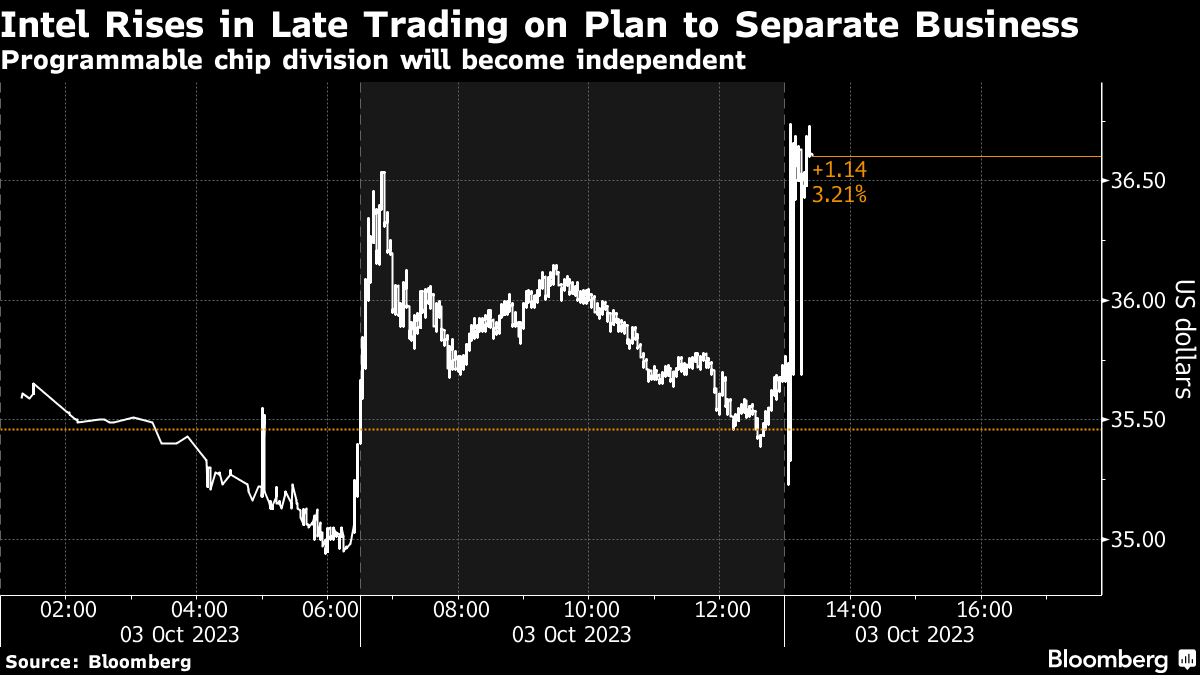
Gelsinger, who took the helm in 2021, has been shaking up Intel and raising funds for a costly turnaround effort. The company paid more than $14 billion for Altera in 2015, and spinning the business off should help unlock some of that value. Investors applauded the move, sending the shares up almost 3% in late trading Tuesday.
“Over the next two to three years, Intel intends to conduct an IPO for PSG and may explore opportunities with private investors to accelerate the business's growth, with Intel retaining a majority stake,” the chipmaker said in the statement.
Programmable chips — also known as field programmable gate arrays, or FPGAs — can have their function changed or updated even after they've been installed in electronic devices. They're used in communications hardware, data center gear, and in the design and development of other chips. While their characteristics make them extremely flexible and powerful, they have traditionally been difficult to program, making mass adoption difficult.
Under Intel's ownership, the programmable unit has focused on the cloud computing and communications equipment markets. That's meant it missed out on other areas, such as chips for industrial and aerospace customers. Though those semiconductors fetch lower prices, demand for them is growing. Gelsinger said the PSG business has “underperformed” because of that concentration.
“We haven't been managing it as well as we could have,” he told analysts on a conference call. Some customers have been underserved, he said.
To rectify that, PSG has mid-priced products coming to market and will follow up with cheaper chips at the beginning of next year. Intel expects an investor for the business to be announced soon, followed by an IPO in two to three years, Gelsinger said.
The spinoff plan mirrors what Intel did with Mobileye Global Inc., a maker of chips for self-driving cars. The company carved out the business and returned a portion of it to public markets last year.
Gelsinger is seeking to restore Intel to the forefront of the chip industry after mistakes under his predecessors led to a loss of market share. Intel, based in Santa Clara, California, slid down the ranks of the biggest producers of semiconductors, ending decades of leadership.
After several years of shunning Intel stock, investors has become more optimistic about the turnaround. The shares have gained 35% this year, outrunning a 33% rally by the Philadelphia Stock Exchange Semiconductor Index.
Gelsinger's comeback plan involves a spending spree on new factories. He's committing billions of dollars to facilities that will take years to come online — an audacious move at a time when Intel's current product lineup is struggling. The company has lost ground to competitors and the main market for Intel's processors, personal computers, has slumped back to pre-pandemic levels. Many owners of large data centers, meanwhile, have switched to AI-related gear built on Nvidia Corp. chips.
In its most recent quarter, Intel said the PSG unit posted record sales — without giving the precise details. When it last reported sales for the business in 2019, Altera had annual revenue of about $1.99 billion. The total market for such chips will grow to $11.5 billion in 2027 from $8 billion in 2023, Intel said, citing third-party estimates.
The other major provider of such capabilities is Intel rival Advanced Micro Devices Inc., which acquired Altera competitor Xilinx Inc. The Intel spinoff will be managed by Sandra Rivera, who currently heads the chipmaker's data center unit.
(Updates CEO comments starting in sixth paragraph.)
More stories like this are available on bloomberg.com
©2023 Bloomberg L.P.
Essential Business Intelligence, Sharp Market Insights, Practical Personal Finance Advice, Daily Fuel, Gold and Silver Prices and Latest Stories — On NDTV Profit.