(Bloomberg Businessweek) -- By the standards of the gadget business, everything about Huawei's release of its Mate 60 Pro smartphone in late August was unusual. Instead of talking up the device in a splashy marketing event, the company quietly started selling it online. Huawei didn't even reveal several key technical specifications, yet burned through its inventory in hours. Within China, this inspired a wave of patriotic celebration.
The debut is easier to understand if the Mate 60 Pro is seen less as a mobile device and more as a message from one global superpower to another. Huawei Technologies Co. has been at the center of US attempts to undercut Chinese tech development for years. In 2019 the Trump administration added the company to the so-called Entity List, curtailing its access to US technology and effectively destroying its huge smartphone business. Both the Trump and Biden administrations have since ratcheted up pressure on China's tech industry, most recently with export controls that the US Department of Commerce outlined in October 2022. The Mate 60 Pro went on sale just as Commerce Secretary Gina Raimondo was visiting China, inspiring memes there such as an image of her giving the phone a thumbs-up with the caption, “Brand Ambassador of Huawei.”
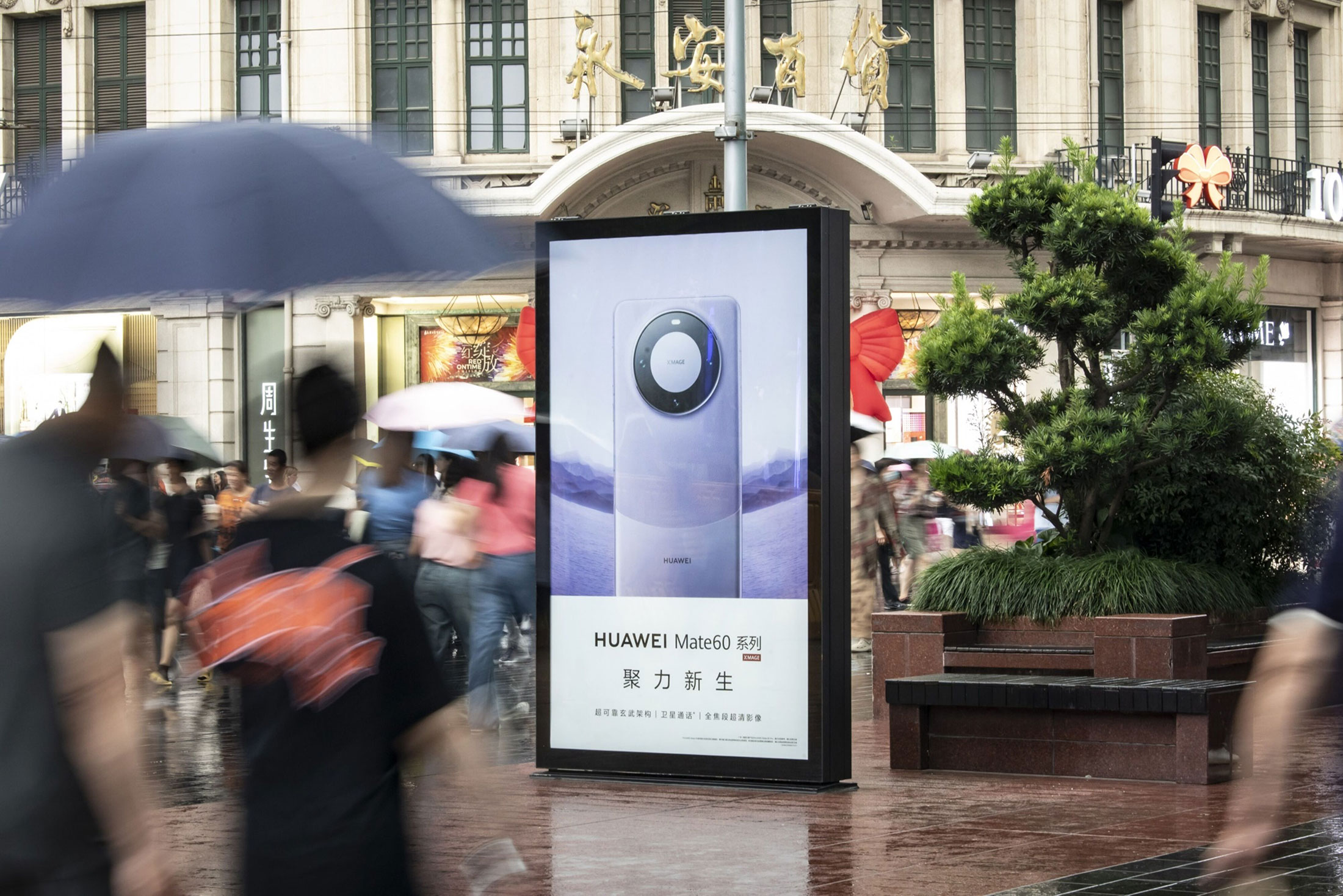
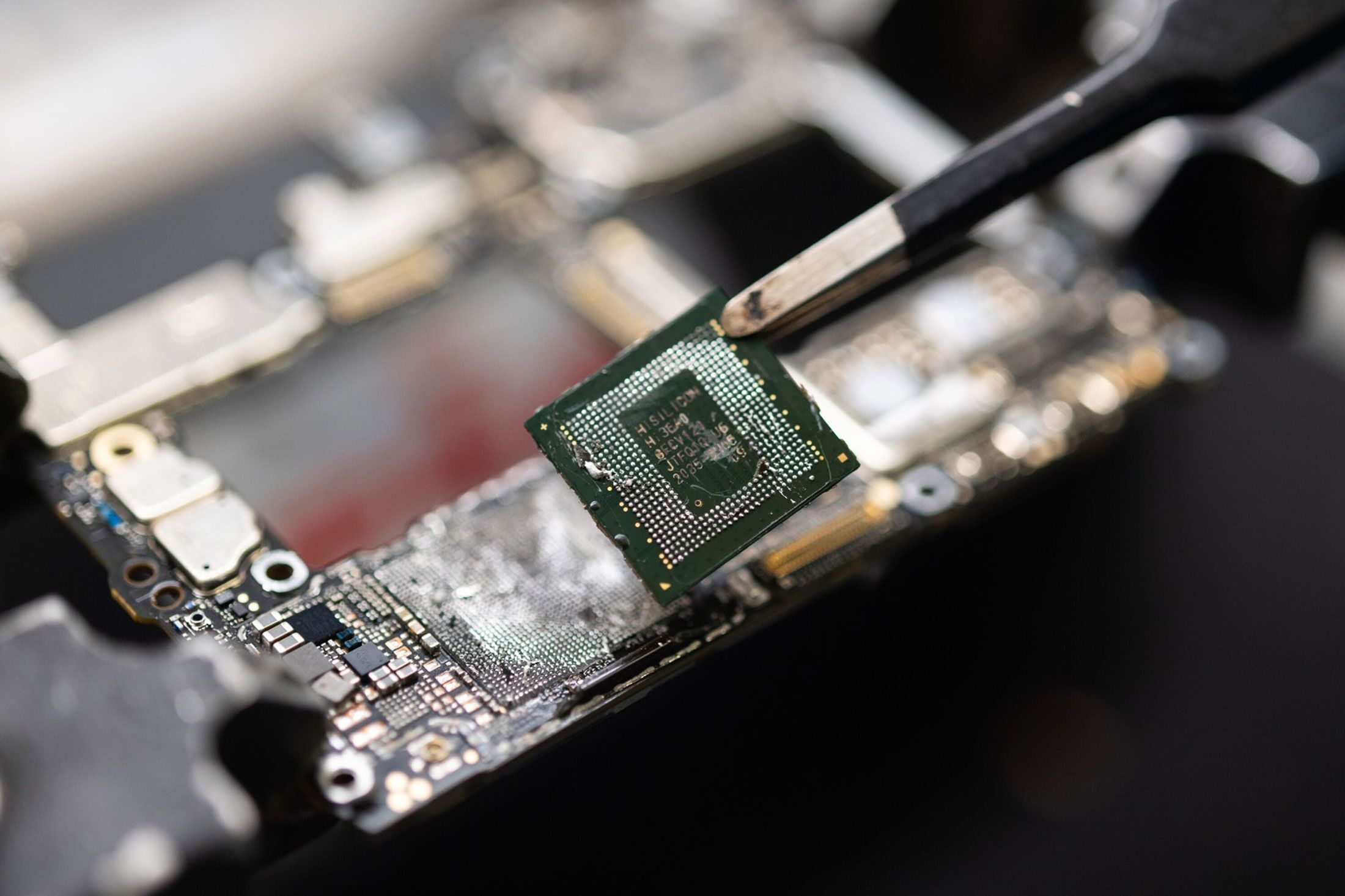
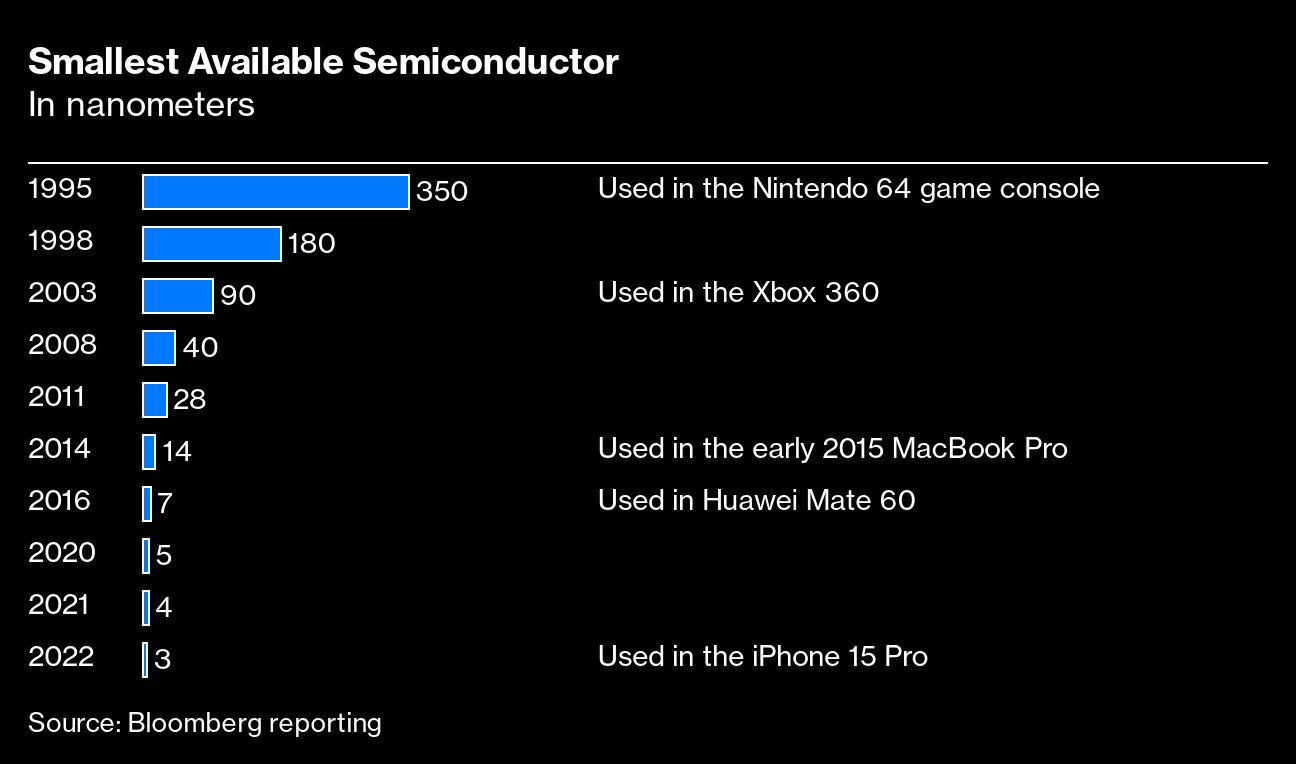
The reason Chinese nationalists saw the phone as such a blow to Raimondo and the US was its main processor, a component designed and manufactured in China that uses 7-nanometer chip technology. (The chip industry distinguishes chips by referring to them in nanometers, or billionths of a meter. The smaller the transistors are, the more can be packed onto a single chip, increasing their power. Seven nanometers is slightly less than three times the diameter of a single strand of human DNA.) The Mate 60's Kirin chip isn't as advanced as the 3nm chips that power Apple Inc.'s most advanced new iPhones. But the export controls were aimed at keeping China's tech capabilities 8 to 10 years behind the US, and the phone demonstrated that Huawei's chipmaking partner, Shanghai's Semiconductor Manufacturing International Corp. (SMIC), may be only four years behind. SMIC declined to comment, while Huawei didn't respond to requests for comment.
Also Read | Layoffs Are Rising In Tech, But These Skills Are Helping People Unlock Better Pay
After years of escalation, the conflict between the US and China over chips is reaching a crucial moment. This fall, the Biden administration is expected to finalize its export controls and broaden the range of US technology it tries to keep away from Chinese customers. China recently placed restrictions on the use of iPhones at state-backed companies and agencies, a move that a US National Security Council spokesman characterized as “aggressive and inappropriate retaliation to US companies.” By showing it can make its own devices using domestically produced semiconductors, China is trying to signal that US efforts to maintain its superiority are faltering.
Ultimately the struggle isn't about smartphones but over strategically important applications such as artificial intelligence and supercomputing, including for military technology. “If these chips are getting into Huawei's hands for smartphones,” says Reva Goujon, director at the Rhodium Group consulting firm, “where else will they go?”
The situation remains complicated for both Beijing and Washington. In China, the US sanctions are seen as a continuing threat. In the US, concerns are mounting that its policies are actively backfiring. Several key US allies remain ambivalent about joining the US efforts to isolate the world's second-largest economy.
A major stumbling block for President Xi Jinping's government is its continued lack of access to the world's most advanced chipmaking machines, extreme ultraviolet lithography (EUV) equipment. These machines direct ultraviolet radiation with wavelengths outside the range of human perception onto treated silicon wafers, carving patterns needed to create advanced semiconductors. They took decades to develop, cost hundreds of millions of dollars, and are made by a single company, the Netherlands-based ASML Holding NV. ASML is banned from selling them to Chinese customers, and Beijing's prospects for making domestic alternatives anytime soon are dubious.
Chinese companies have been able to buy deep ultraviolet (DUV) lithography machines, which work similarly to EUV machines but use radiation with larger wavelengths and produce chips that lag behind the cutting edge. These companies have been able to push the machines to produce relatively advanced products like the chip at the heart of the Mate 60 Pro. How much further they can advance in this way, though, is a matter of debate.
Because the Biden administration unveiled its export controls last year before getting allies such as the Netherlands and Japan on board, Chinese buyers were able to stockpile the gear from ASML, Canon Inc. and Nikon Corp. But the loophole will largely close this year, and running the existing DUV equipment may grow more difficult as companies stop providing service and maintenance.
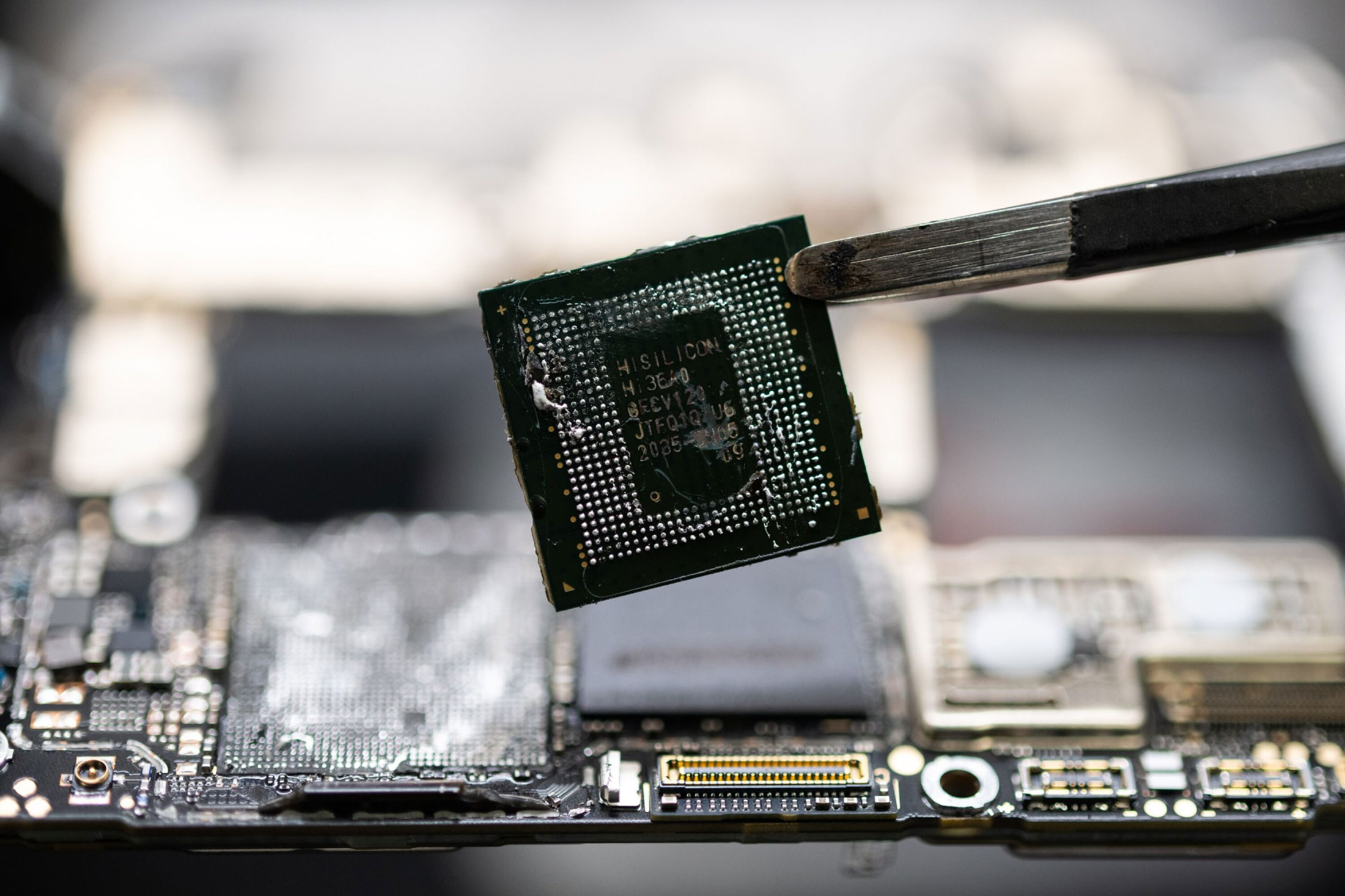
That could make it more challenging for Chinese companies still rushing to catch up. SMIC could have created a limited number of the 7nm chips as a show of force, even if it hadn't yet figured out how to make them at large volumes or in an economically sustainable way. In testimony to Congress on Sept. 19, Raimondo said the US has no evidence China can make the key components in the Huawei phones at scale. Analysts such as Dylan Patel of SemiAnalysis are more bullish on Chinese chipmakers' capabilities. “There's no reason they can't produce tens of millions,” says Patel, who projects Huawei will ship 40 million phones with the SMIC chip next year. (The entire smartphone industry shipped 1.21 billion units in 2022, according to research firm IDC).
To break free of US constraints, Xi's government will have to sustain fantastically expensive investments in its domestic semiconductor industry with no clear end date and no guarantee of success. The Chinese government has laid out plans to spend more than $150 billion in its domestic semiconductor industry between 2014 and 2030, with the goal of building 70% of the chips needed for smartphones, automobiles, computers and other products. But that commitment looks increasingly challenging as the Chinese economy flounders. A real estate meltdown will squeeze all levels of government in the next few years, limiting its resources.
Despite Beijing's challenges, there's a growing worry within the US government—where anti-China sentiment is among the few topics with bipartisan support—that its hardline tech policies are failing.
Under last year's measures, China wouldn't be able to buy advanced chips for AI development or the leading processors for supercomputers, purchase chipmaking equipment capable of 14nm production, or even employ American passport holders for certain roles at its chipmaking companies. National Security Advisor Jake Sullivan argued repeatedly that the policies were essential to limit China's military capabilities in an era of growing conflict.

But the US blockade proved porous. Although the Biden administration said it had the support of its allies, negotiations with the Netherlands and Japan dragged on for months. Peter Wennink, chief executive officer of ASML, publicly opposed the measures and warned that China would develop competing technology. “The more you put them under pressure, the more likely it is that they will double up their efforts,” he said in a January interview with Bloomberg News.
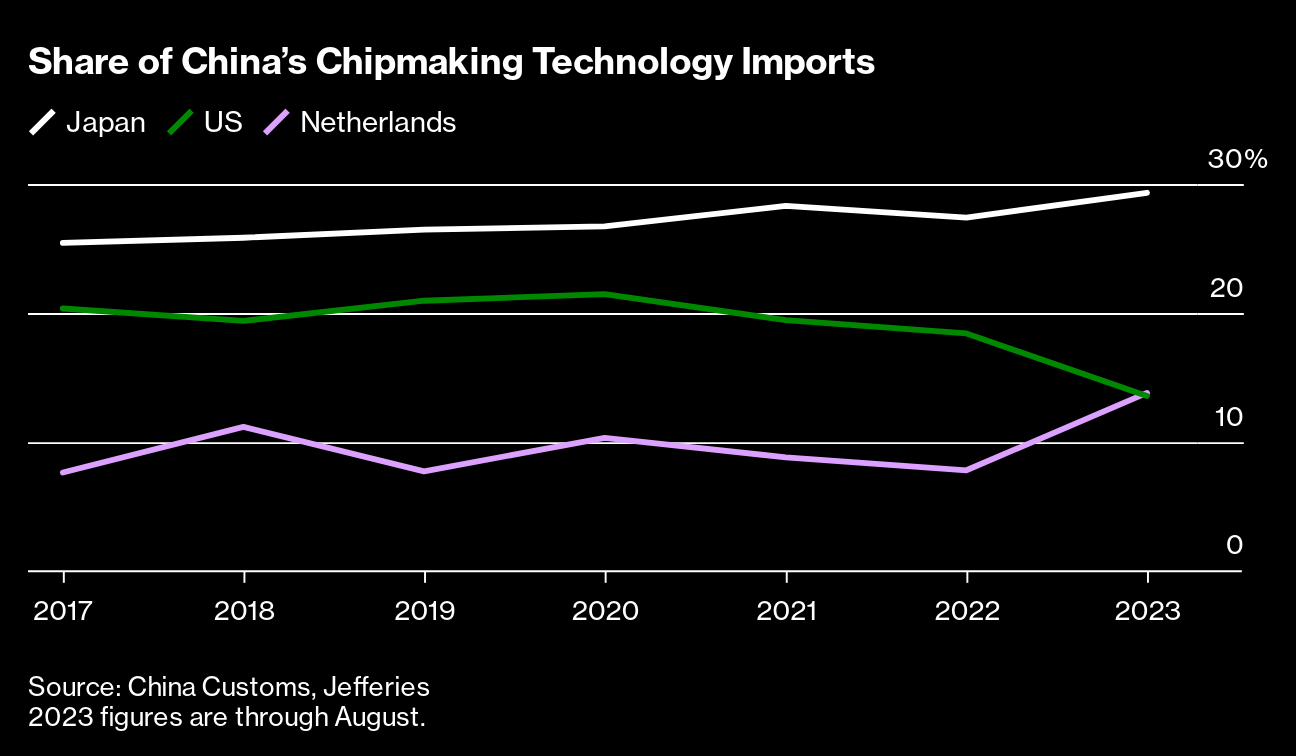
The three leading US chip equipment makers— Applied Materials, KLA and Lam Research—complained that they couldn't sell their advanced machines into China while their overseas rivals could. Chinese imports of chipmaking equipment spiked, especially from Japan and the Netherlands, hitting a record $4 billion in July. ASML can still sell high-end DUV machines capable of producing 7nm chips through the end of the year. “Look at China's import data,” says Chris Miller, author of and associate professor at the Fletcher School at Tufts University. “You can see they're buying and buying.”
While China has been cut off from the most sophisticated chips, its companies are still able to get their hands on capable products from Advanced Micro Devices, Intel and Nvidia. Nvidia quickly developed a modified chip for training AI models for the China market that wouldn't be subject to the rules imposed by the Biden administration. Sales of Nvidia's A800 and H800 chips have surged this year as giants such as Alibaba, ByteDance and Tencent build domestic rivals to OpenAI.
To promote local production, China is also pouring money into virtually every step of the chip process. Several companies, including Biren Technology, are working on graphics processing units that could replace Nvidia's chips for training generative AI models. Shanghai Micro Electronics Equipment Group, or SMEE, is working on alternatives for ASML's lithography machines. China is also building more chip plants for production with older technologies than any country in the world, a strategic push into legacy semiconductors that has raised concerns in the US and Europe.
In the US, Raimondo is under fresh pressure to contain China's progress. Republicans in Congress criticized the Commerce Department's Bureau of Industry and Security for its “inability to effectively write and enforce” export controls. They've said that the Huawei device shows that SMIC has violated the export controls by providing advanced technology to Huawei, and they've called for completely cutting off Huawei and SMIC from American suppliers, by removing the ability of companies to sell older technologies so long as they get a license.
The Commerce Department hasn't taken a stand on whether SMIC violated export controls. It has started an investigation into the phone and has long been weighing whether to cut off Huawei entirely. Raimondo told the House panel in September that she was “upset” that Huawei introduced its phone while she was in China and pledged “to take appropriate action to protect US national security.” In a statement, a BIS spokesperson said the export controls are “just one tool in the US government's toolbox” and argued its actions since 2019 had had an impact on Huawei and the Chinese government.
The Biden administration's best chance of blocking China from producing large numbers of advanced semiconductors for such things as AI-guided missile systems or drone fleets will require global support. Japan, for example, is home to a dozen companies that are dominant in key niches of the semiconductor supply chain. In theory, Prime Minister Fumio Kishida could press leaders in strategic chemicals and components to cut off SMIC and other Chinese chipmakers from the supplies needed to keep their machines running smoothly. But Kishida would be asking companies that are pillars of the economy to sacrifice revenue with almost complete certainty China would boost investment in building rivals.
The Netherlands is in a similar bind. The government will mandate ASML, the country's most valuable company, to stop selling its high-end DUV machines to Chinese customers this year, but the company can continue to sell less advanced DUV equipment. Given the difficulty of earlier negotiations with the Netherlands and Japan so far, it isn't clear other countries will comply with additional restrictions. “You can't take for granted that the allies will get on board,” says Goujon of the Rhodium Group. “Trying to push them further at this point—especially the Dutch—it's hard to see the US making big advances.”
The US can force its allies to comply with more China constraints, but doing so would come with political risks. The Biden administration could invoke what's known as the foreign direct product rule, which allows the Commerce Department to regulate foreign products even if they use a small amount of US technology. The risk is that such a move could be seen as extraterritorial bullying and damage diplomatic relations. “That's not something that should be done casually,” says Gregory Allen, artificial intelligence director at the Center for Strategic and International Studies.
On Sept. 25, Huawei held an event in Shenzhen to showcase its latest products. Consumer chief Richard Yu avoided talking about the Mate 60, but he demonstrated tablets and other gear, and vowed to hike smartphone production to meet rising demand. Tensions with the US seem to be stoking enthusiasm for the devices at home. At a Huawei store in Shanghai recently, 39-year-old Ding Ailan checked out the latest offerings with her husband. Both of them have been using iPhones but plan to trade them for a Mate 60 Pro or Pro+. “I won't buy iPhones anymore,” she says. “I want to support our homemade brand.”
--With assistance from Yuan Gao, Lulu Shen, Debby Wu, Ian King, Vlad Savov and Cagan Koc.
More stories like this are available on bloomberg.com
©2023 Bloomberg L.P.
Essential Business Intelligence, Sharp Market Insights, Practical Personal Finance Advice, Daily Fuel, Gold and Silver Prices and Latest Stories — On NDTV Profit.