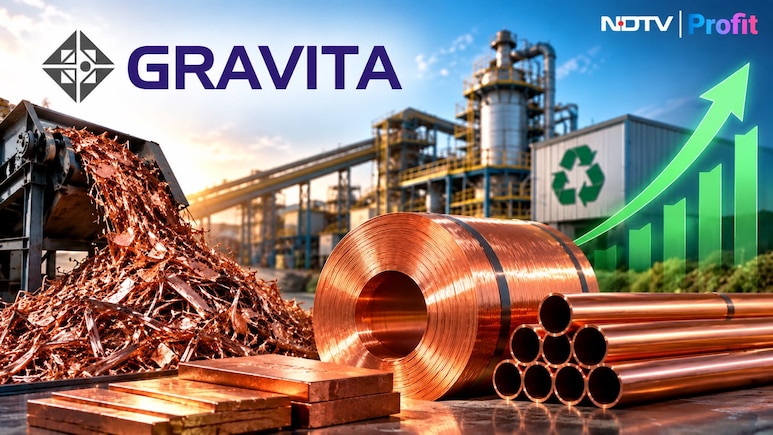
Gravita India is gradually moving beyond its traditional dependence on lead recycling. The company has entered copper recycling by acquiring Rashtriya Metal Industries and plans to expand into lithium-ion batteries and steel. At the same time, it is increasing its mix of high-margin, value-added products across existing businesses.
The shift is visible in the numbers. Lead still accounted for 79.2% of total volume in Q1FY27, followed by copper at 7.3%, aluminium (6.8%) and plastic (6.7%). However, non-lead segments already contributed more than 25% of consolidated quarterly revenue. The company wants this share to rise to 35% to 40% over time.
Gravita has also earmarked Rs 1,680 crore for capital expenditure through FY29. The spending will expand existing businesses and enter new recycling segments. The company plans to increase total manufacturing capacity from 4.97 lakh metric tonnes per annum (MTPA) currently to more than 8 lakh MTPA by FY29.
Also Read | Layoffs Are Rising In Tech, But These Skills Are Helping People Unlock Better Pay
The scale of this expansion makes capacity utilisation important. Gravita has set a Vision 2030 target of 20-25% volume CAGR and 25-30% profitability CAGR. It is also targeting a return on invested capital above 25%. The key question now is whether Gravita can turn its expanded capacity and newer businesses into sustained earnings growth.
Capacity Expansion Faces Utilisation Challenge
Gravita expanded its lead recycling capacity at Phagi, Jaipur by 40,500 MTPA, taking the facility's total capacity to 75,819 MTPA. The expansion involved an investment of about Rs 30 crore. At an optimal utilisation rate of 70%, the company expects the new capacity to generate about Rs 50 crore of additional monthly revenue once scrap availability normalises.
However, utilisation remains a near-term constraint. Lead recycling utilisation at Jaipur was around 45% during the quarter, impacted by limited scrap availability due to supply chain disruptions. Gravita also commissioned an 80,300-ton lead capacity in Gujarat in February 2026, but utilisation remained at about 50%.
Management acknowledged that the newly added capacity could not be fully utilised during the quarter. Group utilisation across the capacities stood at 52%. Management expects that as scrap supplies normalise, plant utilisation will return to normal by the end of FY27. As utilisation improves, the company could see a recovery in revenue growth and margins.
Copper Changes the Business Mix
With 31,200 MTPA capacity, Copper is becoming an important part of Gravita's growth strategy. The acquisition of Rashtriya Metal Industries gave the company entry into copper recycling and reduced its dependence on lead. The copper business operated at 50% capacity utilisation in Q1FY27 and generated Rs 376 crore of revenue.
EBITDA per tonne stood at Rs 55,151, the highest among Gravita's major recycling segments. Management plans to debottleneck the business and reach utilisation above 60% by year-end. EBITDA per tonne is expected to remain around Rs 55,000 in the near term and gradually increase to Rs 75,000 over the next 2.5 years through backward integration and larger scale.
This will be largely driven by a 29,400 MTPA copper recycling plant in Gujarat. The project is currently under construction and remains firmly on track to be commissioned within the next 12 months. This expansion will further increase copper's contribution to the overall business. Over the next three years, copper capacity is targeted to double to 60,000 MTPA.
Achieving these targets will depend not only on adding capacity but also on converting that capacity into revenue and profit. Unlike parts of the lead vertical, Gravita's copper products are 100% value-added. This segment is the primary reason the company's consolidated Value Added Product (VAP) revenue share jumped to a record 63% in Q1FY27.
Higher Value Added Products Support Margins
In addition to capacity expansion, Gravita is also trying to increase the proportion of VAP, which can improve profitability without relying entirely on higher volumes. Even after excluding copper, the share of value-added products in core segments such as lead increased from around 40-42% to 50% during the quarter.
This difference is also reflected in EBITDA per tonne. Copper yielded Rs 55,151, aluminium (Rs 25,175), lead (Rs 24,181) and plastic (Rs 10,197). This product mix is becoming an important part of the company's earnings strategy. Gravita is also working to enter into lithium-ion battery recycling.
Earnings Growth Needs to Catch Up With Valuation
Gravita reported 42% year-over-year revenue growth in Q1 FY27 to Rs 1,475 crore, while volumes increased 4% to 55,455 MT. EBITDA rose 29% to Rs 145 crore, although the margin declined by 94 basis points to 9.8%. Net profit increased 14% to Rs 106.4 crore. The acquisition of Rashtriya Metal accounted for 86.4% of Gravita's absolute revenue growth during Q1FY27.
Gravita's core business was affected by geopolitical tensions in the Middle East. Historically, around 15-20% of its total scrap supply originates in or passes through the Gulf region, leaving procurement exposed to disruptions there. To ease the bottleneck, it is developing its own yard procurement network in developed markets such as the US.
Lead, aluminium, plastics, and copper are expected to be sourced directly from these yards. This direct procurement model could reduce dependence on supply channels and help reduce sourcing costs. Management expects this to help resolve the scrap sourcing issue by the end of FY27.
ALSO READ: Buy, Sell Or Hold: Paytm, MobiKwik, L&T, Tata Motors PV, Paras Defence, Suzlon — Ask Profit
However, the decline in EBITDA margin was mainly due to the copper business, which reported margins of only 5.2-5.9% compared to a consolidated EBITDA margin of 9.8%. The decline was driven by a 50% increase in global copper prices to $13,500 per tonne in Q1FY27, compared to an average of $9,000 per tonne last year.
Management said EBITDA per tonne is a more relevant measure of profitability because of the company's back-to-back hedging model. Gravita also hedges its metal exposure through a 100% back-to-back hedging model, limiting the impact of metal price movements on profitability. The copper business also diluted the company's Return on Capital Employed (ROCE).
Management expects the ROCE to return to the 25%+ level over the next 2.5 to 3 years as copper assets mature and capacity utilisation scales.
At Rs 1,695 per share, Gravita trades at about 24 times EV to EBITDA, above its five-year historical median of 22 times. It also trades at a premium to Pondy Oxides (16x) and Jain Resource (19x). The valuation therefore leaves less room for a higher multiple to drive the next phase of the stock's performance. The focus will increasingly be on earnings growth.
Gravita has multiple levers in place. Copper expansion, higher utilisation of new capacity, a larger value-added product mix and new recycling businesses can support growth. But the new capacity needs to translate into higher utilisation. The next phase will depend on how quickly these additions drive earnings and improve returns on capital.
ALSO READ: Catch Stock Market Live Updates Here
Essential Business Intelligence, Sharp Market Insights, Practical Personal Finance Advice, Daily Fuel, Gold and Silver Prices and Latest Stories — On NDTV Profit.