
(Bloomberg) -- Asia's emerging-market currencies are losing their traditional close relationship to local bonds as falling hedging costs means more investors are choosing to offset their foreign-exchange risks.
The correlation is also breaking down as China's gloomy outlook weighs on Asian currencies, while having little impact on regional debt markets.
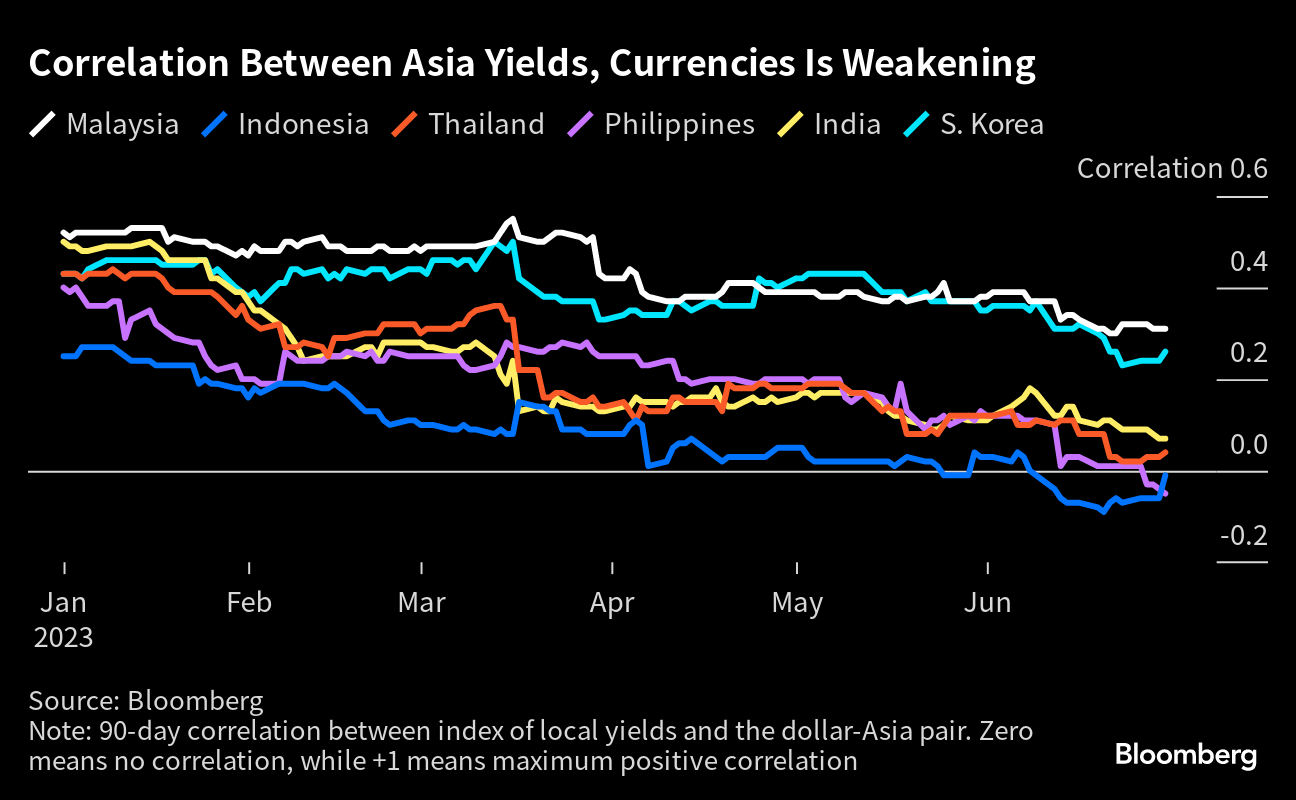
The average 90-day correlation between a basket of emerging Asian currencies and government bond yields has fallen to 0.1 from 0.42 at the end of last year, according to data compiled by Bloomberg. A level of 1 would mean the two move in lockstep.
The breakdown in the relationship shows why increasing inflows into Asia bonds this year are having only a limited spillover into the regional currency market. Cheaper hedging costs and growing expectations for rate cuts in Asia suggest currencies will remain under pressure for the rest of the year.
“It's about relative interest rates,” said Galvin Chia, emerging market strategist at NatWest Markets in Singapore. “Rates in the US have continued to rise with it being clear that the Fed's disinflationary target has not yet been met, while rates in Asian economies have mostly remained lower, resulting in falling hedging costs.”
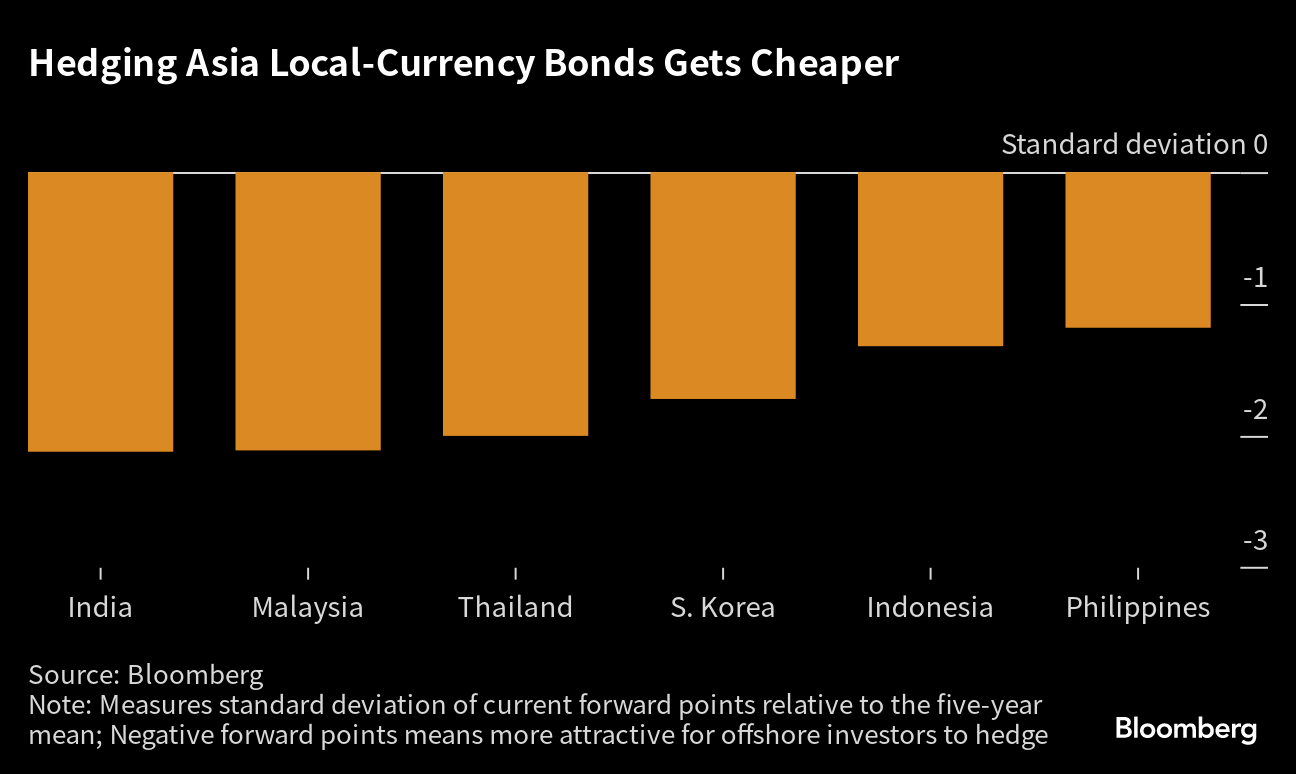
The cheaper cost of hedging is making it more attractive for global funds to offer dollars in exchange for Asian currencies. For example, three-month non-deliverable won forwards have dropped to minus 6 points, about 1.7 standard deviations below their five-year mean, from minus 2.9 basis points at the end of December.
The divergence between Asian bond yields and regional currencies can clearly be see in the case of Malaysia. Overseas investors bought $842 million of the nation's debt in May, above the average net inflow of $388 million for the previous six months, according to the latest central-bank data. Still, the ringgit fell by more than 3% against the dollar in May, the worst-performing Asian currency.
The 90-day correlation between an index of Malaysian bond yields and the dollar-ringgit exchange rate has fallen to around 0.3 from more than 0.5 in December, while a similar gauge for Thailand slid to 0.04 from 0.4.
China Outlook
China's deteriorating growth outlook is also weighing on the correlation between local yields and currencies.
The mainland economy has an outsized impact on Asian currencies via their trading links, especially the South Korean won, Taiwanese dollar, Thai baht and Malaysian ringgit. It has less of an impact on regional bond yields, which are currently being driven by the trajectory of inflation.
Traders have recently boosted bets on interest-rate cuts in emerging Asia as inflation slows. Expectations for more easing will help pull down bond yields, but simultaneously weaken the allure of currencies as targets for carry trades.
--With assistance from Masaki Kondo.
More stories like this are available on bloomberg.com
©2023 Bloomberg L.P.
Essential Business Intelligence, Sharp Market Insights, Practical Personal Finance Advice, Daily Fuel, Gold and Silver Prices and Latest Stories — On NDTV Profit.