India's allocation of more funds will help take tap water to the remaining households. Yet, according to economists and researchers tracking the progress, the test lies in ensuring regular, sustainable water supply.
Finance Minister Nirmala Sitharaman allocated Rs 60,000 crore for the Har Ghar, Nal Se Jal (or tap-water-for-all) scheme. The money is aimed to cover 3.8 crore households in 2022-23. About 5.5 crore households have been provided tap water in the last two years, she said.
“The increased allocation is going to help local authorities in speeding up the delivery of tap connections," said Bhabesh Hazarika, an economist at the National Institute of Public Finance and Policy. "But I look forward to how they (the government) are going to look towards the quality of water provided, the sustainability and reliability of the system and, importantly, how they are going to manage regular water supply.”
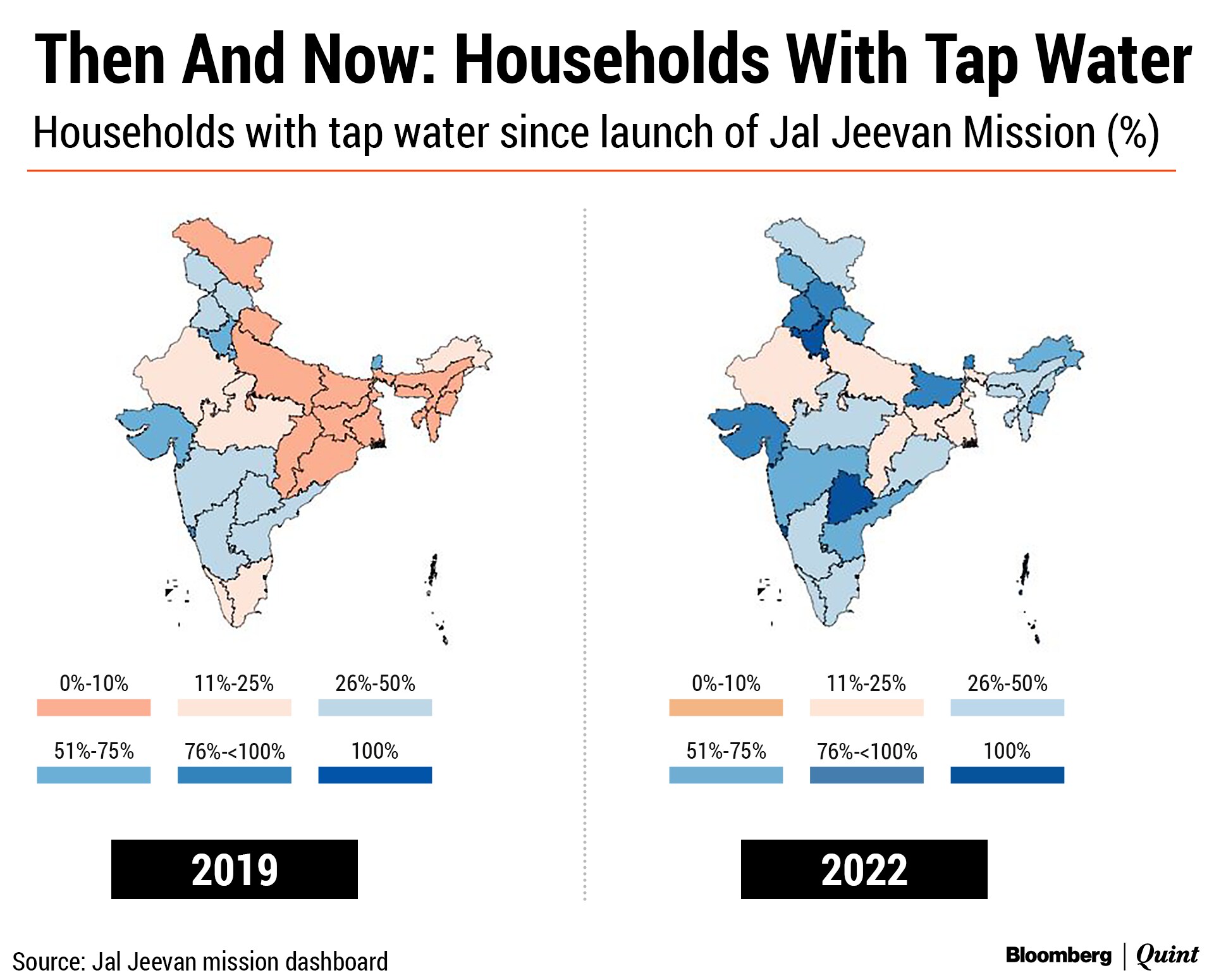
The Jal Jeevan Mission launched in 2019 to provide a functional household tap connection in every rural home by 2024. Of the more than 19 crore Indian homes recognised, over 5.6 crore have benefited, according to the latest data on the scheme's dashboard.
A total of 8.9 crore households have a tap water connection now. Seven states and union territories—Goa, Telangana, Andaman and Nicobar Islands, Puducherry, Dadra and Nagar Haveli, Daman and Diu and Haryana—have 100% tap water supply, according to the Economic Survey for 2021-22.
Break 'Build-Neglect-Rebuild' Cycle
The allocation dovetails with Prime Minister Narendra Modi's effort to boost the nation's infrastructure. And it continued in the budget for 2022 with funds earmarked for capital expenditure rising.
While higher allocations help, monitoring systems are equally important, according to Deepak Sanan, senior advisor at National Council of Applied Economic Research and Indian Institute of Human Settlements. Often, major developmental schemes fall into a routine of “build, neglect and rebuild” when the pursuit is on infrastructure more than the sustainable delivery.
"The first step would be setting up good verifiable monitoring and evaluation systems," he said. They can be used to survey last-mile connections and reward states that perform well on functional status, he said.
He cited the Swachh Bharat Mission. Sewage from these toilets ends up polluting water sources, having an impact on both the sanitation and drinking water supply schemes, he said.
Hazarika suggested setting up water quality testing facilities at the local level, offering technology support, geotagging sources and connections, conducting risk assessment of groundwater sources to avoid overuse for efficient rollout of the Jal Jeevan Mission.
“We should also look towards water treatment plants," he said. "India's water recycling plants are in poor condition when compared to other countries. We use a lot of water; hence, we should see how best we can recycle it."
Local Participation Needed
Mobilisation of local authorities, inspiring a behavioural change among the beneficiaries and sustained service management remain the key challenge for India's developmental schemes, including the Jal Jeevan Mission, Hazarika said.
Hazarika, however, said small allocations within scheme may help. The money earmarked under the heads such as the National Centre for Drinking Water and human resources has doubled, he said. “This is a welcome move as this can give better learning outcomes and strengthen local participation.”
Essential Business Intelligence, Sharp Market Insights, Practical Personal Finance Advice, Daily Fuel, Gold and Silver Prices and Latest Stories — On NDTV Profit.