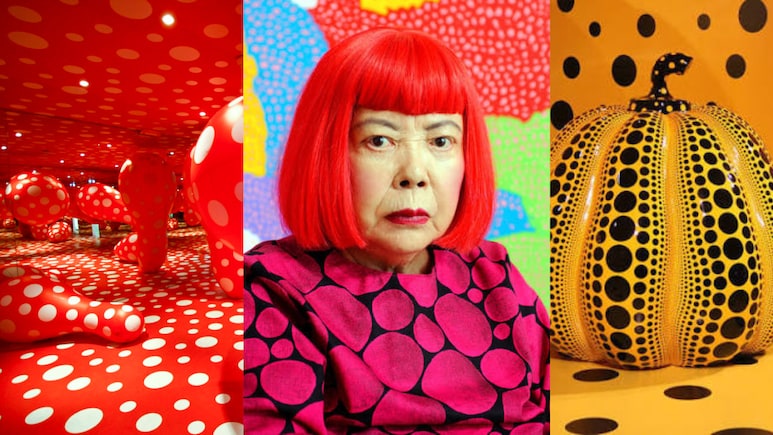
Yayoi Kusama, the Japanese artist who painted surreal worlds of swarming polka dots and turned them into soaring cultural and commercial success, has died. She was 97.
Kusama died in a Tokyo hospital on Aug. 14, according to a statement on her official website. The cause was multiple organ failure, Kyodo News reported.
Kusama's work was easily recognized by her signature polka-dot motif, rooted in visions she'd experienced since childhood. She used the dots to express ideas of infinity and obliteration — both lifelong obsessions — and enfold viewers in immersive, hypnotic environments that she said mirrored her own hallucinations.
Also Read | Layoffs Are Rising In Tech, But These Skills Are Helping People Unlock Better Pay
Furiously prolific, Kusama created many of her famous works in seclusion at Seiwa Hospital, the Tokyo psychiatric clinic where she had lived since 1977.
“My art originates from hallucinations only I can see,” Kusama said in a 1999 interview with Bomb magazine.
Her work, she explained, was both a product of and relief from the struggles of her illness — as specifically as she would ever really address the issue. “I followed the thread of art and somehow discovered a path that would allow me to live,” she wrote in her autobiography, first published in 2002.
An artist since youth and a wild figure in the 1960s New York Avant-Garde scene, Kusama achieved mainstream fame that swelled startlingly in her last decades as high-profile museums hosted retrospectives. Starting around the early 2000s, her blockbuster exhibitions packed out art galleries globally. Sculpture rooms crawling with her signature dots, vertiginous Infinity Net paintings and mirrored installations of endless, twinkling lights drew crowds in places ranging from Los Angeles to the tiny Japanese island of Naoshima.
In 2024, she ranked as the world's top-grossing contemporary artist, beating household names like David Hockney and Lucian Freud with $58.8 million in sales.
Family Tensions
Kusama was born on March 22, 1929, in the rural Japanese town of Matsumoto, to a prosperous plant nursery-owning family. Her childhood was underscored by discomfort. Heart problems and asthma, combined with family tensions stoked by a philandering father and volatile mother, pushed her to take refuge in art.
When she was about 10, she recalled, she perceived violets bearing “uncanny expressions” speaking to each other in a garden. At times, a fine veil would seem to fall and separate her from her surroundings. She witnessed patterns of nets and dots spreading out to engulf her environment, images that the young Kusama compulsively committed to paper. Paintings piled high toward the ceiling of her room.
She entered the Kyoto Municipal School of Arts and Crafts, and pumpkins became an obsessive subject.
“Just as Bodhidharma spent 10 years facing a stone wall, I spend as much as a month facing a single pumpkin,” she remembered. “I regretted even having to take time to sleep.”
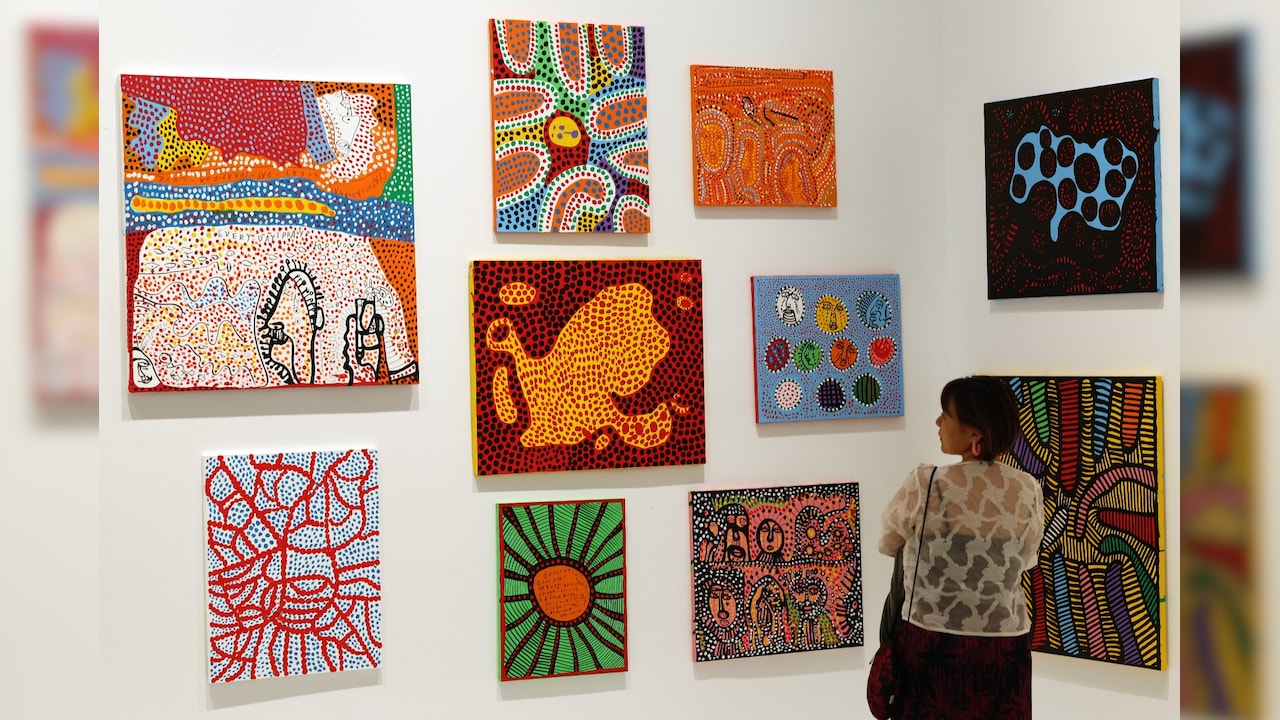
Prescriptive art forms, however, could not restrain Kusama for long. In her late 20s, she moved to the US, where her instinct to push the boundaries of painted artwork — along with her talent for spectacle — would be put to work. There, her works expanded from early Infinity Net paintings and soft sculptures into what she called “happenings” — spontaneous or semi-scripted public performances that often had a political or sexualized edge.
One of the most famous of these performances, Grand Orgy to Awaken the Dead (1969), involved nude people painted with polka dots moving through the open-air sculpture garden of the Museum of Modern Art in New York City — a caper unauthorized by the museum. For another of her happenings, Horse Play (1967), Kusama covered a horse with white dots. Flyers and press releases declared her artistic goals. One said, “Become one with eternity. Obliterate your personality. Become part of your environment. Forget yourself.”
Scandalizing Combination
But Kusama's acumen for publicity was gaining her a certain level of infamy. It wasn't uncommon for police to shut down her events. And while her “happenings” channeled the sexual liberation of the 1960s, media headlines rejoiced in the scandalizing combination of nudity, an eccentric female Japanese artist and anti-establishment protest. Kusama's tabloid nicknames included “Priestess of Polka Dots” and “Dotty.”
Returning to Tokyo in 1970 after an absence of more than a dozen years, Kusama initially struggled to re-import her divisive brand of art. Provocative photos were blocked. Repeated hospitalizations reflected her fragile mental and physical state.
Committing herself to Seiwa Hospital, she began producing artwork at a prodigious rate.
This era was far from the wild transgressive energy of her New York performances. Instead, her works were minimal, all-enveloping experiences of line and color that evoked the uncontrollable hallucinations of her childhood. Mirrors, too, transported viewers into Kusama's dizzying visions of boundless repetition.
In 1993, she attended the Venice Biennale as the first woman to officially represent Japan. It wasn't her first time there. In 1966, she had turned up unscheduled, setting up a field of 1,500 mirror balls as a “Narcissus Garden” and selling them for $2 each before being barred by officials. Now, as a figurehead of Japanese contemporary art, she wore a neat and striking yellow-and-black spotted ensemble and handed out color-coordinated miniature pumpkins.
Kusama's instinct for spectacle may have placed her ahead of her time. In the 1990s and into a new millennium, the reception was rapturous, both from the art world and from mainstream audiences.
Merch Mania
By the time of the record-shattering 2022 sale of Untitled (Nets), a 1959 work, for $10.5 million, Kusama was a household name. Undulating polka dots were stamped not just on sculptures but on A4 folders, keyrings and other merchandise. They were daubed over Louis Vuitton leather. In the art world, rivals and critics began to whisper of overexposure.
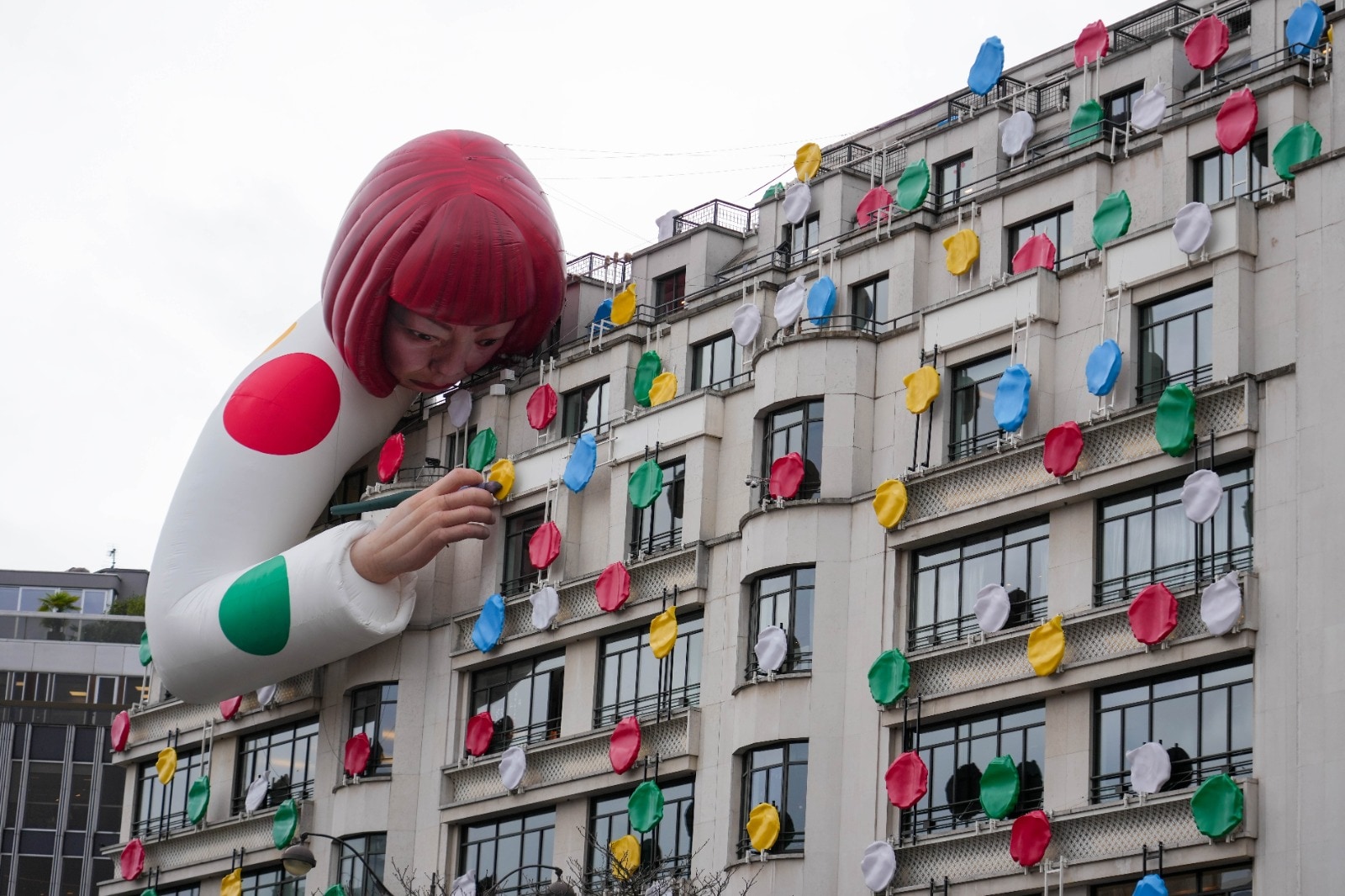
Even as her fame ratcheted up, Kusama receded further and further from public life. “I have no connection to the art world,” Kusama wrote in 2002. “I just dig ever deeper into myself.”
She chose to forgo openings of her exhibitions, and her last in-person interviews dated back to the mid-2010s. Her image remained as present as ever, however, pasted on catalogues and books: a brightly-colored blunt bob above unsmiling eyes, figure swathed in bold patterned fabric.
Throughout a life spent confronting fear, obsession and mortality, Kusama returned to a single idea: that the self is ultimately temporary. Beyond it lay what she called eternity — an infinite space where, at last, we become part of something larger than ourselves. The polka dot, she often said, was a symbol of that. For Kusama, obliteration was not annihilation, but rather a next stage.
“By obliterating one's individual self, one returns to the infinite universe,” she said in 1999.
(This story has not been edited by NDTV staff and is auto-generated from a syndicated feed.)
Essential Business Intelligence, Sharp Market Insights, Practical Personal Finance Advice, Daily Fuel, Gold and Silver Prices and Latest Stories — On NDTV Profit.