Scan to Download
The US Federal Reserve on Wednesday kept its key interest rate unchanged for the second time, in line with expectations. In addition, core inflation rate is expected to be at 2.7% by end of 2026, up from 2.5% forecast in December.
At its last meeting, the Federal Reserve kept its policy interest rate steady in the 3.50%–3.75% range. Before that, it had delivered three consecutive rate cuts of 0.25% each to prevent a softening labour market from slipping into higher unemployment.
Here are the key highlights from the FOMC meet and Federal Reserve Chair Powell speech and press conference:
Near-Unanimous Decision
Jerome Powell and ten other members voted for maintaining the interest rate, while voting against the action was Stephen I. Miran, who preferred to lower the target range for the federal funds rate by 1/4 percentage point.
Inflation Outlook Revision
The Federal Reserve officials revised the core inflation outlook upward to 2.7%, compared to 2.5% forecast in December. Even though inflation has made further progress toward the Committee's 2% objective but remains 'somewhat elevated,' the Federal Reserve said in a statement.
Powell, in his speech, said, "Near term inflation expectation are up in the recent weeks."
"Main thing we are looking for is lowering goods inflation," he added.
He further added that "If we don't see inflation progress, won't see rate cut."
Higher GDP Forecast
The US Federal Reserve raised the median GDP 2026 projections to 2.4% from 2.3%. Addressing the upward projections, Powell said that it reflected confidence in productivity.
No One Knows What Impact Of Middle East War Will Be
“The US economy is doing pretty well,” Powell said. But, “We don't know what the effects of this will be,” he said. “Really, no one does.”
He further added that energy prices will push up overall inflation and some of the oil shock will show up in core inflation. The series of shock due to the Middle east war have interrupted inflation progress, he pointed.
The live blog has ended. We will back in April to see what the Fed decides in what could be Jerome Powell's last FOMC meet as the Chair.
Fed Chair Powell while talking about inflation said that while the central bank's projection is that inflation will ease this year, the progress isn't as quick as they would like. The comment comes after the Federal Reserve officials revised the core inflation outlook upward to 2.7%, compared to 2.5% forecast in December.
Read Full Story Here
Jerome Powell said that Data center buildout is probably is pushing inflation up, he added that AI investment probably boosts neutral rate in near term.
Jerome Powell during FOMC presser said that he has not seen productivity effects from generative AI, but also underlined that in the long run AI may contribute to US output and productivity.
Federal Reserve Chair Jerome Powell on Wednesday said that he has no intention to leave the board unless the investigation is completely over. He further added that he would serve as Chair pro-term until a successor is confirmed.
Read More: Federal Reserve Chair Powell To Stay Until DOJ Investigation Is Over
Jerome Powell expects tariff induced inflation to come down by mid-year. Earlier the Fed Chair had blamed tariffs for causing rise in goods inflation.
Jerome Powell thinks Donald Trump's sweeping tariffs should be a "classic one-time thing."
The US Federal Reserve raised the median GDP 2026 projections to 2.4% from 2.3%. Addressing the upward projections, Powell said that it reflected confidence in productivity.
The US Federal Reserve on Wednesday kept its key interest rate unchanged for the second time, in line with expectations. In addition, core inflation rate is expected to be at 2.7% by end of 2026, up from 2.5% forecast in December.
At its last meeting, the Federal Reserve kept its policy interest rate steady in the 3.50%–3.75% range. Before that, it had delivered three consecutive rate cuts of 0.25% each to prevent a softening labour market from slipping into higher unemployment.
Here are the key highlights from the FOMC meet and Federal Reserve Chair Powell speech and press conference:
Jerome Powell and ten other members voted for maintaining the interest rate, while voting against the action was Stephen I. Miran, who preferred to lower the target range for the federal funds rate by 1/4 percentage point.
The Federal Reserve officials revised the core inflation outlook upward to 2.7%, compared to 2.5% forecast in December. Even though inflation has made further progress toward the Committee's 2% objective but remains 'somewhat elevated,' the Federal Reserve said in a statement.
Powell, in his speech, said, "Near term inflation expectation are up in the recent weeks."
Read More: FOMC Meeting Highlights
When asked if Jerome Powell will leave his post as the Federal Reserve Chairman amid on on-going investigation instigated by Donald Trump, he said, "I have no intention of leaving the board unless the investigation is well and truly over with transparency and finality."
Jerome Powell said as tradition goes, he will remain chairman till his full term till his successor is named as the new Fed Chair.
Goods inflation used to be negative, and just before tariffs it was at 0%, Fed Chair Jerome Powell highlighted. He pointed out that the current rate stands at 2% and he hopes that it will come back down.
Fed Chair Jerome Powell said that the Fed won't see any rate cuts unless there is "progress" in inflation.
The progress on inflation should come by the middle of this year, said Fed Chair Jerome Powell.
Jerome Powell said that "the main thing" the Fed is looking for is to bring down goods price pressures to see progress in inflation.
Near-term inflation expectations are up in recent weeks, said Fed Chair Jerome Powell. He pointed out that most longer-term expectations consistent with 2% goal. Past rate cuts should help stabilise labor market, he added
Powell: Fed sees current stance of policy as appropriate.
Powell: Implications of Middle East developments uncertain.
Powell: Consumer spending has been resilient.
Powell: Unemployment rate has changed little since last summer.
Powell: Labour demand has clearly softened.
The Federal Reserve said that it is fully committed to bringing inflation back down to its 2% objective. Projections for PCE 2026 inflation were seen at 2.7%.
The Federal Reserve has boosted America's median GDP 2026 projection to 2.4% from 2.3%
Fed's decision to hold the fund rate between 3.5%-3.75% was opposed by Stephen Miran who wanted the rate to be cut by 1/4 percentage point at the meeting.
"Voting for the monetary policy action were Jerome H. Powell, Chair; John C. Williams, Vice Chair; Michael S. Barr; Michelle W. Bowman; Lisa D. Cook; Beth M. Hammack; Philip N. Jefferson; Neel Kashkari; Lorie K. Logan; Anna Paulson; and Christopher J. Waller. Voting against this action was Stephen I. Miran, who preferred to lower the target range for the federal funds rate by 1/4 percentage point at this meeting," Fed outlined in its statement.
The Federal Reserve In Its Official Statement said, "Available indicators suggest that economic activity has been expanding at a solid pace. Job gains have remained low, and the unemployment rate has been little changed in recent months. Inflation remains somewhat elevated."
"The Committee seeks to achieve maximum employment and inflation at the rate of 2 percent over the longer run. Uncertainty about the economic outlook remains elevated. The implications of developments in the Middle East for the U.S. economy are uncertain. The Committee is attentive to the risks to both sides of its dual mandate.
In support of its goals, the Committee decided to maintain the target range for the federal funds rate at 3‑1/2 to 3‑3/4 percent. In considering the extent and timing of additional adjustments to the target range for the federal funds rate, the Committee will carefully assess incoming data, the evolving outlook, and the balance of risks. The Committee is strongly committed to supporting maximum employment and returning inflation to its 2 percent objective."
The Federal Reserve has maintained projection of one rate cut in 2026.
The Federal Reserve has held the fund rate steady between 3.5% and 3.75%.
Wall Street continued to trade in the red minutes before the Federal Reserve announces its rate cut decision. S&P 500 was down 0.63%, Dow Jones slipped 1%, and Nasdaq traded 0.58% lower.
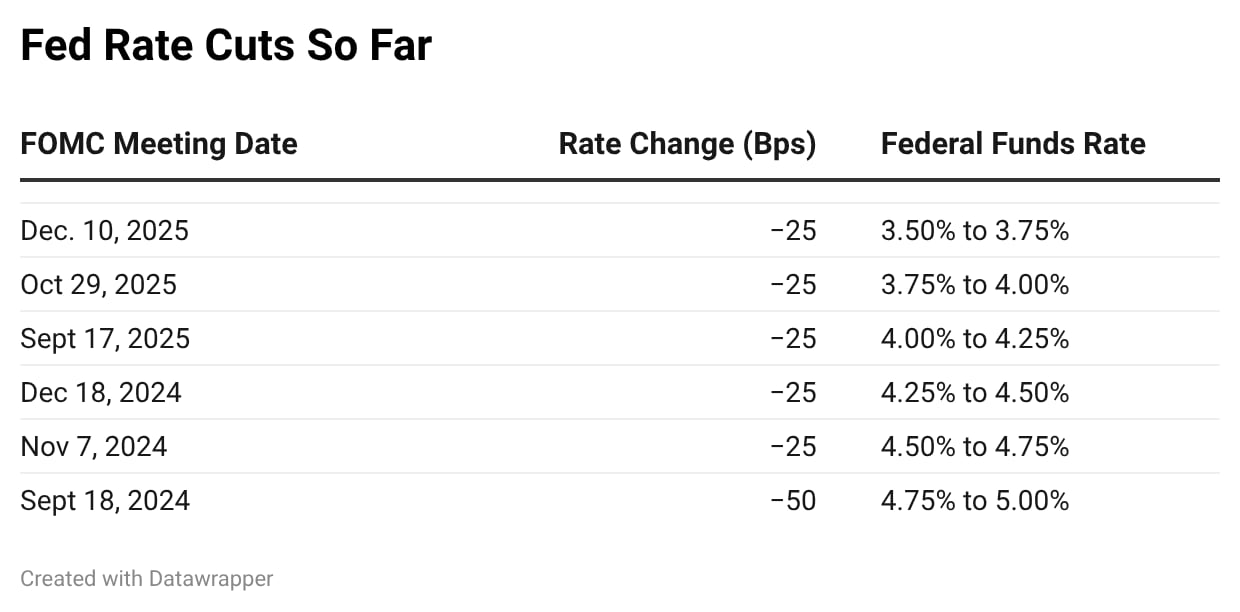
At its last meeting, the Federal Reserve kept its policy interest rate steady in the 3.50%–3.75% range. Before that, it had delivered three consecutive rate cuts of 0.25% each to prevent a softening labour market from slipping into higher unemployment.
This comes amid data pointing to little change in the US economic outlook. Even so, the recent data now seems outdated after Strait of Hormuz tensions escalated and President Donald Trump has not outlined clear objectives or timeline to end the war.
As the Iran war wages on, some of the key American defense stocks rose ahead of the FOMC rate cut decision. Lockheed Martin Corp. jumped 1.25% to $644, while Northrop Grumman rose 0.5% to $728.02.
Federal Reserve's fund rate is a primary lever for the US economy. The Fed prefers inflation to rise by 2% and for the labor market to be as fully employed as possible without causing inflation to go beyond that target rate.
In cases economic growth remains sluggish and prices rise slow, the Fed instigates rate cuts to give the economy a liquidity boost.
S&P 500 and Nasdaq traded 0.60% lower at 6,675.44 and 22,347.11 respectively. Dow Jones slipped 1% to 46,530.06.
In the wee hours of March 18 (EST), President Donald Trump took to his social media platform truth social to take yet another jibe at Fed Chair Jerome Powell.
"When is “Too Late” Powell lowering INTEREST RATES? President DJT," Trump remarked.
US wholesale inflation unexpectedly accelerated in February from a month earlier, reflecting higher costs for goods and services prior to the war in Iran.
The producer price index rose 0.7% after a 0.5% gain in the prior month, according to Bureau of Labor Statistics data out Wednesday. An underlying gauge of wholesale inflation that excludes food and energy increased 0.5%.
US Fed will unveil new economic projections, marking a prediction whether their firm stand against inflation with a continued tight monetary policy will play out this year or rate cuts will be needed to offset an economic slowdown. Given the current uncertainty, Wall Street economists believe that the easiest approach now may be to stay close to December's monetary policy outlook, which showed a median forecast of just one rate cut this year.
Crude oil prices rose on Wednesday amid the on-going Iran War. Global benchmark Brent Crude rose over 6% to $109.74 per barrel fuelling inflation fears.
Iranian control over the Strait Of Hormuz has mounted strain on oil supply world-wide, stirring chaos in the oil market.
Dow Jones slumped nearly 1%, shedding over 400 points to trade at 46,570.64 within one hour of market open. Losses in big tech weighed on the Nasdaq index which slipped over 0.7% to 22,317 and S&P 500 declined 0.7% to 6,670.15.
Wall Street traders have ramped up bets that rate cuts will start in June. The stakes are high for Fed chair Jerome Powell as faces a litmus test amid the current external risks due to the Iran war-led impact to the economy. Additionally, Powell will deliver his second-last policy review verdict as the Fed chair before the April meeting. US Fed is transitioning to a new leader, Kevin Warsh, nominated by Trump and expected to eventually win Senate confirmation to take over from Powell after mid-May. The June FOMC meeting could be Warsh's first as Fed chief if he is confirmed by the US Senate in time.
The intense US and Israeli airstrikes and Iranian counterattacks have all but closed the strategic Strait of Hormuz. It provides the only sea passage from the Persian Gulf to the open ocean and is one of the world's most strategically important choke pointsEven at this point, President Donald Trump has set out no clear set of objectives or timeline for ending the war.
The US central bank will draft a policy outlook while balancing the current dynamics of a waging geopolitical war, rising commodity costs and weaker hiring. This has put the Fed in a "stagflation" phase that policymakers last year had thought they could avoid. The FOMC is expected to hold interest rates steady at its policy meeting on Wednesday, as per global market experts.
According to most market analysts, US Fed policymakers are more likely to strike a cautious if not an outright hawkish tone this week. US inflation is mired about a percentage point above the central bank's target and is poised to move higher, particularly if oil prices that jumped almost 50% in two weeks remain elevated. Amid the high risk premium due to the Iran war, US Fed will have to weigh whether the developing economic shock and higher consumer prices results in tighter financial conditions.
The US Federal Reserve is set to announce its interest rate and monetary policy decision on Wednesday, March 18, after a two-day Federal Open Market Committee (FOMC) meeting amid the ongoing geopolitical tensions with Iran. The upcoming interest rate verdict will be the second last policy review for Jerome Powell before his term as Fed Chairman ends on May 15, 2026. The Federal Open Market Committee (FOMC) had cut the federal funds rate by a quarter-point twice last year to 3.75%-4.00%.
The main US stock market indices opened in the red on Wednesday ahead of the Federal Reserve's rate cut decision. Government's producer price index data also stirred inflation fears as prices accelerated unexpectedly.
S&P 500 opened 0.33% lower at 6,693.61, erasing previous day's gains. Similarly, tech-heavy Nasdaq Composite opened 0.37% lower at 22,396.32 and Dow Jones Industrial Average ticked 0.36% lower to 46,825.16.
Essential Business Intelligence, Continuous LIVE TV, Sharp Market Insights, Practical Personal Finance Advice and Latest Stories — On NDTV Profit.