(Bloomberg) -- Investors are calling for Switzerland to overhaul its rules on Additional Tier 1 bonds, arguing that the market will stay closed unless regulations are brought in line with the rest of Europe.
Fund managers like BlueBay Asset Management, which owned some of the AT1 bonds that were wiped out in the Credit Suisse Group AG takeover, say regulators should allow Swiss lenders to alter the terms on future sales.
They want banks to change the terms so debt can be converted into stock in a worst-case scenario, or even rewrite the rules so they follow English law, which stipulates more clearly that AT1 bonds are senior to common equity.
But first, they need approval from Swiss banking watchdog Finma — and it's unclear if that will happen anytime soon. One banker at a smaller Swiss lender, who asked not to be named because he wasn't authorized to speak about the matter, said his firm had discussions about selling AT1s under English law, but this was ultimately seen as unfeasible as regulators would likely block the move. A spokesperson for Finma declined to comment.
“As an investor, you would want the structure to change but it's a question of whether Finma will allow it,” said Laurent Frings, head of European credit research at Aegon Asset Management. Allowing conversion to equity is an option, if bankers find a way to do this — otherwise some investors may avoid Swiss AT1s altogether, resulting in higher costs for the issuer, he said.
Swiss AT1 Wipeout Rocks Brazil Market and Puts Bankers on Edge
In Brazil, the major market for contingent convertible bonds with rules that most closely resemble those in Switzerland, there's also growing pressure from bankers to clarify the rules over when a writedown can occur.
European officials have effectively changed the AT1 rulebook in the past. So-called CRR2 regulations, which came into force in 2019 to improve the resilience of banks, ended up being a boon for Deutsche Bank AG. The German bank was able to rely on the rule to avoid stopping coupon payments on AT1 bonds as it pushed ahead with an overhaul plan.
“Swiss regulators made a mistake, and it would make sense for them to look at this issue again,” said Kaspar Hense, a portfolio manager at BlueBay. “Right now, the AT1 market is closed for Swiss banks.”
Accessing that market is important. Issuing AT1 debt is a way banks can bolster financial resources that's usually cheaper than shares, and helps banks to comply with capital requirements. The bonds were created by regulators after the financial crisis as a way to impose losses on creditors when banks start to fail without using taxpayer money.
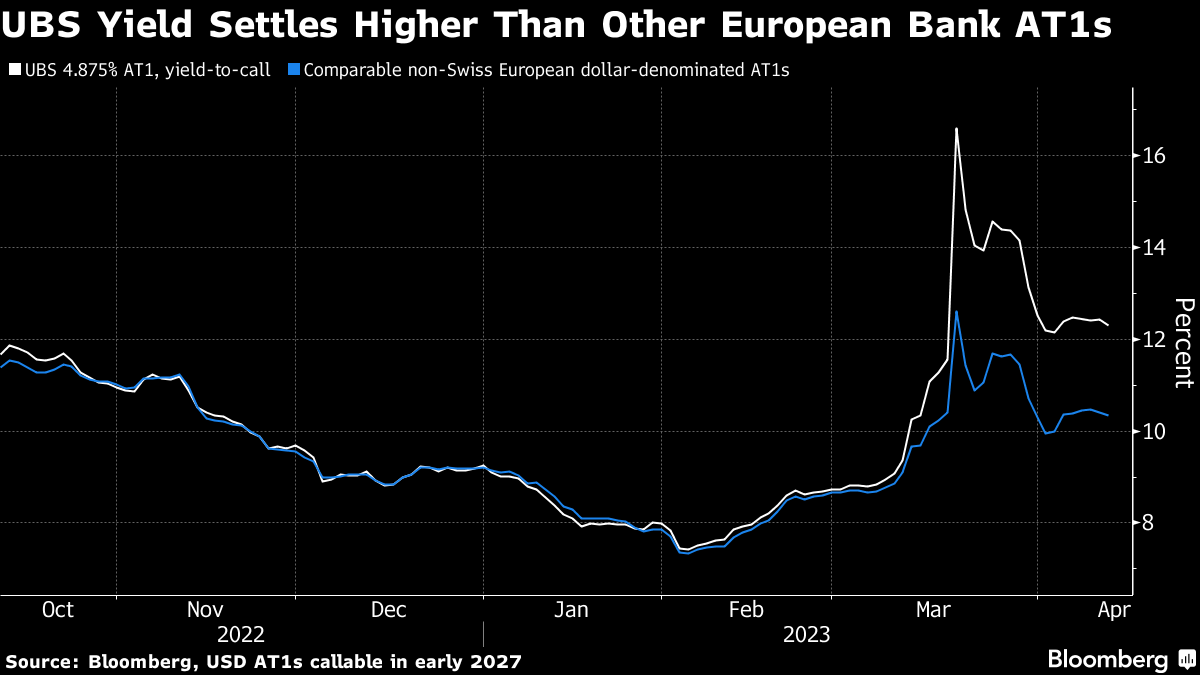
Swiss AT1 yields are still elevated compared with other European banks in the wake of the Credit Suisse writedown. The yield that investors demand until a $1.5 billion bond UBS Group AG bond is callable in early 2027 stands at more than 12%, about 200 basis points above the yield in similar notes from non-Swiss issuers.
And as long as the debt is yielding more than 12%, it'll be too expensive for banks like UBS to sell any more of it, according to BlueBay's Hense.
UBS is now the largest AT1 issuer in Switzerland, while Julius Baer Group Ltd and EFG International AG also have AT1 notes in foreign currencies, based on data compiled by Bloomberg. Regional banks like Basler Kantonalbank and Zürcher Kantonalbank also have Swiss franc-denominated AT1 notes.
“It is going to be more challenging for UBS, Julius Baer and the rest to issue AT1s to say the least,” according to Jeroen Julius, senior credit analyst at Bloomberg Intelligence. “It is conceivable that Finma and the Swiss regulatory framework is adjusted somewhat and bond documentations become more like what you see in the EU.”
More stories like this are available on bloomberg.com
©2023 Bloomberg L.P.
Essential Business Intelligence, Sharp Market Insights, Practical Personal Finance Advice, Daily Fuel, Gold and Silver Prices and Latest Stories — On NDTV Profit.