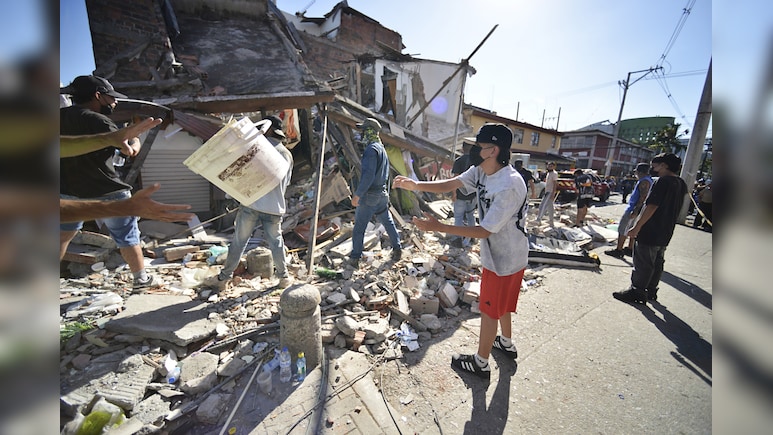
A deadly earthquake hit Colombia on Monday morning, toppling buildings, burying people under rubble and leaving more than 100 dead in the Pacific region and the central Andes. The magnitude 7.4 quake struck at 7:34 a.m. local time near the town of San Jose del Palmar, Choco province, the US Geological Survey said. Significant damage was reported in the country's coffee heartland, the region immediately east of the epicenter.
The death toll from the earthquake has reached 132, according to Asocapitales, an association of Colombian capital cities. That number is likely to continue rising as rescue teams search for survivors amid the wreckage.
In a televised statement, President Abelardo de la Espriella said more than 5,000 homes were damaged, three hospitals collapsed, and some 188 people were missing in the Valle del Cauca province alone.
Also Read | Layoffs Are Rising In Tech, But These Skills Are Helping People Unlock Better Pay
Some of the hardest-hit areas, particularly the provinces of Caldas and Risaralda, are part of Colombia's coffee region, responsible for about a quarter of production. It wasn't immediately clear how the industry would be affected by the quakes, but major roads were closed due to resulting landslides. Colombian aviation authorities said that operations had been suspended at five airports in the affected region. No damage to major energy infrastructure was immediately reported.
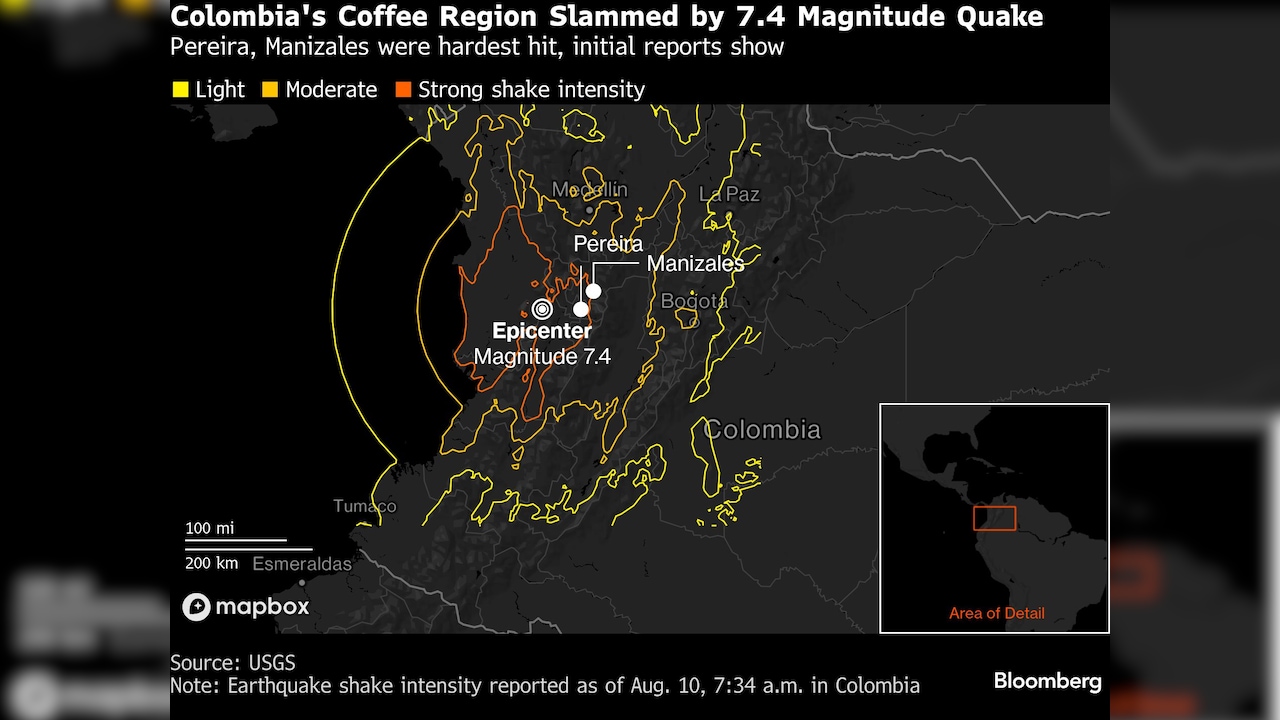
Colombia's Coffee Region Slammed by 7.4 Magnitude Quake
Photo Credit: (Photo: Bloomberg)
The earthquake is the first major test for De la Espriella, who was sworn in on Friday in a ceremony in Cali, where at least 19 buildings collapsed, trapping residents under fallen masonry. He initially said he would travel to Risaralda province, scene of some of the most intense damage, then changed his destination to Bogota to coordinate with the National Risk and Disaster Management agency.
De la Espriella arrived in Quibdo, the capital of Choco, on Monday afternoon to assess the impact of the earthquake. Local Governor Nubia Córdoba said that some of the department's connectivity infrastructure is more than 50 years old and 10 municipalities remained cut off. De la Espriella pledged government support for Choco, saying it had been "forgotten and left to its fate."
In Manizales, the capital of Caldas, gaping holes in building facades exposed apartments to the street and shattered glass was strewn in front of shops, many of which remained closed. Chunks of concrete and debris blocked sidewalks and roads, creating traffic jams in parts of the city. Downed power lines laid in the streets, while broken pipes disrupted water supply. In some neighborhoods, residential gas service was suspended.
Natalia Aguirre, a 40-year-old healthcare worker, said that when the quake hit she ran back to her home to get her children out. They were safe, but "everything inside the apartment was destroyed," she said.
Jacobo Pelaez, a 60-year-old personal trainer in the same neighborhood, said several of the buildings in his residential complex looked uninhabitable. "It's frightening to go back inside because you don't know if there will be an aftershock," he added.
Sirens echoed through the streets, where police have cordoned off some areas with yellow caution tape. Still, local emergency services in Manizales were overwhelmed on Monday, leaving civilians to help with rescue efforts.
Sebastián Guzmán, a 29-year-old biologist, worked alongside a group of friends in the Milan neighborhood in eastern Manizales. They were helping families at one building retrieve their belongs, when "the Fire Department arrived and told us that we had to leave because there was a risk of collapse."
About 140 miles north in Medellin, the nation's second largest city, there were reported cracks in buildings but no initial reports of injuries.
Colombians have turned to social media to find missing people and support affected communities. Websites previously used during the earthquakes that struck Venezuela in June have been adapted for the emergency, including Colombia Te Busca, which lists more than 2,000 people as missing.
Colombia's disaster management agency UNGRD opened a form for residents to report deaths, injuries, missing people and infrastructure damage. The government has also asked state agencies and authorities to channel all official reports of damage, needs and other impacts exclusively through UNGRD, in an effort to centralize information and direct resources to the areas most in need.
The disaster will complicate De la Espriella's pledge to freeze public spending.
The National Risk and Disaster Management agency gave a recommendation to declare a state of disaster, it said in a statement, a move that allows the government to speed up relief, rehabilitation and reconstruction efforts.
Some lawmakers are asking the president to also declare an economic emergency, which would allow him to raise taxes without going through congress.
The earthquake rocked buildings in Bogota, causing some residents to flee into the streets while still dressed in pajamas. There were no immediate reports of damage, according to the capital's mayor.
The US government is closely monitoring the situation and "stands ready to support the people of Colombia," Secretary of State Marco Rubio said in a social media post. De la Espriella is an ally of President Donald Trump, who endorsed him in June's presidential election.
Mexico's Claudia Sheinbaum, Brazil's Luiz In~CHECK~cio Lula da Silva and Ecuador's Daniel Noboa said their governments were available to provide support.
The disaster revived memories of a devastating 1999 earthquake that struck the same area, killing nearly 1,200 people.
The quake comes less than two months after twin earthquakes struck Venezuela in June. The official death toll from that disaster has surpassed 6,000, ranking it among the deadliest to hit Latin America in recent years.
Carlos Andrés Valoyes, a 27-year-old systems engineer, was at home in Quibdo with his wife and baby daughter when the quake struck.
Like many residents of the city, they lost electricity and mobile data service for much of the day. By the late afternoon, Valoyes said in a WhatsApp message that people were still sitting on sidewalks, afraid to return to homes that may have been damaged and worried about further aftershocks. The Colombian Geological Survey said 18 aftershocks had been recorded as of noon across Choco, with magnitudes ranging from 1.4 to 4.8.
Valoyes is now sheltering two neighboring families in his apartment after their homes became uninhabitable.
"I think tonight is going to be one of the longest nights," Valoyes said.
(This story has not been edited by NDTV staff and is auto-generated from a syndicated feed.)
Essential Business Intelligence, Sharp Market Insights, Practical Personal Finance Advice, Daily Fuel, Gold and Silver Prices and Latest Stories — On NDTV Profit.