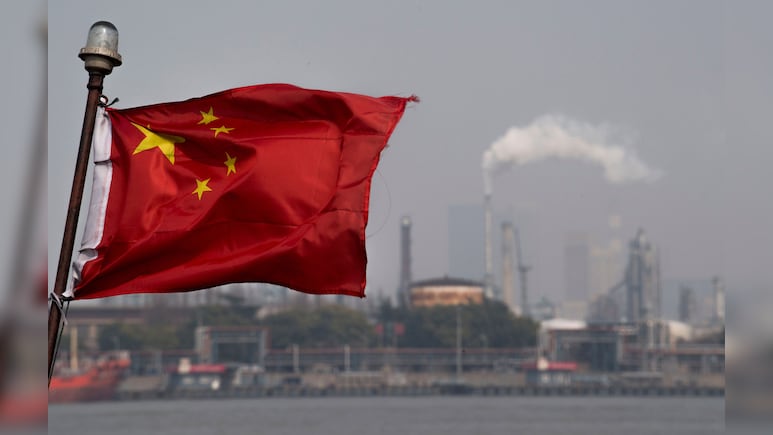
China has ordered companies to defy US sanctions for the first time, a step that threatens to put its banking sector into the crosshairs of competition between the world's largest economies.
The decision, announced on Saturday, risks becoming a watershed moment. While China has often railed against unilateral sanctions, it has in the past quietly allowed companies to comply with them to avoid blowback on its own economy and preserve access to the US financial system.
Beijing is now signaling a far firmer stance against such restrictions by directing companies not to abide by US sanctions on five domestic refiners linked to the Iranian oil trade.
Also Read | Layoffs Are Rising In Tech, But These Skills Are Helping People Unlock Better Pay
A commentary on the People's Daily app, the Communist Party mouthpiece, called the announcement "a pivotal step in the transition of China's foreign-related legal weapon from institutional reserves to practical application."
The move represents Beijing's most aggressive action to date in countering Washington's financial statecraft, setting up a showdown before a long-awaited meeting between President Donald Trump and his counterpart Xi Jinping later this month. It comes with the US sanctions system already under strain, as Washington vacillates on restrictions against Russia, Venezuela and Iran.
ALSO READ: 'Project Freedom': Trump Announces Initiative To 'Free Ships' Locked In Hormuz
China is deploying a blocking measure introduced in 2021 that was aimed at protecting its firms from foreign laws it deemed unjustified. The refiners - including Hengli Petrochemical (Dalian) Refinery Co. which was sanctioned last month, and several other privately-owned processors - had been facing asset freezes and transaction bans.
Lenders working with Hengli and other private processors are scrambling to understand the decision and are seeking clarity from the banking regulator. Public holidays in China this week allow them some time, since business is on hold, as does the grace period provided by the Treasury Department's Office of Foreign Assets Control.
"Judging by its specific provisions, the prohibition order primarily targets the concrete US sanctions imposed on particular Chinese firms," Ji Wenhua, a law professor and adviser to the Commerce Ministry, wrote in an opinion piece for the state-run Economic Daily. "Its central objective is to nullify their legal effect within Chinese territory, rather than simultaneously resorting to more aggressive retaliatory measures."
The US measures unlawfully restrict normal trade with third countries and breach international norms, the country's Commerce Ministry said in a statement on Saturday. It banned recognition, enforcement, and compliance with the sanctions aimed at the five companies.
"The Chinese government has consistently opposed unilateral sanctions that lack authorization from the United Nations and a basis in international law," the department said.
While the blocking measure is not likely to derail the Xi-Trump summit, Washington's reaction to it will indicate if the matter escalates, according to analysts from Eurasia Group.
"The refineries primarily work with Chinese banks that have not yet been directly sanctioned," the analysts led by Dominic Chiu wrote in a note. "If the US extends secondary sanctions to those institutions, or major state-owned entities, Beijing would likely respond with more forceful countermeasures."
China has long been the single largest buyer of Tehran's oil shipments, many of them arriving indirectly and through private refiners, and then turned into gasoline, diesel and other oil products. Chinese customs data do not reflect that trade, with the last official shipment recorded several years ago.
ALSO READ: US Jobless Claims Plunge To 189,000, Lowest Since 1969
Before Hengli, and wary of the economic and diplomatic fallout, Washington's efforts to cut off Tehran's oil revenue had targeted smaller Chinese companies and facilities. Hengli, by contrast, is representative of the most modern of China's private refiners, with a sprawling oil-processing and chemicals complex in the northeastern province of Liaoning.
While the country does still have an army of small independent players - the original so-called teapots - the larger entities are now giant operations. Altogether, the private sector accounts for as much as a third of refining capacity, in a country where energy security is a priority.
The injunction "allows the refineries to seek compensation in Chinese courts from entities that comply with US sanctions, including domestic actors - such as banks, investors, and downstream customers that have ceased dealings - as well as foreign firms with a presence in China," the Eurasia analysts said, adding the move signals Beijing is taking a more assertive approach to countering sanctions.
"By activating its blocking measures for the first time since adopting the rule in 2021, China is demonstrating a lower threshold for deploying its legal and regulatory toolkit to counter US sanctions," they said.
Essential Business Intelligence, Sharp Market Insights, Practical Personal Finance Advice, Daily Fuel, Gold and Silver Prices and Latest Stories — On NDTV Profit.