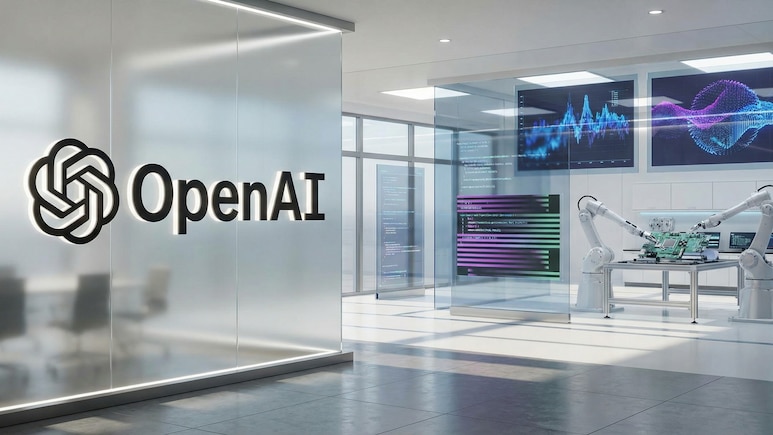
OpenAI said that an internal, unreleased AI model had produced a solution to the Navier-Stokes existence and smoothness problem, one of seven Millennium Prize Problems set by the Clay Mathematics Institute in 2000, each carrying a $1 million reward.
Only one of the seven had previously been solved.
What Is The Navier-Stokes Problem?
Also Read | Layoffs Are Rising In Tech, But These Skills Are Helping People Unlock Better Pay
The Navier-Stokes equations describe how fluids such as water and air move, using Newton's second law applied to a continuous medium rather than individual particles.
The open question, unresolved for roughly 90 years, was whether a smooth, three-dimensional incompressible fluid could develop a "singularity" - a point where its motion breaks down entirely in finite time, despite the smoothing effect of viscosity.
OpenAI said its system found that it can, describing a spiralling vortex that stretches and speeds up while its energy remains bounded, satisfying two of the problem's four possible resolution conditions.
ALSO READ: Meet Muse: Meta's New AI Agent For 'Real-World' Tasks - Features And How It Works
How The AI System Found The Proof
According to OpenAI, the work was carried out by an internal model "significantly more capable" than its public GPT-6 Astra system, which has been in training since August 28. The company said it deployed roughly 10,000 coordinating AI agents, working under strict monitoring and isolation safeguards, to pursue multiple Millennium Prize Problems at once.
The agents arrived at the Navier-Stokes solution 88 hours after starting, with a further 17 hours spent formalising the proof in Lean, a programming language used to verify mathematical arguments.
Across all the problems attempted, OpenAI said its agents exchanged 4.9 million messages and used roughly 300 billion output tokens.
A Concurrent Claim By Independent Mathematicians
OpenAI said it accelerated its effort on September 1 after hearing that mathematicians Levent Alpöge, described in the company's post as an Anthropic employee, and NYU professor Tristan Buckmaster were working on a related question.
After completing its own proof, OpenAI said it discovered the pair had independently solved a related equation, the forced Euler problem, without using any of its products, and it credited their achievement in a joint announcement.
ALSO READ: OpenAI Chief Scientist Warns Of AI Risks, Calls For Slower Development
Caution Amid The Celebration
OpenAI stopped short of claiming the Clay Institute's prize money, saying the result marks "substantial progress" by its models rather than a finished culmination of AI capability, and that further verification by the mathematics community is expected before the result is considered fully settled.
Essential Business Intelligence, Sharp Market Insights, Practical Personal Finance Advice, Daily Fuel, Gold and Silver Prices and Latest Stories — On NDTV Profit.