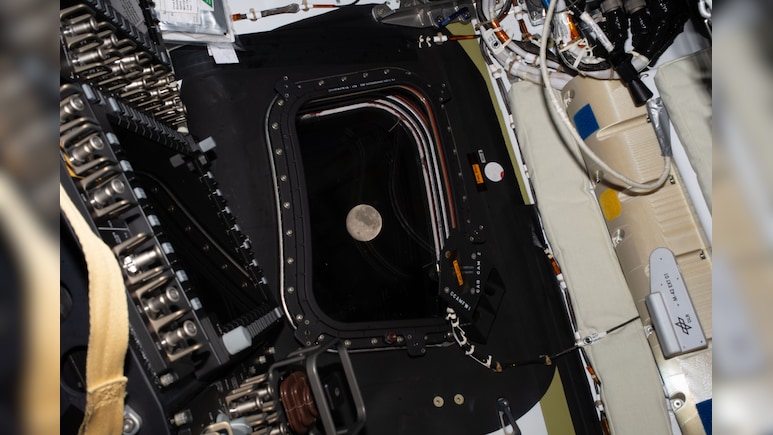
NASA's Artemis II crew is set to fly around the Moon, aiming to break the record for the farthest humans have travelled from Earth. The crew, consisting of three Americans and one Canadian, launched last week and will enter the Moon's gravitational sphere of influence today, swing around the Moon, and then return safely to Earth.
Reid Wiseman, Victor Glover, Christina Koch, and Jeremy Hansen continue their workday aboard the Orion spacecraft.
NASA on X posted: "Sweet dreams, @NASAArtemis II crew," along with a Moon image. "One last look at the Moon before flight day six and your epic lunar flyby, taking you farther into space than humans have EVER travelled," the post read.
ALSO READ | 'We're Halfway There': NASA's Artemis II Crew Are Now Closer To The Moon Than To Earth
Sweet dreams, @NASAArtemis II crew.
— NASA (@NASA) April 6, 2026
One last look at the Moon before flight day six and your epic lunar flyby, taking you farther into space than humans have EVER traveled. pic.twitter.com/roqklB0iGQ
On April 6, the Artemis II astronauts will fly around the Moon for the first time in over 50 years. They will pass behind the far side of the Moon, the part that cannot be seen from Earth.
The crew is expected to break the record set by Apollo 13 in 1970. The crew will study 30 different locations on the Moon. One of the main targets is the Orientale basin, a huge crater about 600 miles wide that lies on the edge of the Moon's near and far sides.
When and where to watch Artemis II?
You can watch the entire event live on NASA's website, YouTube, Amazon Prime, Apple TV, Hulu, and even Netflix. The nearly seven-hour mission will start around 12:15 a.m. IST and end around 6:50 a.m. IST.
We're going farther than ever before ????
— NASA (@NASA) April 6, 2026
Today, the Artemis II crew will break the record for how far humans have traveled from Earth as they fly around the far side of the Moon.
Coverage begins at 1 p.m. EDT (1700 UTC). Watch Artemis II make history:… pic.twitter.com/hCOVQPkxUF
At 9:14 p.m., Mission Control will temporarily lose communication as Orion passes behind the Moon. At 9:15 pm, the crew will witness "Earthset", when Earth disappears behind the Moon from their view.
Orion will reach its closest point to the Moon at 9:32 p.m., about 4,070 miles above the surface, and shortly after, at 9:37 p.m., the crew will be at their maximum distance from Earth during the mission.
By 10:05 p.m. IST, "Earthrise" will occur, and Earth will come back into view from the other side of the Moon. Between 11:05 p.m. and 11:57 p.m., the crew will see a solar eclipse. Lunar observations will conclude at 11:50 p.m.
On Tuesday, April 7, at 1:55 a.m., Orion will exit the Moon's gravitational sphere of influence, around 41,072 miles away, and will begin its journey back to Earth.
NASA's Artemis II was launched from Kennedy Space Center on April 1.
Essential Business Intelligence, Continuous LIVE TV, Sharp Market Insights, Practical Personal Finance Advice and Latest Stories — On NDTV Profit.