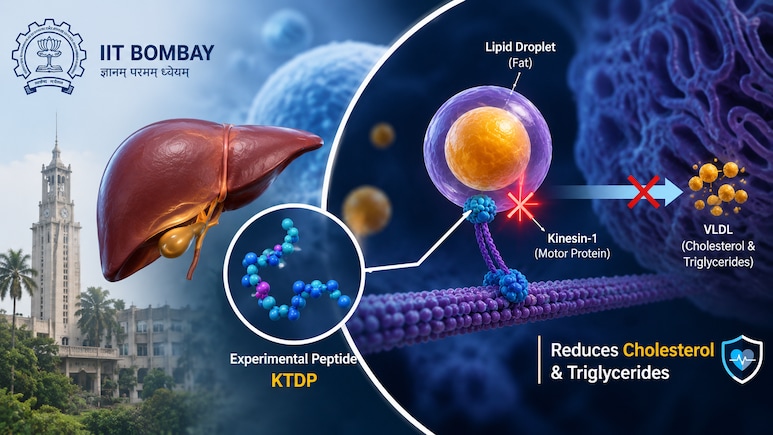
Scientists from IIT Bombay, working with researchers from IISER Pune and IISER Kolkata, have developed an experimental peptide that could offer a new way to lower cholesterol and triglyceride levels by preventing fats from being exported into the bloodstream.
The findings, published in the Proceedings of the National Academy of Sciences (PNAS), describe a short peptide called KTDP that reduced the secretion of cholesterol and triglycerides by nearly 50% in laboratory-grown liver cells and zebrafish models.
Unlike conventional cholesterol-lowering treatments such as statins, which reduce cholesterol production or increase its removal from the blood, KTDP targets the internal transport of fats within liver cells.
The liver stores fats such as cholesterol and triglycerides in structures known as lipid droplets. These droplets are transported to specific cellular locations where they are packaged into very low-density lipoproteins (VLDL) before being released into the bloodstream.
ALSO READ | India's Fragmented Water Governance Raises Fiscal Risks, Warns Moody's
According to the researchers, KTDP interferes with this transport process. The peptide is derived from kinesin-1, a motor protein that helps move lipid droplets inside cells. By disrupting this movement, the peptide prevents fats from reaching the sites where they are repackaged and exported.
“There are little balls of fat inside our liver cells that need to be carried to specific locations before being sent into the bloodstream,” said Professor Roop Mallik of IIT Bombay.
“If we can tone down the export of fat from the liver using a small peptide, it could eventually become a new way of treating high serum lipids.”
The study found that blocking lipid-droplet transport significantly lowered the release of both cholesterol and triglycerides. Researchers also reported no signs of harmful fat accumulation in the liver. Instead, excess fatty acids appeared to be redirected to mitochondria, where they were broken down to produce energy.
The discovery is notable because it targets fat transport rather than fat production, potentially opening a new therapeutic pathway for managing elevated low-density lipoprotein (LDL) cholesterol and triglycerides, two major contributors to cardiovascular disease.
ALSO READ | 'Heartbreaking': Internet Erupts Over Viral Videos Of Weeping NEET Students Denied Entry
While the results are promising, the research remains in the preclinical stage and has not yet been tested in humans. The team has filed a patent for the technology and plans to evaluate the peptide in mammalian models before moving toward human clinical trials.
Future studies will focus on long-term safety, dosing requirements and treatment efficacy. If successful, the approach could pave the way for a new class of lipid-lowering therapies aimed at reducing cardiovascular risk at its source.
Essential Business Intelligence, Sharp Market Insights, Practical Personal Finance Advice, Daily Fuel, Gold and Silver Prices and Latest Stories — On NDTV Profit.