- Remittances from India abroad have exceeded USD 135 billion in five years and are rising
- Liberalised Remittance Scheme (LRS) allows residents to send up to USD 250,000 abroad yearly
- LRS covers education, medical, travel, business, gifts, investments, and property purchases
Data shows that remittances from India to foreign countries have increased over the years. Today, residents of India are sending money abroad for a variety of purposes -- education, travel, medical treatment, employment/business/professional purposes, and so on. Over USD 135 billion has been remitted abroad in the last five years, with an increasing trend. If you are planning to send money abroad for any purpose this year, knowing about the Liberalised Remittance Scheme (LRS) will be useful.
So, let's understand what the Liberalised Remittance Scheme (LRS) is.
Liberalised Remittance Scheme (LRS)
The LRS, introduced by the Reserve Bank of India (RBI) in 2004, enables all ‘resident individuals', including minors, to freely remit abroad for purposes permissible under Para 1 of Schedule III of the FEMA (CAT) Amendment Rules (2015), that is:
Also Read | Layoffs Are Rising In Tech, But These Skills Are Helping People Unlock Better Pay
- For private visits abroad, other than to Nepal and Bhutan, for all tour-related expenses, including cost of rail/road/water transportation, as well as passes/tickets, and overseas hotel/lodging expenses, wherein the tour operator can collect the money in Indian rupees or in foreign currency
- For gift or donation purposes to a person residing outside India or to an organisation
- When going abroad for employment
- For a business trip in connection with attending an international conference, seminar, specialised training, apprentice training, etc.
- For educational purposes
- For emigration purposes
- Towards the maintenance of close relatives abroad
- Medical treatment abroad, including for a person accompanying as an attendant to a patient going abroad for medical treatment/check-up.
ALSO READ: Is There Money Waiting For You? Here's How To Check For Unclaimed Deposits
Remittances under this scheme can also be used for the purchase of objects of art, subject to the provisions of other applicable laws, such as the extant foreign trade policy of the Government of India.
As regards the permissible capital account transactions under the LRS, they are:
- Opening of a foreign currency account abroad with a bank
- Acquisition of immovable property abroad
- Overseas Direct Investment (ODI) and Overseas Portfolio Investment (OPI), as per the FEMA Rules.
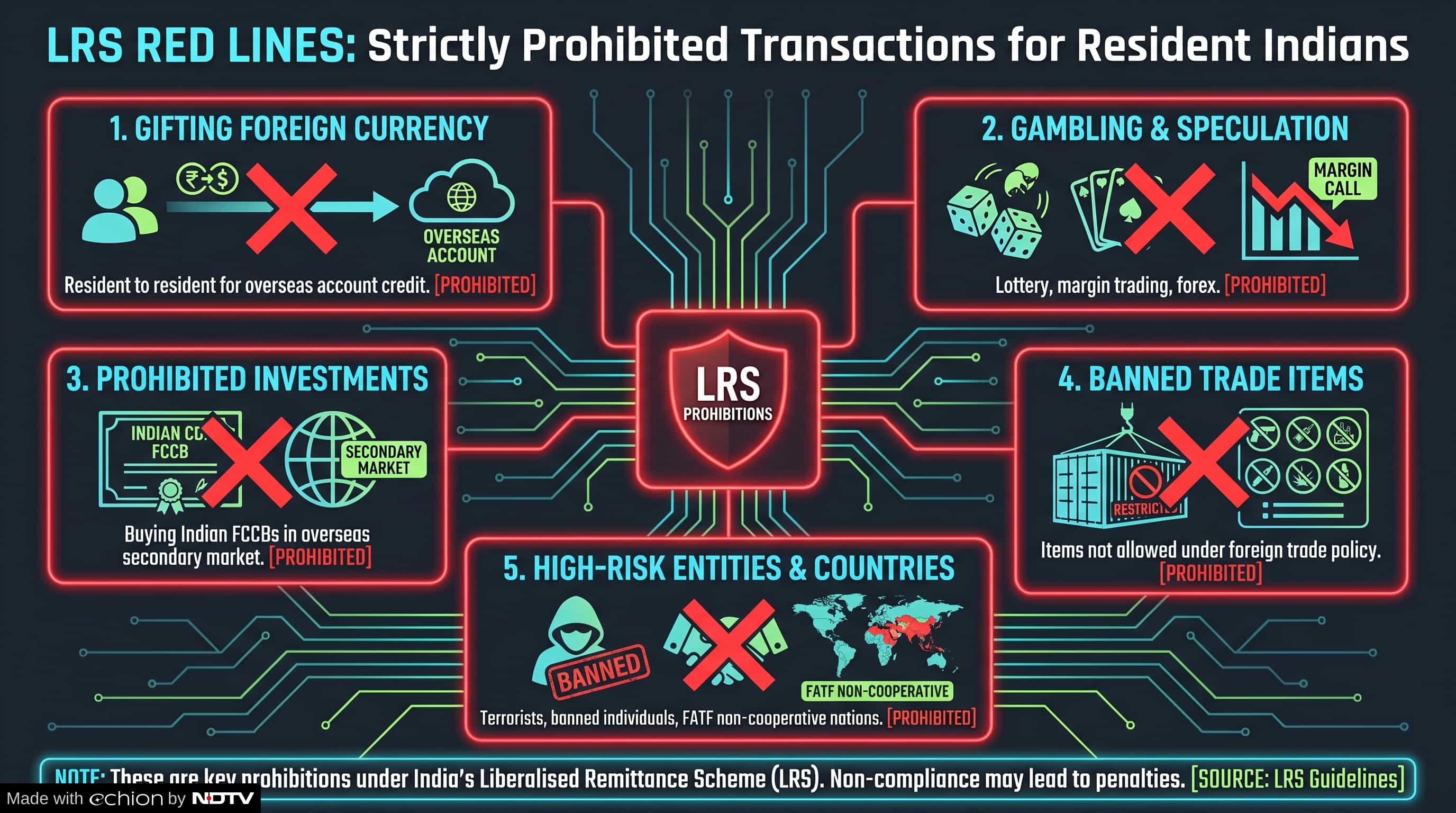
The following transactions are strictly prohibited under the LRS:
- A resident Indian cannot gift foreign currency to another resident Indian for the credit of the latter's foreign currency account held abroad under LRS.
- Remittances for buying lottery tickets, gambling, speculating, trading (involving margin trading and/or margin calls, or forex trading)
- Prohibited investments, such as purchasing Foreign Currency Convertible Bonds (FCCBs) issued by Indian companies in the overseas secondary market.
- Buying prohibited items that aren't allowed under India's foreign trade policy
- Transacting/sending money to banned entities, individuals involved in terrorist activity or countries [identified by the Financial Action Task Force (FATF) as non-co-operative countries and territories]
Keep in mind, LRS is available only to ‘resident individuals' (including minors). It does not apply directly to NRIs. An NRI can remit funds abroad using an NRE account (fully repatriable) or an NRO account (up to $1 million/year for income earned in India).
LRS is also not available to corporates, partnership firms, HUFs, Trusts, etc.
ALSO READ: Index Funds vs Exchange-Traded Funds: Which One Should You Consider?
How Much Is The Limit Under LRS?
The maximum limit under the LRS currently is USD 250,000 per financial year (April-March) when remitting money outside India.
Over the last decade, the limit has doubled.
How Can You Send Money Abroad Under LRS?
As per the RBI, outward remittances can be paid by issuing a demand draft in the individual's or the beneficiary's name. Individuals can also open, maintain and hold foreign currency accounts with a bank outside India for making remittances under LRS without prior approval of the RBI.
The foreign currency accounts may be used to process all transactions connected with or arising from remittances eligible under the LRS.
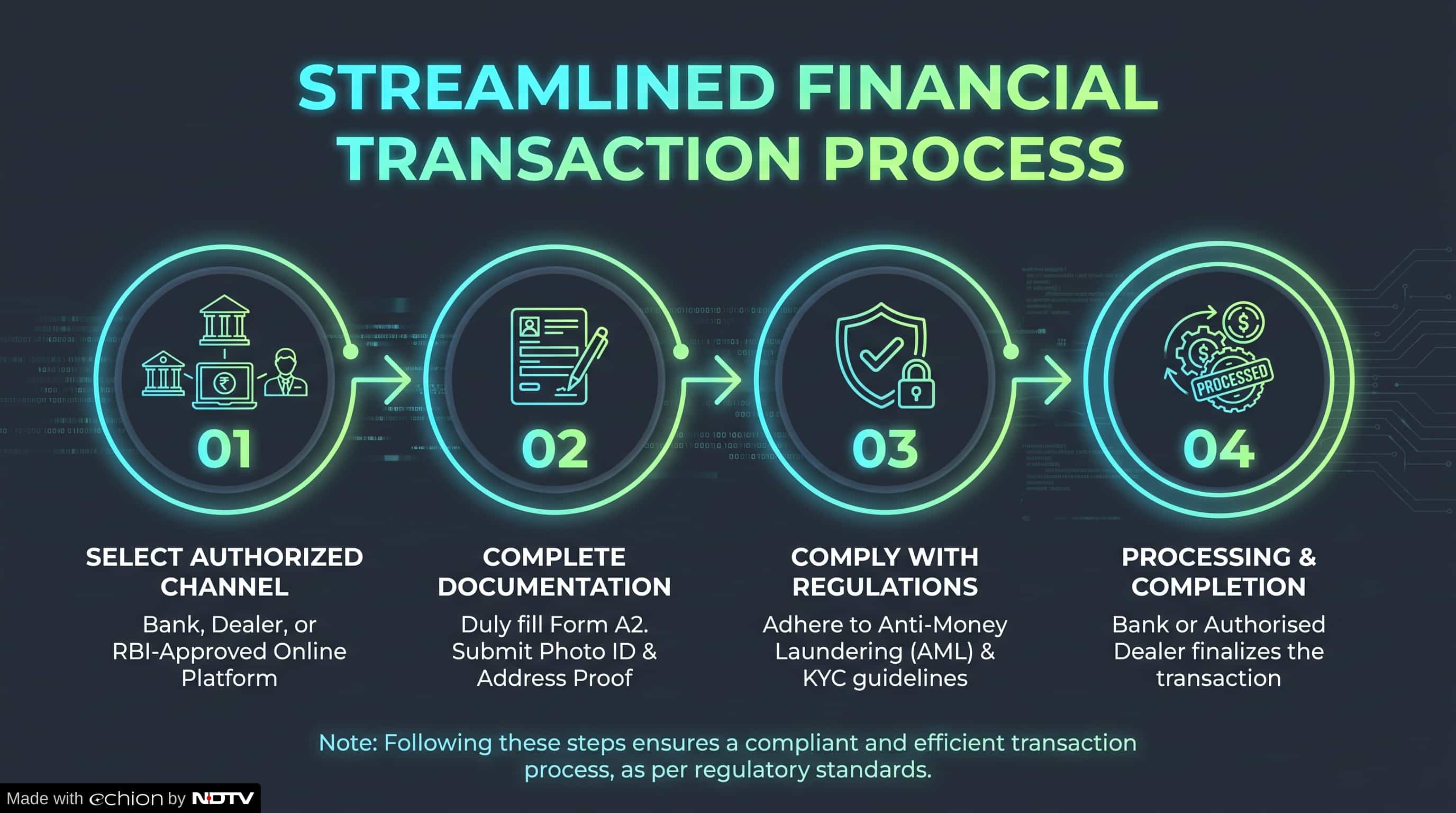
So, here are some steps to follow:
- Approach a bank, authorised dealer, or RBI-approved online platform
- Duly fill Form A2
- Submit address proof and a photo identity document
- Comply with the Anti-Money Laundering and KYC guidelines
Once all this is done, the bank or authorised dealer would process the transaction. The bank will debit the equivalent amount in Indian Rupees from your account and convert it into the desired foreign currency. You will be provided with a SWIFT copy (often an MT103 document).
Note that under the LRS, banks are not allowed to provide any credit facilities to resident individuals to facilitate capital account remittances.
Charges Levied For Remittance Under The LRS?
Most banks, usually, charge a flat fee of Rs 250-1,500 per transaction. In comparison, the digital or RBI platforms are a bit cheaper.
The charges cover the SWIFT (Society for Worldwide Interbank Financial Telecommunication) charges.
Besides, there is a forex mark-up or margin (spread) ranging between 1-4% of the total transfer value, depending on the bank or authorised dealer you are transacting with.
In addition, a 18% GST is applied to the service fees and the deemed value of currency conversion, not the principal amount.
ALSO READ: Do You Rely On AI Tools And Finfluencers for Investment Advice? Read This
Tax Rules on LRS?
Tax collection at source (TCS) applies to remittances abroad. However, there is no TCS up to Rs 10 lakh per financial year in most cases (except for overseas tour packages).
However, when the Rs 10 lakh threshold is crossed, TCS is applicable, as follows:
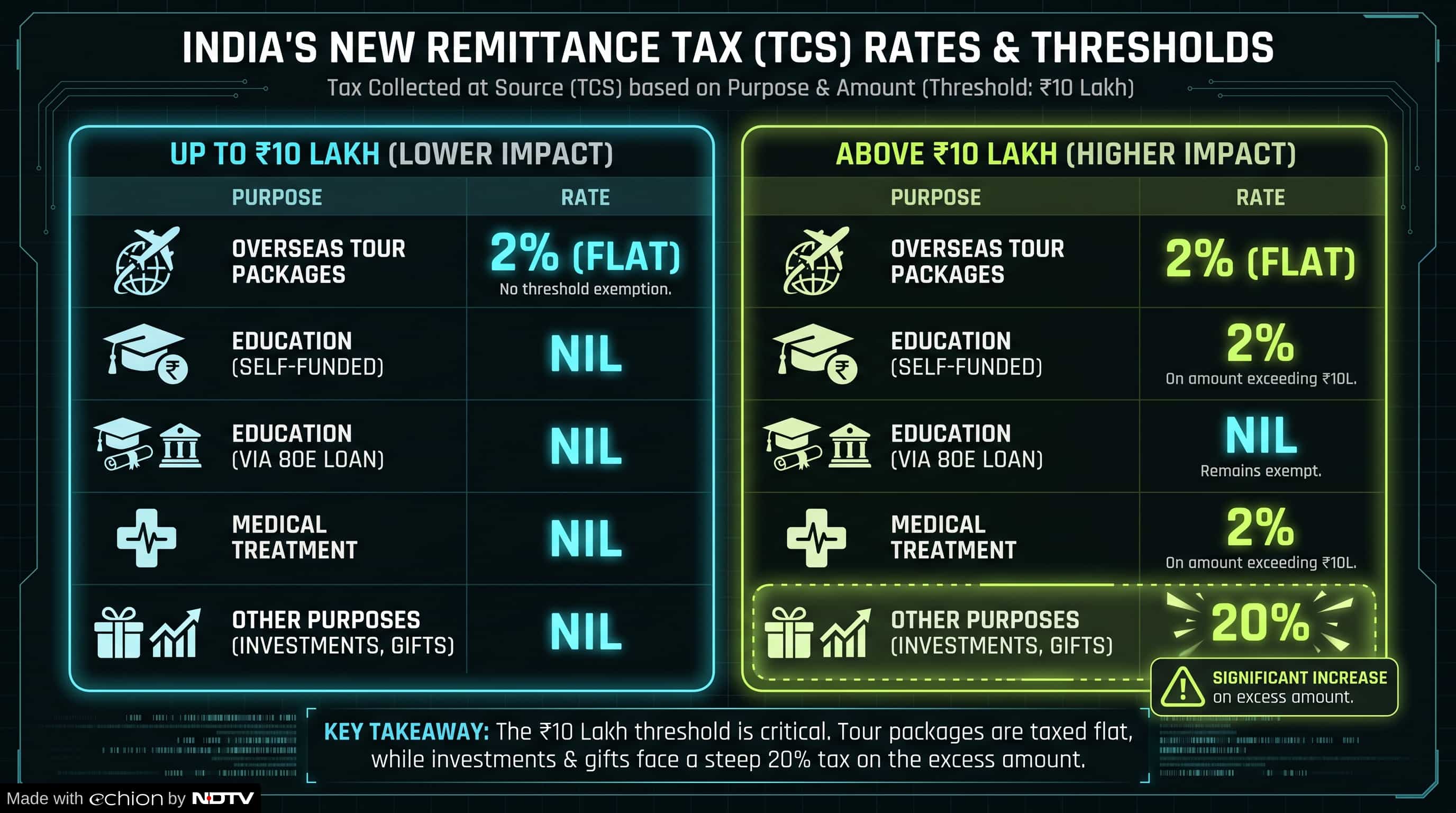
On tax collection at source, the collecting party is bound to issue a TCS certificate in Form 133 (formerly 27D) as proof of tax deposited within 15 days of the quarterly TCS statement filing, as per Section 395(4)(a) of the Income-tax Act, 2025.
This helps you claim TCS credit when filing your income-tax returns.
To sum up…
The LRS is an effective medium for transferring money abroad for any purpose, as long as it is not on the exclusionary list. It provides a structured framework to send money abroad. Use it wisely.
Happy banking!
ALSO READ: How NRIs Can Sensibly Invest In GIFT City Funds And Mutual Funds
Essential Business Intelligence, Sharp Market Insights, Practical Personal Finance Advice, Daily Fuel, Gold and Silver Prices and Latest Stories — On NDTV Profit.