Fifty years after America withdrew from South Vietnam in April 1973, losing its first war, which lasted eight years, America is quitting Afghanistan. The final withdrawal deadline of September 11 will mark the worst terrorist attacks on U.S. soil, which claimed 2,977 lives. In losing its second war, at least 2,352 Americans died, excluding private contractors and suicides, and $2.26 trillion dollars were spent including the cost of veterans' care and interest on debt. Between 66,000-69,000 Afghan troops, plus at least 47,245 Afghan civilians, died. Over 2.7 million Afghan refugees fled, especially to Iran, Pakistan, and Europe.

What Endures?
To ask whether America's longest war was worth it depends more on the future than the past.
Were the deaths and dislocations in vain, the dollars pissed away? Is Matthew's Gospel 26:52, that violence only begets violence, the grim past truth that will determine the future?
Also Read | Layoffs Are Rising In Tech, But These Skills Are Helping People Unlock Better Pay
No. There's more.
The logical mind and compassionate heart collaborate to look into the eyes of Afghan veterans—some of whom are this columnist's former students—and say: “You and your fallen comrades mattered. You all persevered to light a better path.”
The core argument concerns durable outcomes.
What kind of Afghanistan is America looking at across the next decade? Likewise, what kind of Afghanistan can the nations to its east – Pakistan, India, and China – expect? The answer is no less, or more, hopeful than the reality that for all its mistakes, the U.S. did its best, but cannot control, nor is responsible for, what happens next in Afghanistan and its neighborhood.
“Time will tell whether what you tried to leave behind will endure. The answer is ‘maybe' on your four deliverables.”
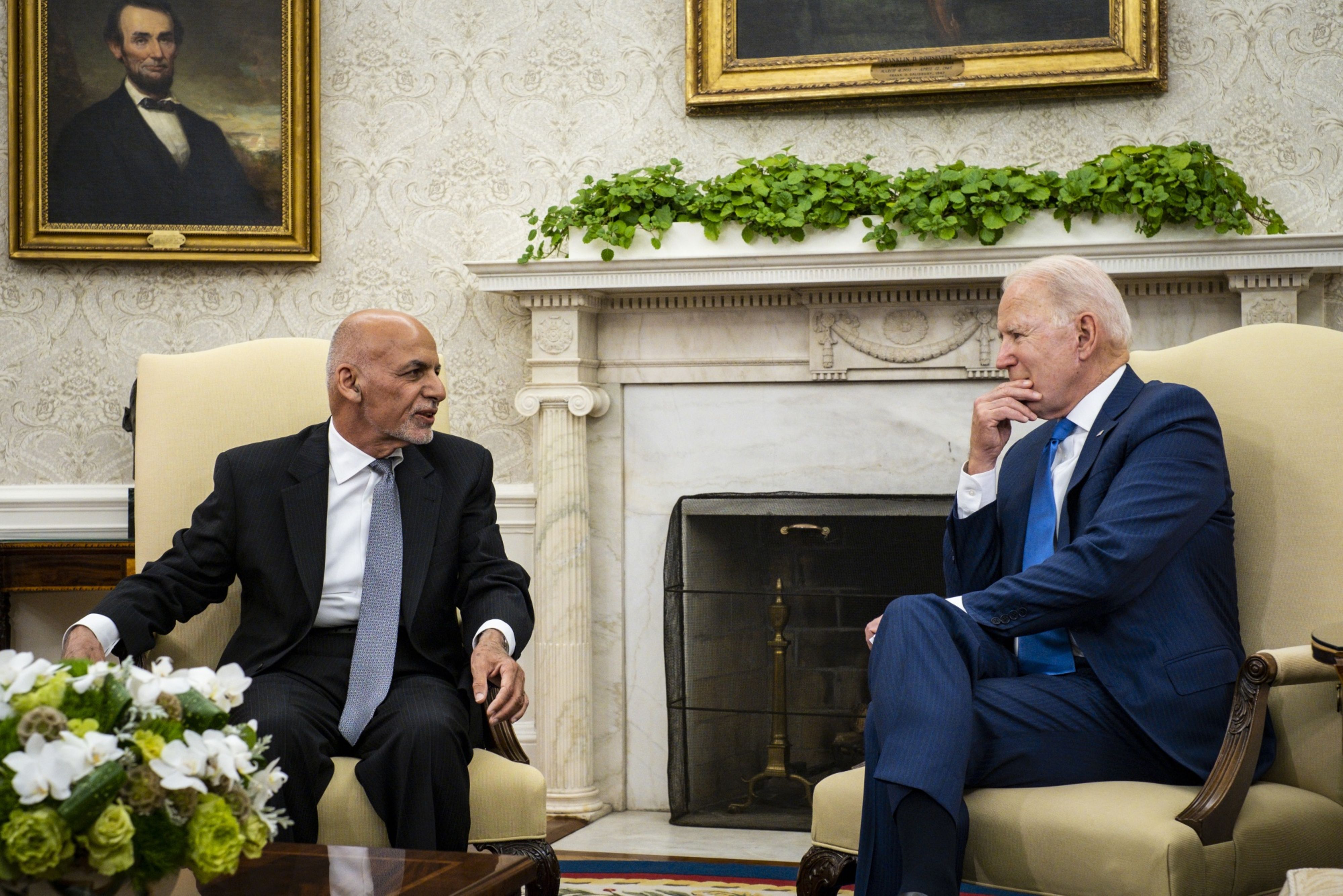
Afghan President Ashraf Ghani, with U.S. President Joe Biden, in the Oval Office of the White House in Washington, D.C., on June 25, 2021. (Photographer: Pete Marovich/The New York Times/Bloomberg)
Security?
War in Afghanistan was not inevitable; it was a war of choice, not of necessity. U.S. President George W. Bush opted to respond to the 9-11 terrorist attacks, which were an act of war, with war. The President could have characterised the horror as a law enforcement problem. He chose to invade Afghanistan to dislodge the Taliban from power because they refused to hand over Osama Bin Laden. He could have resisted the war drums and focused on capturing Bin Laden using Special Operations forces and intelligence officials. Instead, troop levels surged to 100,000 between August 2010 and May 2011 (Here's a detailed timeline of the 20-year war).
U.S. Navy Seals got their man where everyone suspected he would be after the Tora Bora debacle – in Pakistan, on May 2, 2011. But Mission Creep crept in. Indeed, it was embedded in the name ‘Operation Enduring Freedom'. Bin Laden's death was not a prompt to leave but a temptation to continue nation building.
Hamid Karzai, America's avatar and Afghan President from December 2001 to September 2014, didn't build back better. WikiLeaks cables affirmed what local and international observers saw: a corrupt regime headed by a weak, indecisive, and paranoid leader dependent on warlords for power.
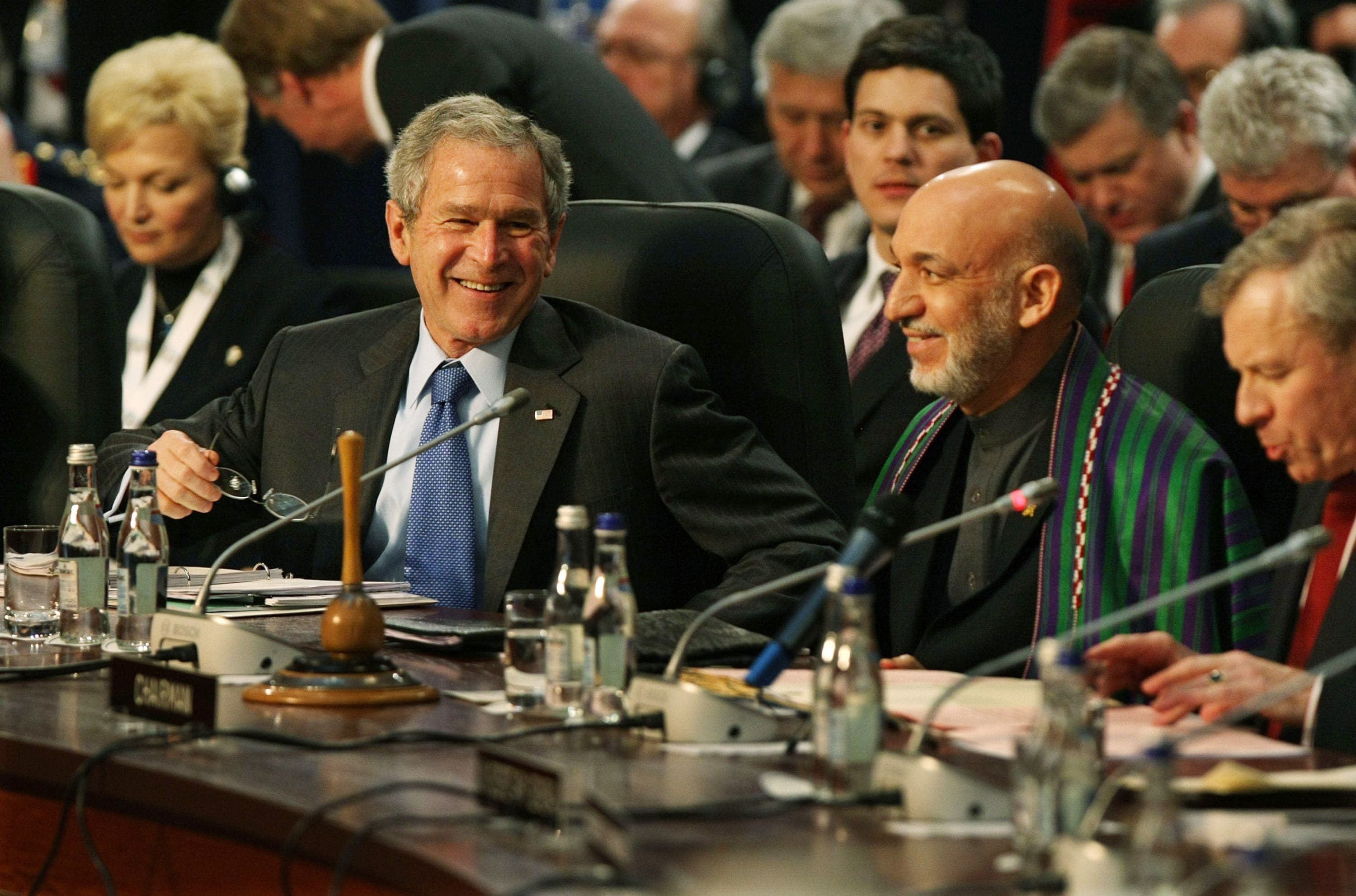
U.S. President George W. Bush, with Hamid Karzai, Afghanistan's president, during the NATO summit in Bucharest, Romania, on April 3, 2008. (Photographer: Suzanne Plunkett/Bloomberg News)
Astute history students contemplated ominous parallels to South Vietnam's Nguyễn Văn Thiệu, Cambodia's Lon Nol, and Lao's Savang Vatthana.
The enemy of those American-backed puppets – the Viet Cong, Khmer Rouge, and Pathet Lao, respectively – wouldn't go away. The puppets did. Nor has or will the Taliban.
In its rationalist pursuit of security, then, as now, America misread adversaries as only ideological extremists, be it Islamist or Communist. In truth, they also were nationalists and anti-colonialists: they wanted all foreign troops out of their country, period.
So, Central Asia in 2021, or maybe 2022, will be like Indochina in 1975. Turmoil will continue, after the last American troops—other than those protecting the Embassy in Kabul—leave. The Taliban will run the country within 6-18 months. Once it does, ‘peace', narrowly defined as the absence of war is likely, but ‘security', meaning a stable, predictable, rule-of-law society, is uncertain.
Security will depend on whether the Taliban is willing and/or able to:
disavow links to terrorist groups that threaten American interests worldwide.
restrain the Pakistani Tehrik-i-Taliban from killing – among others – Chinese businesspeople, as allegedly occurred on July 14.
Will China have sufficient leverage over Pakistan through the Belt and Road Initiative's $50 billion China-Pakistan Economic Corridor to compel Pakistan to crack down on Islamist extremism? No. That's because Pakistan doesn't have the wherewithal, and maybe not the inclination, to listen.
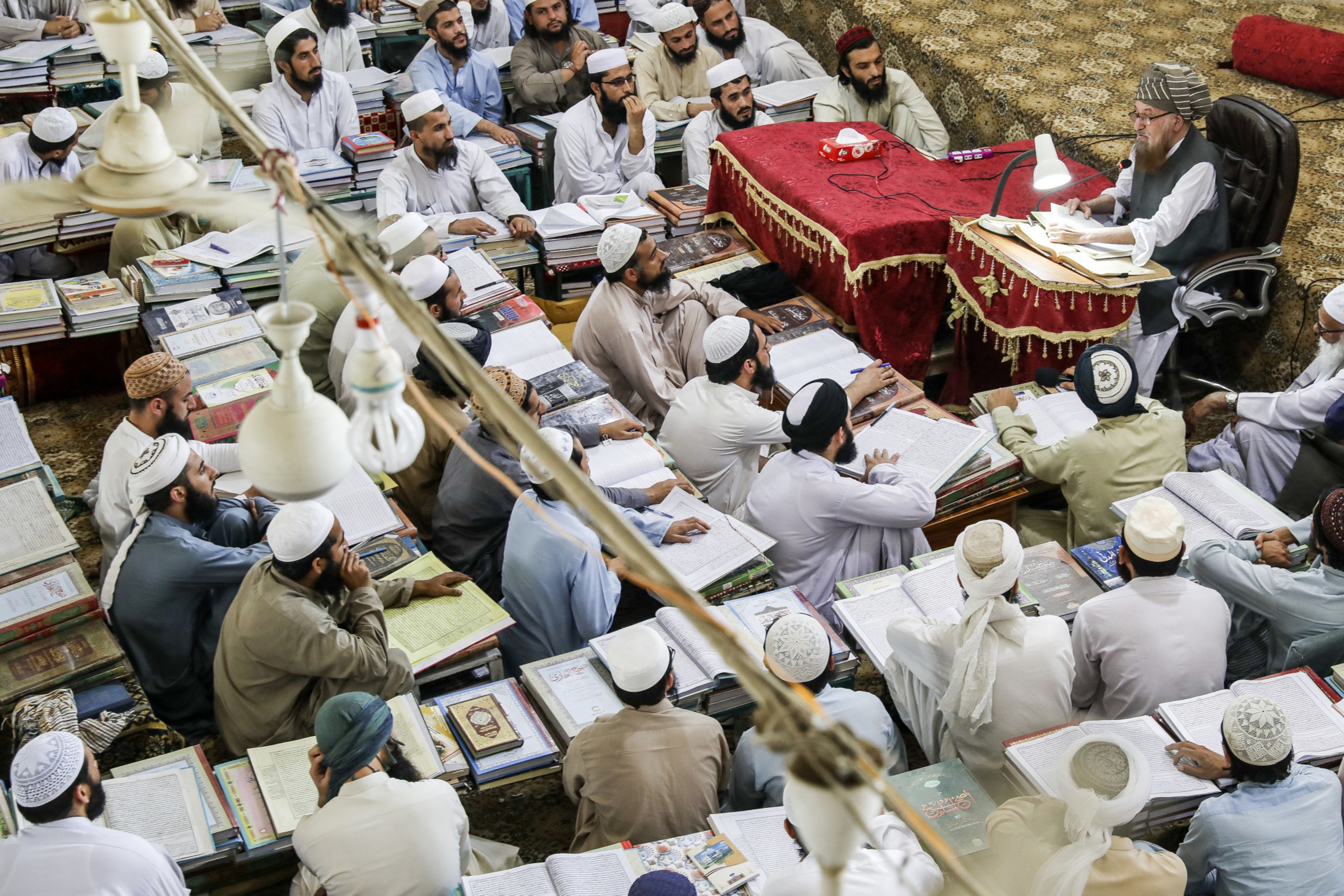
Islamic cleric Maulana Samiul Haq, who taught the Taliban's leaders, and called on China to play a larger role in Afghan negotiations, at a seminary in Khyber Pakhtunkhwa Pakistan, on Oct. 1, 2018. (Photographer: Asad Zaidi/Bloomberg)
To be sure, the Chinese Communist Party's Global Times, said “[China] will not only provide the necessary support and assistance if Pakistan's strength is insufficient, China's missiles and special forces could also directly participate in operations to eliminate threats against Chinese in Pakistan with the consent of Pakistan. We will set an example as a deterrent.”
Really?
China has no idea how to console mothers whose sons – their only son thanks to China's 1980-2015 One Child Policy – might return from the AfPak theatre in (God forbid) a body bag. No Great Firewall will block their grief and anger, nor defer for 20 years them and surviving Chinese veterans from asking, “Was it worth it?” The hypocrisy of the CCP's amorally practical foreign policy will be exposed: 70 years of non-interference in the internal affairs of other countries will perish in Kandahar and Khyber Pakhtunkhwa.
Meanwhile, American interests will be served.
China will incur the human and economic costs of trying to contain instability on its borders, while the U.S. pivots from Central Asia to the Indo-Pacific region to confront China.
China hopes the Afghan #Taliban will put Afghanistan's national interests first, uphold commitment to peace talks, embrace the goal of peace, create a positive image and adopt an inclusive policy. pic.twitter.com/GVQKz2kTma
July 28, 2021Democracy?
Nearest to Afghanistan with a vibrant democracy boasting on-time elections is India. But, the Taliban didn't look to India for civics lessons when it held power between 1996-2001. It won't do so once it's back in Kabul. The religious extremism stoked by some current Indian leaders, which trumps Hindus over Muslims, makes Indian ‘democracy' hardly exemplary for the Taliban.
If only Pakistan could be Afghanistan's lodestar.
Alas, Pakistan systematically over-estimates its leverage with its western neighbour. Moreover, 74 years after Partition, it's not clear what vision of Muslim-majority democratic governance Pakistan offers. Is it what the founder, Muhammad Ali Jinnah, is said to have suggested: a secular country with an Islamic identity? Or, is it what Prime Minister Imran Khan dreamt of: “In my vision, I dreamed of making Pakistan a welfare state like Medina. My vision is based on the lessons of history, and there is a reason we should learn from history”?
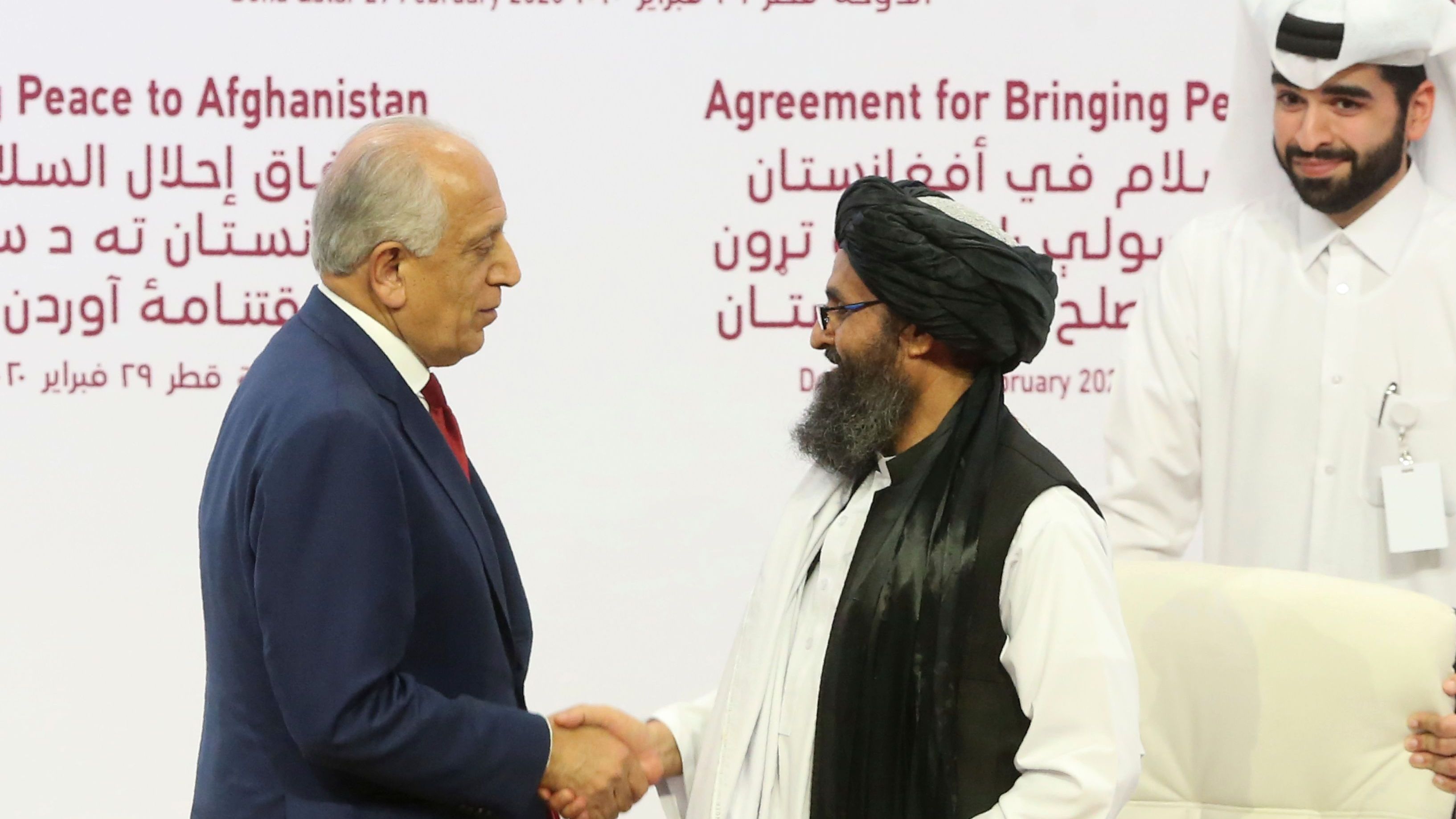
Even if regional role models existed, it's reasonable to infer the Taliban has no interest to do the needful for a flourishing democracy, namely, compromise.U.S. peace envoy Zalmay Khalilzad and Mullah Abdul Ghani Baradar, the Taliban group's top political leader after signing a peace agreement in Doha, Qatar, on Feb 29, 2020. (Photograph: PTI)
The February 2020 U.S.-Taliban peace agreement envisions an intra-Afghan dialogue and negotiations between the Taliban and the American-backed Afghan government. But, the Taliban never committed not to fight government forces – only to back off against foreign forces, if they decamp on time. Steadily since that deal was signed, the Taliban have gained control of up to 85% of the country, despite being outnumbered against Afghan security forces, 75,000 versus 300,000.
After it prevails, will the predominantly Pashtun Taliban lay down its arms, heal tribal divisions, and invite erstwhile battlefield targets to form a coalition government? That would be consistent with the bloodless conquest by the Prophet Muhammad (Peace Be Upon Him) of Mecca, a script from 630A.D. that helped reunify the Hejaz after the battles that followed the 622 A.D. Hijra.
Or, maybe the Taliban will follow its 1997 script: it tortured to death the former President Mohammad Najibullah, and fought to the death Ahmad Shah Massoud's Northern Alliance of non-Pashtun Tajik, Uzbek, and Ḥazāra.
Tolerance?
Mission Creep entailed transformation to religious moderation. Buddhist statutes wouldn't be blown up. Burkhas wouldn't be ubiquitous. The Jan. 23, 2004, Constitution of Afghanistan, which the 502-diverse member Loya Jirga (Grand Assembly) approved by consensus, would be enforced.
So, on the one hand, per Articles 1-3, Afghanistan would be an ‘Islamic Republic' with Islam as its religion, and no law would “contravene the tenets and provisions” of Islam.
But, on the other hand:
Per Article 2, “[f]ollowers of other faiths shall be free within the bounds of law in the exercise and performance of their religious rights.”
Per Article 7, Afghanistan would adhere to the United Nations Universal Declaration of Human Rights, Articles 18-19 (“everyone has the right to freedom of thought, conscience, and religion” and of “opinion and expression”) of which sum to the right to proselytise.
Per Article 22, gender equity would prevail, because “[t]he citizens of Afghanistan, man and woman, have equal rights and duties before the law.”
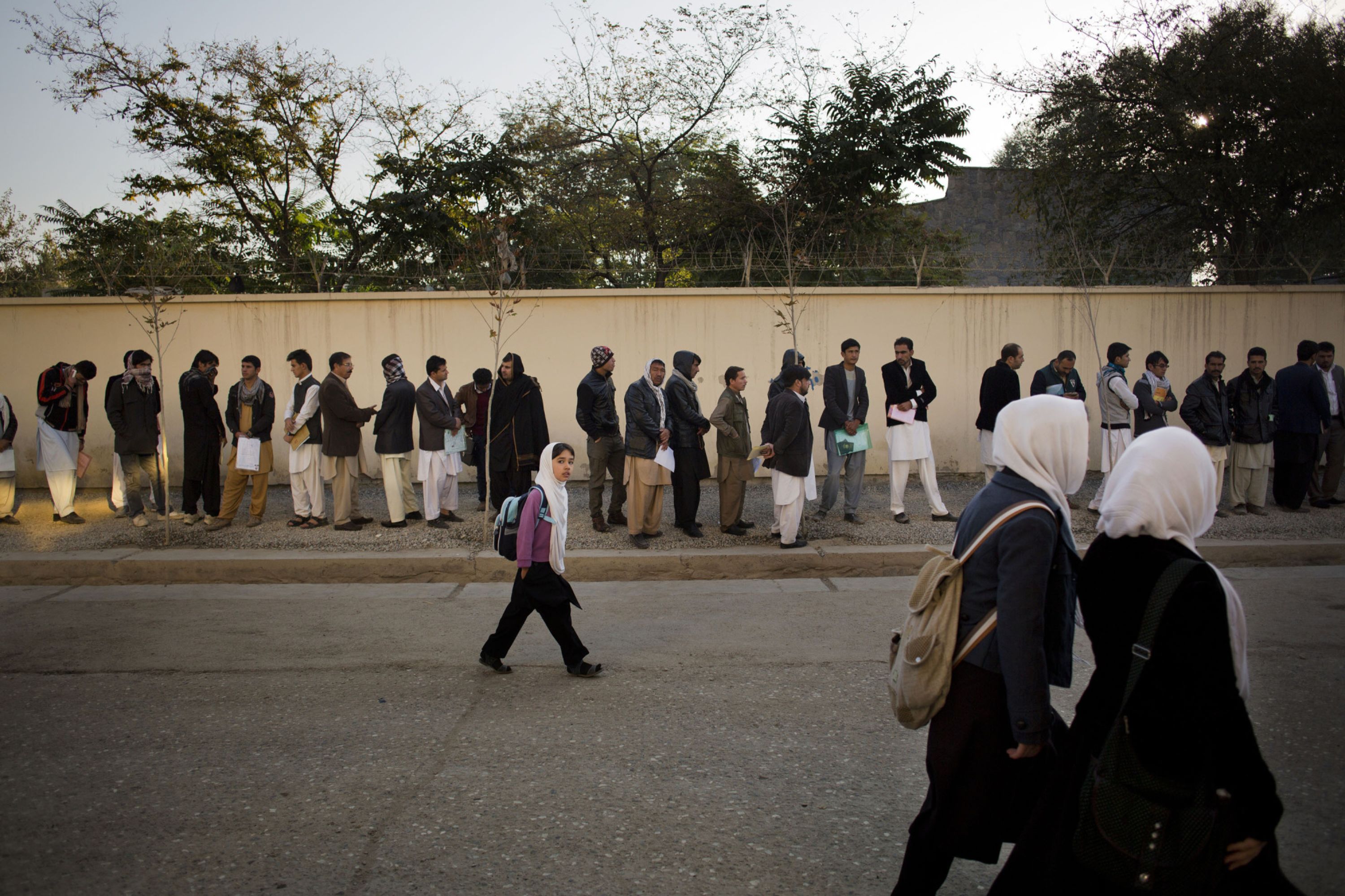
Yes, in March 2021, on the 20th anniversary of the destruction of the monumental Bamiyan Valley Buddha statues, Afghans celebrated “A Night with Buddha.” The statues were rebuilt – but as 3D holographic projections. And yes, in theory, girls can go to school in Afghanistan – but with only 16% of schools being girls-only, 17% of girls marrying before age 15, and women teachers in short supply, only about one-third of them make it to class.
School girls walk past Afghans waiting in line to apply for passports, in Kabul, on Oct. 31, 2015. (Photographer: Victor J. Blue/Bloomberg)
So, no, under Taliban rule, don't expect the Constitution to be applied in an authentically Islamic manner.
Rather, the Taliban likely will continue its political literalist Salafism, i.e., its narrow-minded, ideologically purist method of reading Islamic Law. It will emphasise selected passages from the top two Sharī‘a sources, the Holy Qur'ān and Tradition (Sunnah) of the Prophet (PBUH), but de-emphasise two vital secondary sources, analogical reasoning (qiyās) and consensus (ījma‘).
Forget about it reopening the door to ijtihād (independent reasoning). Buddhists and women, beware.Growth?
If the Taliban and PM Khan agree on one point, it's that they don't want to model their respective economies after the Asian Tigers. That's, well, dumb.
One of the ironies of the Afghan War is ‘Taliban' means ‘students' in Pashto and Farsi. Astute economics students know Hong Kong, Korea, Singapore, and Taiwan all escaped the middle-income trap to grow via sustained increases in per capita GDP into advanced, post-industrial economies with high U.N. Human Development Index metrics. The Tigers are distinct. Contrary to the stereotype, they don't all look alike; rather, each has kept its unique stripes and heritage, while differentiated in its innovation. They're models for economic progress with cultural preservation.
Astute students also know Afghanistan could have benefitted from the greenbacks America spent. Seeing the legal, political, and war risk that doomed America's expenditures, China won't dare invest nearly as much through its BRI. With no major public investment from overseas, private capital won't flow to Afghanistan. So, unlike the Tigers, which benefitted from private capital inflows, the Taliban are unlikely to expand labour- or capital-intensive industries, and forge regional production networks.
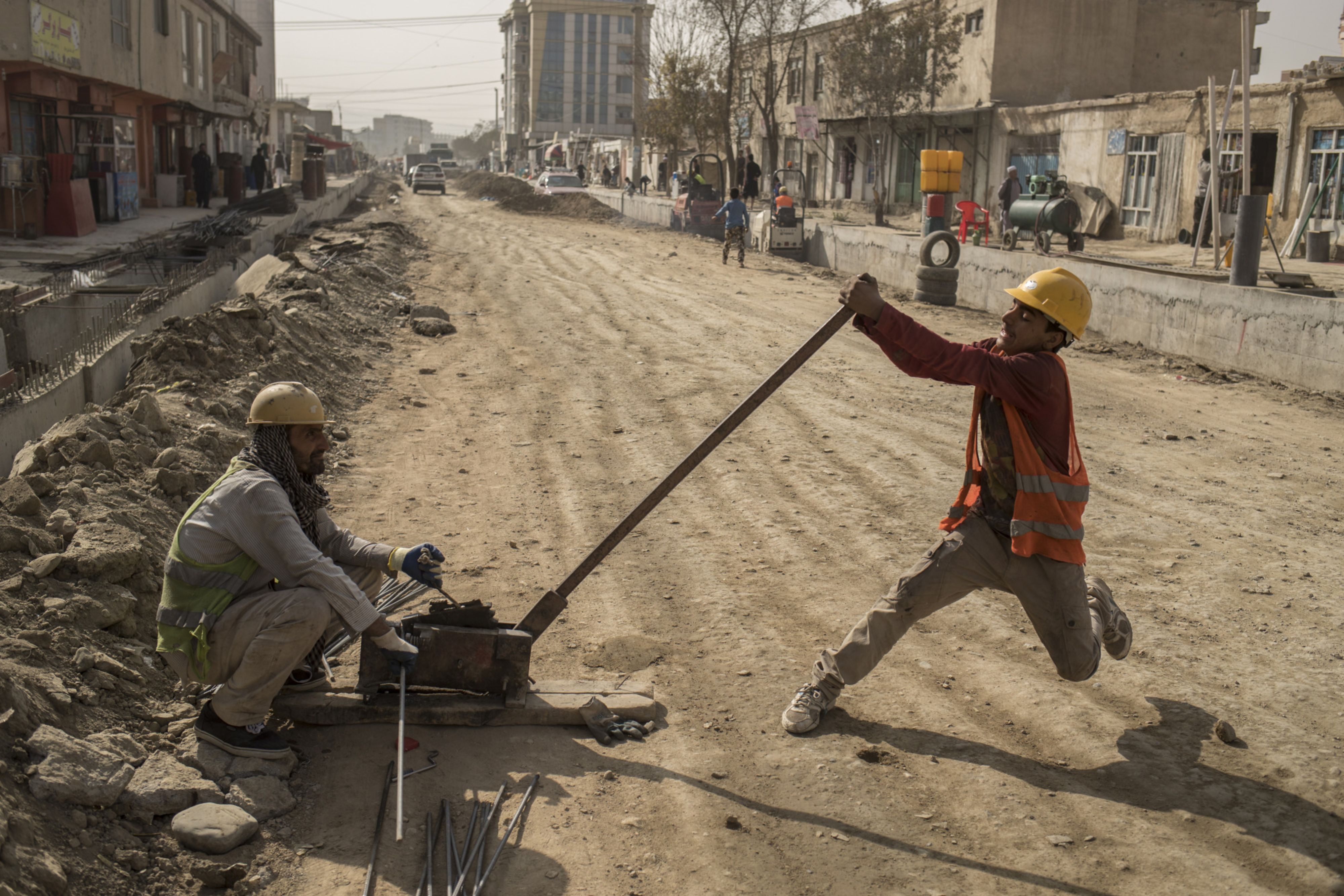
Count on Afghanistan being a least developed country until the Taliban lives up to their name.Contractors bend a piece of iron rebar while working on a street under construction in Kabul, on Nov. 5, 2017. (Photographer: Victor J. Blue/Bloomberg)
Hope
“Was it worth it? It's a big ass question,” said U.S. Special Operations Forces Marine Raider Jason Lilley. “A hundred percent we lost the war. The whole point was to get rid of the Taliban and we didn't do that. The Taliban will take over. I don't think one life was worth it on both sides.”
This noble veteran is right to be disillusioned about being sent to what was a graveyard for the British Empire in 1842 and Soviet Empire from 1979-1989. He's right to conclude that “We should avoid war at all costs,” and advise “don't rush into the racket of war, into the machine of making money, contracts. A lot of people made a lot of money off of this.”
Hopefully, he and his colleagues will take pride in the truth that they offered the chance of peace, security, democracy, tolerance, and growth. Theirs was a better example than the British or Soviets gave, and a better one than China, Pakistan, or India can give. And they need not surrender a hopeful long-view: even the most recalcitrant of enemies, be they in Indochina or Central Asia, might one day reform and become friends.
Raj Bhala is the inaugural Brenneisen Distinguished Professor, The University of Kansas, School of Law, Senior Advisor to Dentons U.S. LLP, and Member of the U.S. Department of State Speaker Program. The views expressed here are his and do not necessarily represent the views of the State of Kansas or University, Dentons or any of its clients, or the U.S. government, and do not constitute legal advice.
The views expressed here are those of the author, and do not necessarily represent the views of BloombergQuint or its Editorial team.
Essential Business Intelligence, Sharp Market Insights, Practical Personal Finance Advice, Daily Fuel, Gold and Silver Prices and Latest Stories — On NDTV Profit.