Scene I: England, 1679
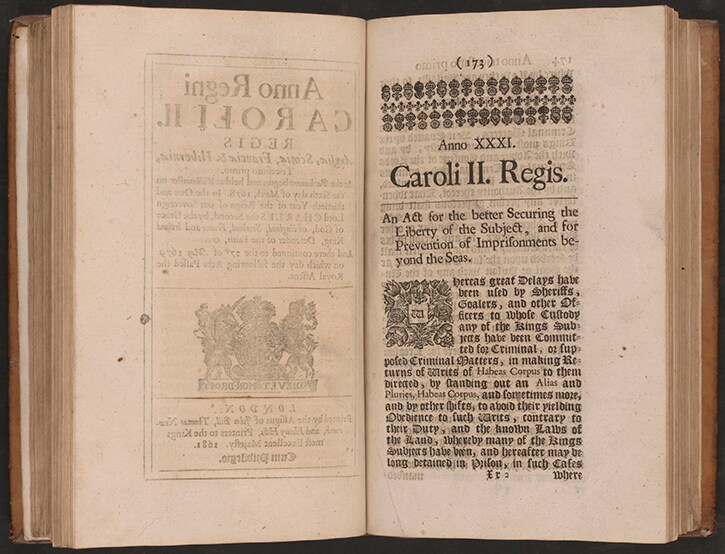
On a lazy spring Saturday in 1679, King Charles II gave his assent to the Habeas Corpus Act, 1679. The background was this: his father, Charles I, was a profligate ruler who depended on forced loans from his knights to survive. When Darnel and four other knights refused to give these ‘loans' to Charles I in 1626, they were imprisoned. They challenged their imprisonment in court, but were told that the King's fiat was sufficient justification for their imprisonment. In response, the Petition of Right was enacted in Parliament in 1628 – which Charles I approved due to financial considerations – which prohibited the king from arbitrary imprisonment.
But hopes that the writ of Habeas Corpus would now be an effective check on the king were misplaced: after Charles II became king, Lord Chancellor Nottingham would simply refuse to hear petitions for issue of the writ unless they were within specifically defined legal sittings. All the king had to do, then, was to ensure that he ordered his detentions when the courts were not sitting. This led to the enactment of the Habeas Corpus Act of 1679.
Scene II: Australia, 2017
One of the conditions of eligibility for becoming a senator in Australia was that the candidate ought not to be a dual citizen. On July 25, 2017, Matt Canavan, a minister in the Australian government resigned. It had emerged that Italian authorities had registered Canavan as a citizen of Italy, on account of one of his parents being a citizen of Italy. On Aug. 8, 2017, the Australian Senate decided to refer the question of Canavan's eligibility (along with several others who it turned out were considered as citizens-by-descent in other countries, without any active application by them to procure the second citizenship) to the Australian High Court. The decision of the High Court was delivered on Oct. 27, 2017.
Scene III, United Kingdom, 2019
On Aug. 28, 2019, Queen Elizabeth II made an Order-in-Council, proroguing the British Parliament. This was done on the advice—considered as binding on the Queen—of Prime Minister Boris Johnson, whose motives may have been to prevent Parliament from properly considering Brexit which was to happen on Oct. 30, 2019. The prorogation of Parliament was challenged in courts in England and Scotland. The prorogation was upheld by the England & Wales courts and was declared unlawful by the Scottish courts. Appeals were heard by the Supreme Court of the United Kingdom from Sept. 17 to Sept. 19, 2019, and the judgment of the Supreme Court was delivered on Sept. 24, 2019.
This was the moment Britain's top court ruled Boris Johnson's suspension of Parliament unlawful https://t.co/pHZiJzPicv pic.twitter.com/zmZeso2YUF
What do these instances indicate?
- First, that courts must act with great urgency in matters involving personal liberty.
- Secondly, where substantial questions of constitutional law of public importance arise, the judiciary must make all efforts to decide those questions with great promptness: certainly before the question becomes academic.
What, for instance, would have been the point of deciding on the validity of prorogation after Oct. 30, when Brexit would already have taken place? What would have been the point of deciding the fate of the Australian legislators after the relevant terms of Parliament were already over?
Scene IV: The Doctrine Of Judicial Evasion In India
The Indian judiciary, however, seems to have reached the conclusion that sometimes, the best way out is: ‘deciding by not deciding'. Constitutional scholar Gautam Bhatia calls this “judicial evasion”. Writing about the effects of judicial evasion, Gautam Bhatia said:
“…by refusing to decide, the Supreme Court effectively does decide – in favour of the Government... In effect, it takes the side of State power, against citizen… It is open to the Supreme Court to do so. But if that is what it is doing, then it ought to have the moral courage to defend its position in a reasoned judgment… Once the Supreme Court decides, then its judgment can be engaged with, defended, criticised, its reasoning scrutinised closely, its positions critiqued... by simply refusing to hear and decide the case, where the consequences of non-decision are both terribly high and absolutely decisive, the Court only ends up abdicating its role as the organ of the State that is meant to stand between citizen and government power, and to keep the latter within its constitutionally-defined spheres…”
Nonetheless, it must now be said that the Doctrine of Judicial Evasion is firmly embedded in Indian constitutional law. The process began with constitutional challenges to pet policies of the government, where the doctrine may have been initially conceived.
- The Aadhar litigation was initially heard in September 2013 but delayed from time to time and finally decided only five years later. By then, Aadhar had become enmeshed with the lives of most people. Even if the Aadhar challenges were completely successful, going back to 2013 may have been entirely impossible.
- Demonetisation was announced on Nov. 8, 2016. Refusing interim relief, the issue was referred to a Constitution Bench. Any remedy (if demonetisation is held illegal) would be entirely impossible to achieve now.
- The electoral bonds case represents another example.
The doctrine then was quickly adopted and applied to disputes over federalism. The dispute between the Delhi government and the Union over the Lieutenant-Governor's powers is an example.
The first date of hearing in this case in the Supreme Court was Sept. 5, 2016. The ultimate judgment of the Supreme Court was delivered in February 2019. In a situation where the term of a government is five years, with elections in Delhi due in 2020, this is again a case of judicial evasion in taking up more than half that term. Of course, the doctrine was still in a nascent stage in 2016: if it were fully well-developed, the court could have ensured that a decision would have been taken only after 2020!
Events in Jammu & Kashmir now clarify that the doctrine applies to the right to life and personal liberty as well.The litigation arising out of the recent changes to Article 370 can be divided into three types:
- Habeas corpus petitions challenging the validity of detentions;
- Petitions pertaining to access to the access to communications and access to the High Court;
- Constitutional challenges to the changes made by Parliament on Aug. 5-6, 2019.
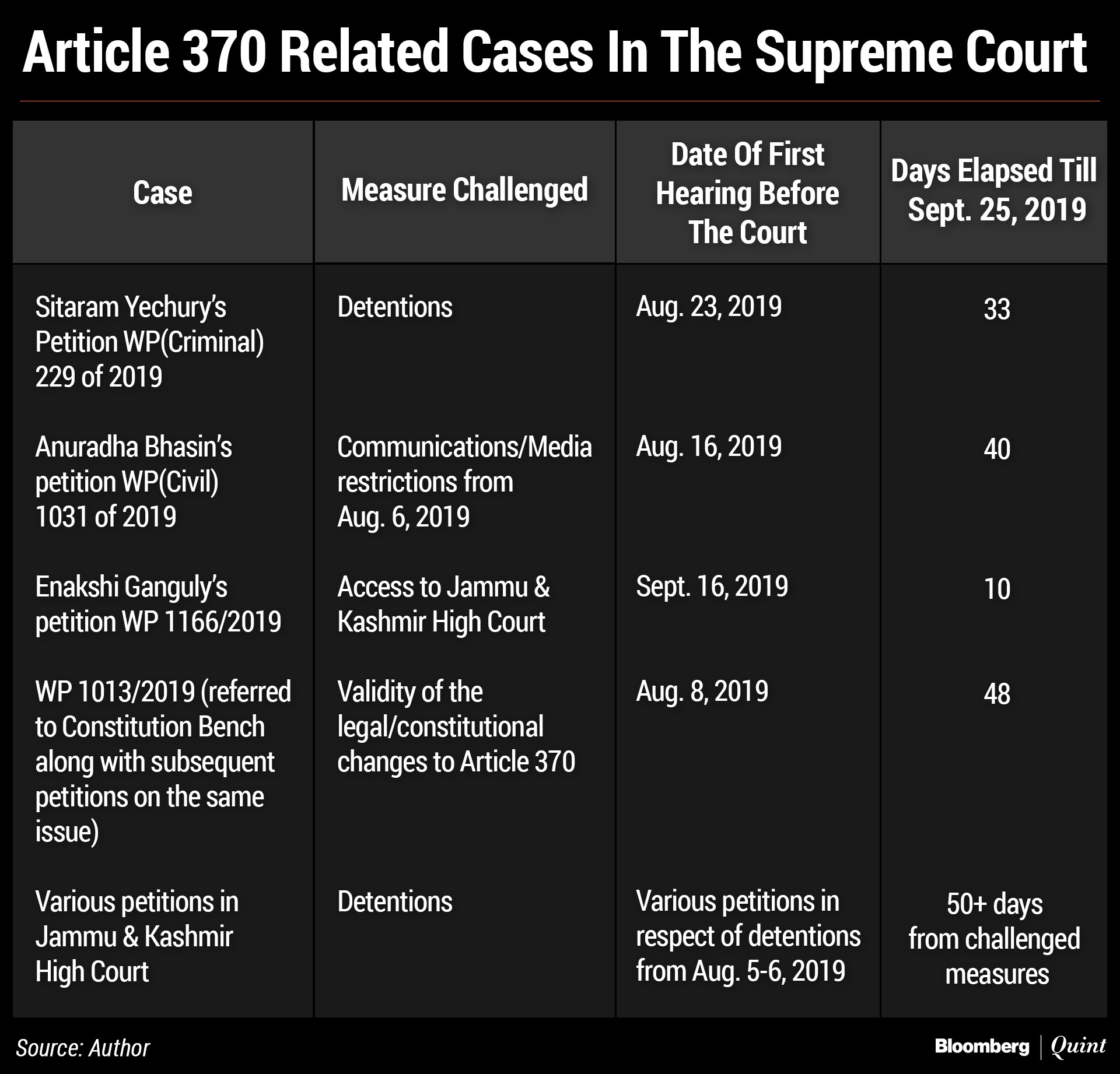
Insofar as the question of restoration of communications is concerned, in Anuradha Bhasin's petition, the first hearing took place on Aug. 16, 2019. On Sept. 5, an order was passed that the petition will be taken up for final hearing on Sept. 16. The court passed an order on Sept. 16 – not finally deciding the petition but adjourning it to Sept. 30, and in the meantime directing the state “keeping in mind the national interest and internal security” to “make all endeavours to ensure that normal life is restored.” The less said about this order, the better.
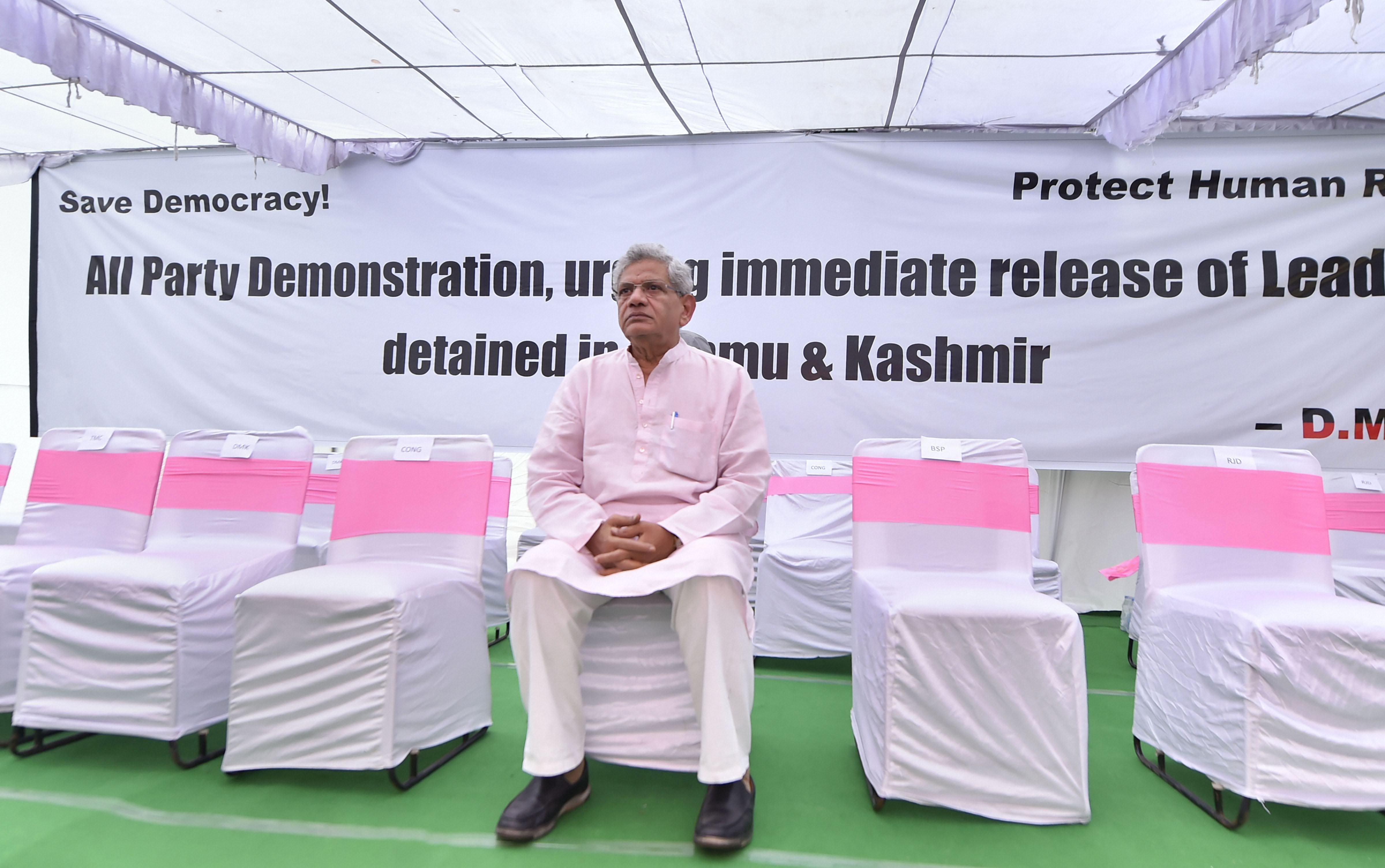
But Habeas Corpus – one would think that those are decided as a matter of the greatest urgency? A few days at most? Indeed: let us see the orders passed by the Supreme Court in one of the habeas corpus matters. A petition filed by Sitaram Yechury was mentioned for urgent hearing on Aug. 23, 2019. An order was passed, directing the petition to be listed on Aug. 26. It appears that the petition was taken up on Aug. 28. In a habeas corpus petition, one would simply assume that the court issues notice, seeks the grounds of detention, examines the validity and either dismiss the petition (if sufficient grounds for detention are made out) or set the detinue free.
But on Aug. 28, the Supreme Court passed a curious order. Sitaram Yechury was permitted to travel to Jammu & Kashmir to meet the detinue, but subject to an undertaking that he would not indulge in any other (i.e. political) act. Yechury was also directed to file a report on his return. The legal and constitutional basis of such an order is unclear to me and several others.
Why should the petitioner be graciously permitted to go to visit the detinue rather than the court simply adjudicating on the validity of the detention?On Sept. 5., notice was formally issued in the petition, and the detinue was permitted to be shifted to AIIMS, New Delhi, for medical treatment. The matter was next taken up on Sept. 16 and it was noted by the court that the detinue had been discharged from AIIMS. The detinue was permitted to go back to Srinagar and was graciously granted the liberty to move the Jammu & Kashmir High Court if he had any grievance about his movement in Srinagar. The petition was kept pending to decide on the validity of the detention which the detinue had suffered since Aug. 5, 2019.
One may consider that there is nothing wrong with how Yechury's petition was dealt with after Sept. 5. The validity of the detention has not been adjudicated for over a month; but, after all, the detinue can (it seems) move around in Srinagar. If there is any hindrance, the Supreme Court has expressly permitted him to approach the Jammu & Kashmir High Court. What can be wrong with such an order?
Well, to start with, the Jammu & Kashmir High Court does not seem to have covered itself in glory in dealing with habeas corpus petitions. According to an Indian Express report, there have been more than 250 petitions for habeas corpus filed in that High Court since Aug. 5; and it seems that none of those have been finally decided.
In a plea in the Supreme Court that there was difficulty in accessing the High Court, the Supreme Court did not consider the issue on the basis of the evidence which may or may not have been placed by the petitioners before the Supreme Court on affidavit. Instead, on Sept. 16, the Supreme Court “requested the Chief Justice of the High Court to submit a report”. It was also reported that the Chief Justice of India commented that the report of the Chief Justice of the High Court did not support the case of the petitioners regarding lack of access. Ordinarily, anyone making a factual averment in the courts must do it on affidavit, subject to perjury, and to cross-examination, if need be. But as this was a report from the Chief Justice, such technicalities apparently need not detain us. The CJI also reportedly considered visiting Jammu & Kashmir himself.
Ordinarily, judges should not place themselves in a position where they are material witnesses in proceedings pending before themselves nor give evidence in such cases.Of course, as this is a case presided over by one of the highest constitutional functionaries, such technicalities again need not detain us. To be fair, the order passed on Sept. 20 does not reflect the reported views of the CJI about the report of the Chief Justice of the High Court or the CJI's plans of visiting, but only states that “at this stage we do not consider it appropriate to offer any comments on the said report”.
Whether that report is available to the petitioners is unclear. As the plea in the Supreme Court specifically raised the issue of detention of children, the Supreme Court tasked the Juvenile Justice Committee of the High Court to examine the facts; and the case is now to be taken up next week. But there is no effective order on the matter of communications and access since Anuradha Bhasin's petition was first taken up in mid-August.
The courts have thus ensured that for a period of nearly two months, the question of the effect of the actions surrounding Article 370 on the rights of persons directly impacted on the ground are not actually adjudicated.The lessons from the times of Lord Chancellor Nottingham and Darnel's case appear to have been learnt well. It is now safe to say that the manner of dealing with these (habeas corpus and access/communication) petitions indicates that it is no answer to the Doctrine of Judicial Evasion to claim that some (so-called fundamental) rights may be affected in the process; and that the Doctrine can be usefully applied even in petitions under Article 32 of the Constitution of India.
The larger question is still open: in respect of the constitutional challenges to the recent changes to Article 370, there are serious legal grounds to question the validity of the Government's action. On Aug. 28, 2019, the issue was referred to a Constitution Bench of the Supreme Court to be heard in the first week of October. In this regard too, the Doctrine of Judicial Evasion points to a clear solution – the only thing which remains now is for the hearings of the Constitution Bench in October to be deferred just a little more. Perhaps already it is too late: how exactly do we reverse everything that has happened in the past two months? But just to be entirely sure that we are presented with a fait accompli, the courts can always give it some more time…
Mihir Naniwadekar is an advocate practicing at the Bombay High Court and the Supreme Court of India.
The views expressed here are those of the author and do not necessarily represent the views of BloombergQuint or its editorial team.
Essential Business Intelligence, Continuous LIVE TV, Sharp Market Insights, Practical Personal Finance Advice and Latest Stories — On NDTV Profit.