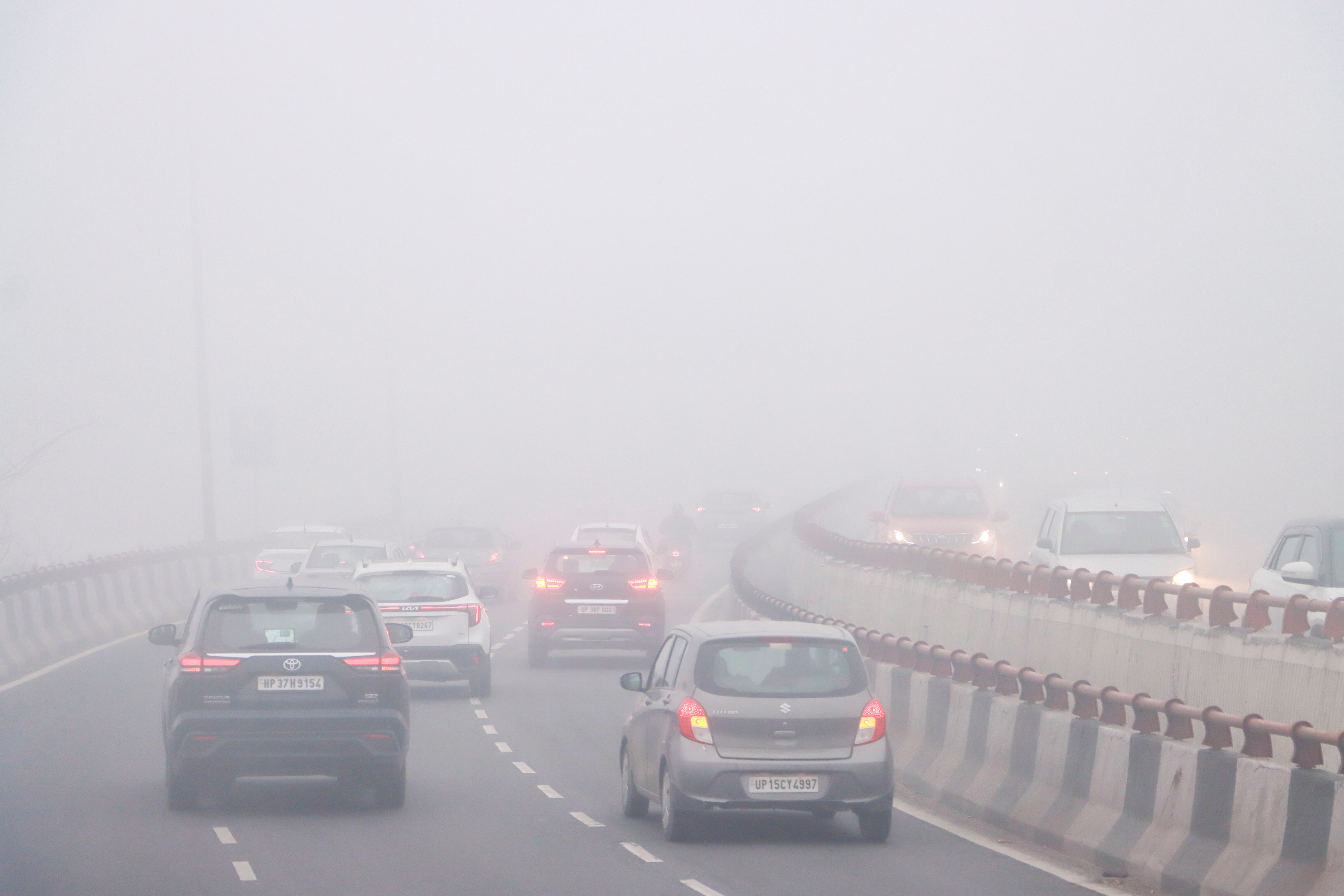
Dense winter fog on Friday disrupted flight operations in Delhi, leading to delays and cancellations. Due to the adverse weather conditions, the Indira Gandhi International Airport has activated the CAT III system, a landing requirement which allows aircraft to operate in very low visibility.
In the winter months, reduced visibility due to dense fog can impact flight operations. As a result, airports adopt advanced systems to help pilots land flights safely. However, such conditions can result in flight delays as advanced CAT III systems require trained pilots and appropriate runway equipment.
As a result, several airlines, such as IndiGo, SpiceJet, Air India, among others, have issued advisories, urging passengers to check the status of their flights before heading to the airport.
What Are CAT III Conditions?
CAT III refers to an Instrument Landing System (ILS) allowing flights to land in adverse weather conditions like fog, snow, or rain when visibility is very low. ILS guides pilots during the final approach to the runway. The system uses two radio signals. One provides horizontal guidance to keep the aircraft aligned with the runway. The other gives vertical guidance to control descent.
ILS has different categories. These depend on visibility, aircraft equipment, pilot training and runway facilities. Each category allows landing in lower visibility conditions.
Category I is the most basic system and requires a descent height of 200 feet and visibility of at least 550 metres. Category II allows landings at 100 feet descent height with a minimum visibility of 300 metres.
Category III is used during dense fog. Category IIIA allows descent heights below 100 feet with visibility of at least 200 metres. Category IIIB permits even lower descent heights, below 50 feet, with visibility as low as 50 metres. Category IIIC allows landings without any visibility limits. However, it is rarely used due to safety challenges.
To apply these systems, aircraft must be technically equipped. Only trained pilots can handle such special conditions, which leads to frequent flight delays during dense winter fog.
CAT IIIC, more advanced than CAT IIIB, allows aircraft to land in zero visibility and is available at airports like the US' JFK and London Heathrow in the United Kingdom.
Essential Business Intelligence, Continuous LIVE TV, Sharp Market Insights, Practical Personal Finance Advice and Latest Stories — On NDTV Profit.