This Indicator Suggests That Bonds Are More Attractive Than Equities
.jpg?downsize=1010:568 "This Indicator Suggests That Bonds Are More Attractive Than Equities")
The sharp rise in bond yields over the past few months has made existing fixed income investors nervous. But the fall in bond prices and the consequent rise in yields, may have made fixed income a more attractive asset class compared to equities. Particularly, since the earnings yield of NSE 500 companies is actually falling.
Earnings yield is the net profit for the trailing 12-month period, divided by market capitalization. In other words, it is the inverse of the price-to-earnings multiple. It reflects the total yield to an investor if the company distributes its entire annual profit as dividend.
Historically, or atleast over the last seven years since the Lehman Crisis, the earnings yield of NSE 500 companies and domestic bond yields have moved in the same direction. This trend has now broken.
Over the past two months, bond yields have risen but earnings yields have fallen further.
The yield on the 10-year government yield is currently at close to 7.4 percent, up from 6.5 percent at the end of December 2016. Over this period, the NSE 500 earnings yield has declined to a decade low of 3.5 percent from 4.3 percent a year ago.
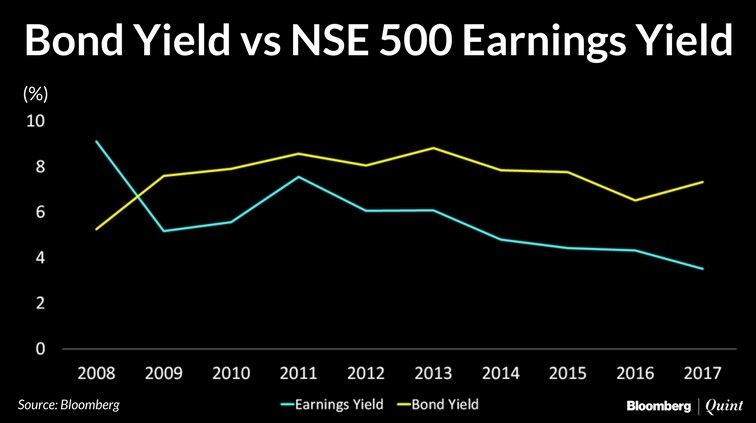
There are two ways to interpret this - that equities are overvalued or bonds are cheap. Either ways, investment professionals say that the divergence between bond yields and earnings yield has increased the relative attractiveness of debt.
“Currently equity markets have become expensive and debt has become significantly cheaper and there is more value in debt as compared to an year ago,'' said R. Sivakumar, head of fixed income at Axis Mutual Fund. He added that this gives investors a good opportunity to enter the debt markets.
Domestic flows into equities has been substantial last year. Given the relative performance of these two markets and valuations, this can be a good opportunity to reconsider how much you should allocate to both these asset classes.R. Sivakumar, Head of Fixed Income, Axis Mutual Fund
The yield on the benchmark 10-year Indian government bond rose 66 basis points in the September-December quarter. Yields jumped as markets factored in higher government borrowings and the possibility of rising inflation. Selling from domestic banks, who were sitting on excess bond holdings, also led to a further fall in prices and a spike in yields.
In contrast, the equity markets chose to focus on strong inflows from domestic investors and the expectation of a pick-up in the economy and earnings growth during the next fiscal.
The result - a nervous bond market but a confident equity market.
Investors, however, may be better off if they look beyond sentiment and pick bonds over equities since a number of macro uncertainties are already priced in there, said Kumaresh Ramakrishnan, Head – Fixed Income, DHFL Pramerica Asset Managers Pvt. Ltd.
The overall macro for bonds remains well-placed as some of the near-term concerns on fiscal worries and incremental borrowings have been priced in yields. We recommend investors look at short and medium term products as they will be able to minimize volatility in their returns.Kumaresh Ramakrishnan, Head – Fixed Income, DHFL Pramerica Asset Managers
Equity market veterans explain that one reason for the recent divergence has been the breakdown in correlation between global growth and domestic growth. While the global economy saw one of its best growth years in 2017, the Indian economy sputtered due to the twin shocks of demonetisation and the implementation of GST.
According to the IMF's October World Economic Outlook, the global economy is seeing growing by 3.7 percent in 2017 and 3.8 percent in 2018. The Indian economy is forecast to grow by 6.7 percent in 2017 and 7.4 percent in 2018.
“This explains the widening gap between bond yields and earnings yields,” said G Chokkalingam, managing director of Equinomics Research & Advisory.
When global economies do well, we do well, but when global economies are falling badly, we fall the least. For the first time, in the recent period, major global economies are doing very well but we are not showing any signs of significant improvement.G Chokkalingam, Managing Director, Equinomics Research & Advisory.

-
Why Amazon And Flipkart Are Struggling To Beat Meesho In India's Smaller Cities

With 274 million users and lowest-cost logistics, Meesho is defending its value commerce crown against giants like Amazon and Flipkart.
-
High US Salaries, No Green Card Certainty: The Financial Calculation Facing Indian H-1B Families
The suspension of PERM processing at eight technology employers does not cancel existing H-1B visas. What it does is force a question many Indian families have been avoiding: is the US salary worth tying your career and family plans to one employer?
-
Swiggy vs Eternal: Food Delivery's Two Rivals Are No Longer In The Same Race
Eternal is building a private AI assistant, dark.ai. Swiggy is still working out how to make Instamart pay, with an operating loss of Rs 895 crore in the July-September quarter while Blinkit stayed profitable.
-
Where You Live Shapes How You Get To Work | The Reason Why
Two-wheelers are the most popular way to get to work in India, accounting for nearly 43% of workplace commutes.
-
Unhedged Position: Can India See An Indonesia-Style Time Correction?
The Nifty is trading below levels it first clocked in 2024. Is there, then, as I have suggested in the headline, potential that the current time correction drags on painfully for the next three-five, even ten years?
-
Navigating Friction And Energy Realities: An Analysis Of Marco Rubio's October Visit To India
Occurring at a critical juncture marked by stalled trade negotiations and escalating geopolitical pressures over global energy supplies, the visit offers a profound window into modern US-India relations.
-
India Exports Capital. Why Not Export Trusteeship?
The big question, then, is whether India can build an institution that global borrowers, investors, banks, and lawyers can trust, even without an Indian connection.
-
France's Economy & Politics Are In Crisis | The Reason Why
Let's look at how the French economy and politics evolved under Nicolas Sarkozy, Franois Hollande and Emmanuel Macron.
-
You May Inherit The Business. You Must Earn Its Credibility.
Succession tests the founder's ability to share authority as much as it tests the next generation's readiness to assume it.
-
Signing Deals Is One Thing; Making Them Work Is Another | The Week In Whys
Sometimes, things don't turn out as planned. Indian companies have lost some bids to rivals, some projects won't produce until 2030.










