Dhoop-Chhaon: Trade Deals, Mixed Markets And A Few Goodbyes | Talking Point This Week
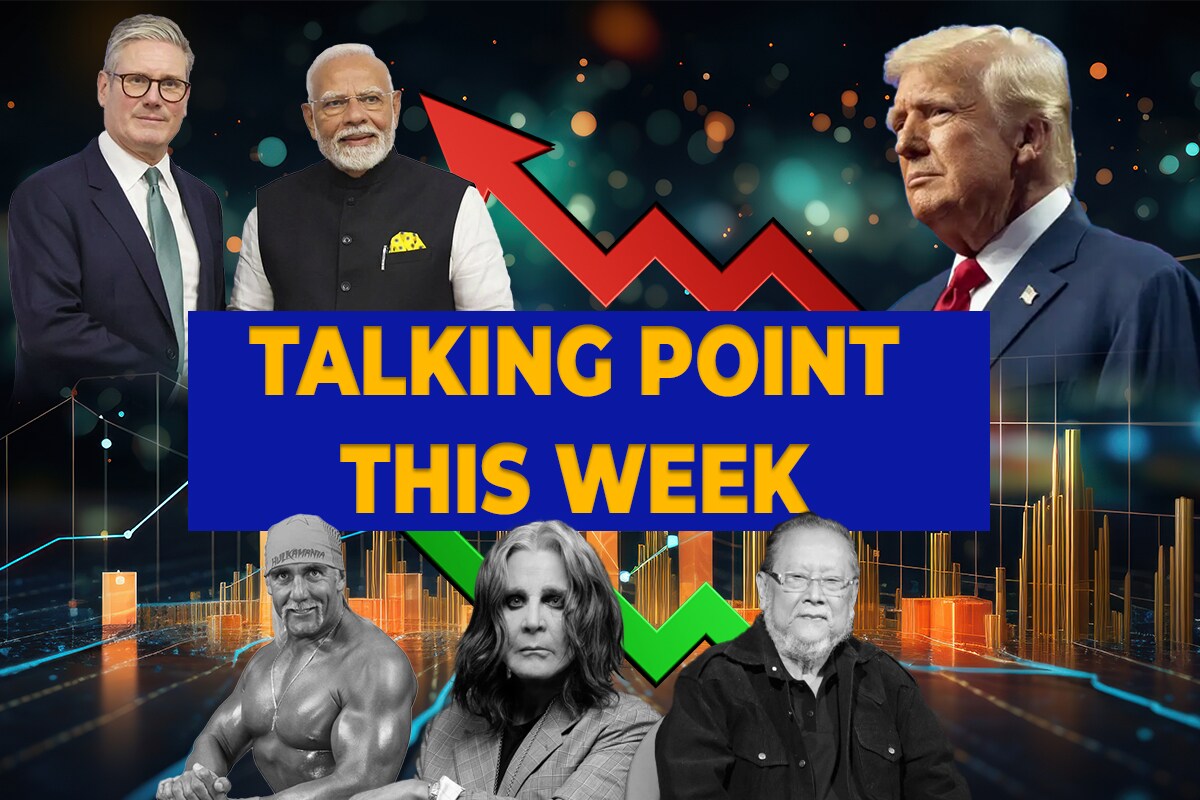
I call this a dhoop-chhaon week because of the mixed news flow. The first quarter results have shown a mixed picture and so have the markets. Meanwhile, the India-UK Free Trade Agreement has finally been signed, but across the Atlantic, Donald Trump has warned US companies of "no more outsourcing to India". He won't fire US Fed Chair Jerome Powell but might continue to nudge him to cut rates. Phew!
USA's trade deal announcements are flying in thick and fast. The European Union and the White House are getting close to a deal that would slap a 15% tariff on most products, insiders are saying. This, plus Japan's deal with the US, got stocks pumped up on Wednesday and there wasn't a selloff on Thursday! Both sides in the EU-US talks have been speed-talking over the past few weeks. The EU countries might just roll with that 15% tariff, and EU bigwigs are pushing to make sure it covers key sectors like cars. And, oh yeah, steel and aluminium imports over a certain limit would get whacked with a 50% duty!
As you can see, the week was dominated by trade deal news and results, which have not been half bad. On Wall Street, results of giants like Verizon, IBM and AT&T beat estimates but Tesla got pummelled post weak reportage on results. Here's the set of key talking points this week.
India UK Sign FTA... Finally
India and the United Kingdom sealed the long-awaited and hopefully game-changing Free Trade Agreement (FTA) on Thursday. The deal will give a fillip to both the economies as we are talking zero tariffs on 99% of Indian goods heading to the UK and a massive 90% tariff cut on British products entering India. This means smoother trade, bigger markets, and a whole lot of economic high-fives. By 2030, the two countries expect their trade to hit a whopping $120 billion, with the UK's GDP getting a £4.8 billion ($6.5 billion) yearly boost. Plus, it's creating jobs and hopefully sparking investments left and right. From easier customs processes to better mobility for professionals, digital trade perks, and a leg-up for small businesses, this deals presumably got it all.
Sectors like textiles, cars, food, finance, and tech are about to get a major glow-up. For the UK, it's one of the biggest post-Brexit trade wins, and for India, it's a strategic economic slam dunk! For Indian stock watchers, the NDTV Profit desk did some research on who will benefit.
The US Consumer Is Holding Back
US consumer spending, as measured by the percent change in Real Personal Consumption Expenditures, has stagnated in the first half of 2025 (H1), showing minimal growth or fluctuation around the zero percent mark, following a period of more significant volatility and a notable decline around 2020. In previous instances of US consumer spending stagnation similar to the current trend in 2025, several patterns emerge.
Historically, stagnation or declines have often been linked to economic shocks, such as the 2007-2009 recession, where consumer spending dropped due to job losses and financial uncertainty, leading to a slow recovery with relative resilience in consumer-related employment by 2012.
Are Indian Consumers In The Same Mood?
This week, several Indian companies reported their Q1FY26 earnings. The week was dotted with consumption names. Nestle India results were weak, as the company faced elevated commodity prices, higher operating costs from manufacturing expansion, and increased finance costs due to temporary cash-flow borrowing.
Tata Consumer Products posted a 15.1% rise in net profit, driven by strong tea, salt and Tata Sampann sales, with revenue up 9.8% to 4779 crores, even as the numbers were slightly below estimates. Zomato (Eternal) and Paytm reported earnings, with both results being cheered by the street. Westlife Foodworld, operating McDonald's in West and South India, saw a 62.5% drop in net profit despite a 6.45% sales increase. Sapphire Foods India, which runs KFC and Pizza Hut, reported a consolidated net loss of 1.73 crore rupees, mirroring the weakness in Westlife. Most of the consumption names reflect weak performances amid challenging market conditions.
In other news, significant development impacting the Indian Energy Exchange (IEX), with its shares plummeting up to 28% after the Central Electricity Regulatory Commission (CERC) approved a phased implementation of market coupling for the Day-Ahead Market (DAM), set to begin by January 2026. This model aggregates buy and sell bids across power exchanges to establish a uniform market clearing price, potentially eroding IEX's dominance in price discovery and market share, as it currently holds an 85% share in India's power exchange market.
Art Market: A Bubble Has Burst?
Auction sales of paintings that cost more than $10 million fell 44% last year, and continue to be depressed in 2025, data from ArtTactic shows. The shift in the market was clear at Sotheby's New York auction in May, when a sculpture by Alberto Giacometti with a $70 million asking price didn't attract a single bid and had to be pulled from sale.
In 1993 and again in 2010, Yale professor William Goetzmann analysed more than two centuries of art-auction results, finding that painting prices are correlated with the stock market and act as a good inflation hedge. Does this point to some issues for risk assets ahead?
Thank You Ratan, Ozzy & Hulk
As we wrap, a few goodbyes are in order. Wrestling fans were saddened by the passing away of Hulk Hogan, the legendary professional wrestler and iconic WWE figure. Known for his handlebar moustache, bandana, and charismatic persona, Hogan's impact on the world of wrestling will forever be remembered.
The entertainment world was also robbed of Ozzy Osbourne, who passed away on Tuesday after putting up a brave fight against Parkinson's disease.
Back home, Indian theatre lost one of its most iconic names — Ratan Thiyam. The Padma Shri awardee's contribution to Indian theatre is unparalleled. The former director and chairman of the National School of Drama pioneered the ‘theatre of roots' movement blending Manipuri art forms with contemporary craft.

-
Indians Are Travelling, But Not Every Journey Is A Holiday | The Week In Whys

Pilgrims, patients and working women are the real travellers, and the system hasn't quite caught up with them.
-
Getting To Work Costs Women More | The Reason Why
It is not just about women paying more than men. It is about women paying much more in cities than in villages.
-
AI Bias In Investing Cannot Be Eliminated, But It Can Be Governed
Framing is a particularly important example as identical financial information presented in terms of gains rather than losses can lead an LLM to reach a different assessment.
-
Joining The Dots | Dark Skies, Steady Diya: Why Hope Holds This Diwali
With war, a weak rupee and foreign outflows weighing on sentiment, policymakers at the NDTV World Summit and market veterans at NDTV Profit Ignite: Diwali Edition offered the same advice: stay invested and filter out the noise.
-
The Curious Case of Equitas Small Finance Bank And A CEO Who Quit For Stock
PN Vasudevan believes persistent investor concerns over a perceived conflict of interest had become a governance overhang on Equitas Small Finance Bank's stock, even as the lender improved profitability and asset quality.
-
Talking Points This Week: AI Cash Burn, A Tiger Comeback And An India That Still Finds Its Own Path
India is not immune to higher oil or tighter global liquidity, yet its earnings base is broader, its domestic policy levers are still available.
-
Foreign Investors Own Half Of HDFC Bank and ICICI Bank. An LTCG Cut Could Matter Most Here
Foreign portfolio investors have US$115 billion parked in HDFC Bank, ICICI Bank. If the government cuts long-term capital gains tax, Jefferies says returning foreign money could land here first.
-
'Never Seen This Level Of Negativity': Sandeep Tandon Says The Next Rally May Be Closer Than You Think
Veteran investor Sandeep Tandon says foreign selling is easing, large-caps are due a comeback and mid-caps are crowded, while he turns positive on gold, power and pharma this Diwali.
-
Indians Stay With Family, Not In Hotels | The Reason Why
India still lacks enough clean, reliable and affordable hotels for budget-conscious travellers.
-
The Economic Imperative: Analysing The Material Driving Force Behind India-Canada Strategic Reset
This economic complementarity is further reinforced by deep institutional investment ties and talent mobility, which form the bedrock of the bilateral framework.










