- Retail traders in India's derivatives market dropped 18% in FY26 to 87.5 lakh participants
- Retail traders lost Rs 91,685 crore in FY26, with average loss per trader rising 2.4% to Rs 1.17 lakh
- Top 10 proprietary trading desks earned 74.5% of Rs 44,483 crore profits from algorithmic trading
Dalal Street's retail derivatives boom is finally running out of oxygen. After years of explosive, uninterrupted growth fuelled by pandemic-era boredom, mobile trading apps, and zero-day-to-expiry, or 0DTE contracts, the bill has come due for India's retail traders.
The Securities and Exchange Board of India (SEBI) data for the financial year 2024-25 and fiscal 2025-26 paints a stark picture of the Indian Equity Derivatives Segment (EDS). It is no longer just a marketplace for hedging or price discovery; it has morphed into a highly efficient wealth transfer machine. Capital is being systematically siphoned from the pockets of young, undercapitalised retail traders and deposited directly into the ledgers of institutional algorithmic trading desks.
The Retail Exodus
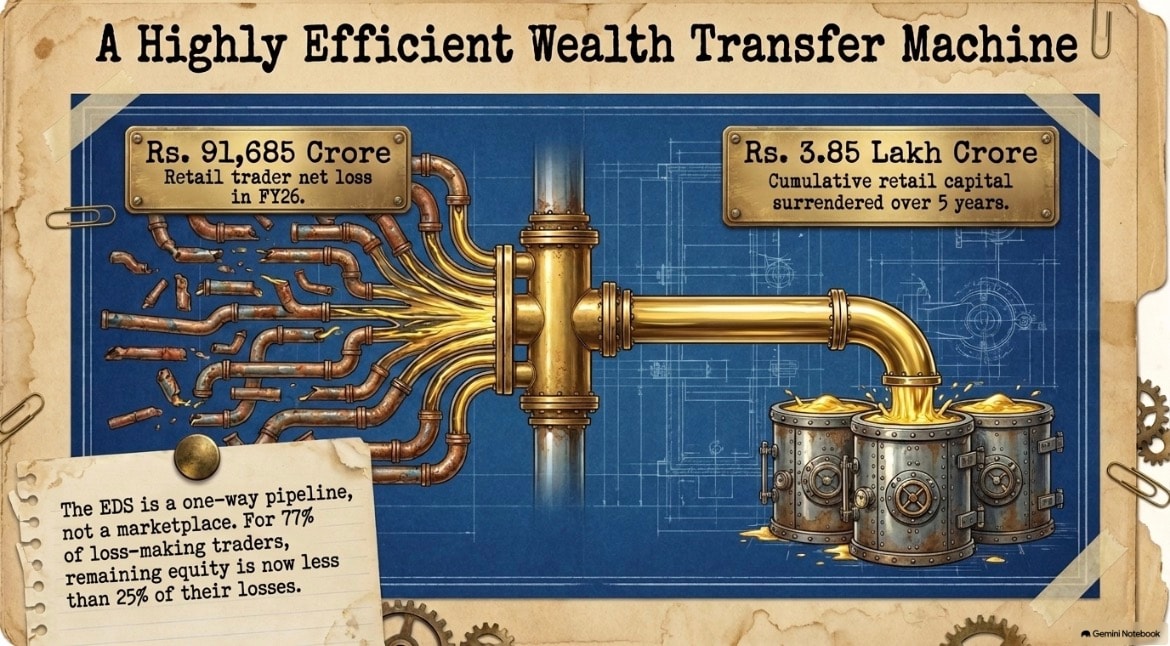
For the first time since fiscal 2016, the retail army is retreating. Active individual traders dropped by 18% year-on-year, falling from a record 1.06 crore in fiscal 2025 to 87.5 lakh in fiscal 2026. But the most glaring indicator of market fatigue is the exit rate. Nearly 46 lakh traders abandoned the segment entirely in fiscal 2026, a 76% surge in market exits compared to the previous year. Net additions to the trader base turned profoundly negative, shedding 24.9 lakh participants.
Also Read | Layoffs Are Rising In Tech, But These Skills Are Helping People Unlock Better Pay
This mass capitulation reflects the sheer scale of wealth destruction. Retail traders bled a staggering Rs 91,685 crore in aggregate net losses in fiscal 2026. While this represents an 18% drop from the Rs 1.12 lakh crore lost in fiscal 2025, it only fell because there were fewer traders left to lose. For those who stayed, the pain intensified: the average loss per person actually rose by 2.4% to Rs 1.17 lakh.
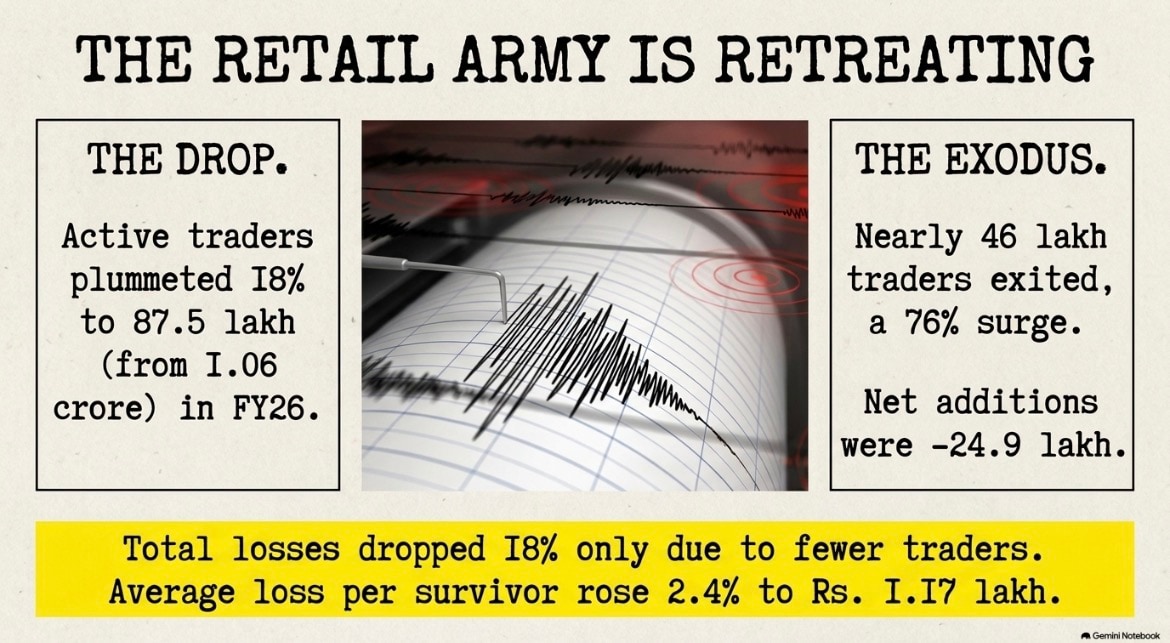
Over the last five years, retail traders have surrendered a cumulative Rs 3.85 lakh crore to the derivatives market. To put this in perspective, for 77% of loss-making traders, their total remaining cash equity portfolio by the end of fiscal 2026 was less than a quarter of the cumulative losses they sustained trading derivatives.
The Machine Always Wins
If retail is losing hundreds of thousands of crores, someone is taking the other side of the trade. That "someone" is cold, emotionless code.
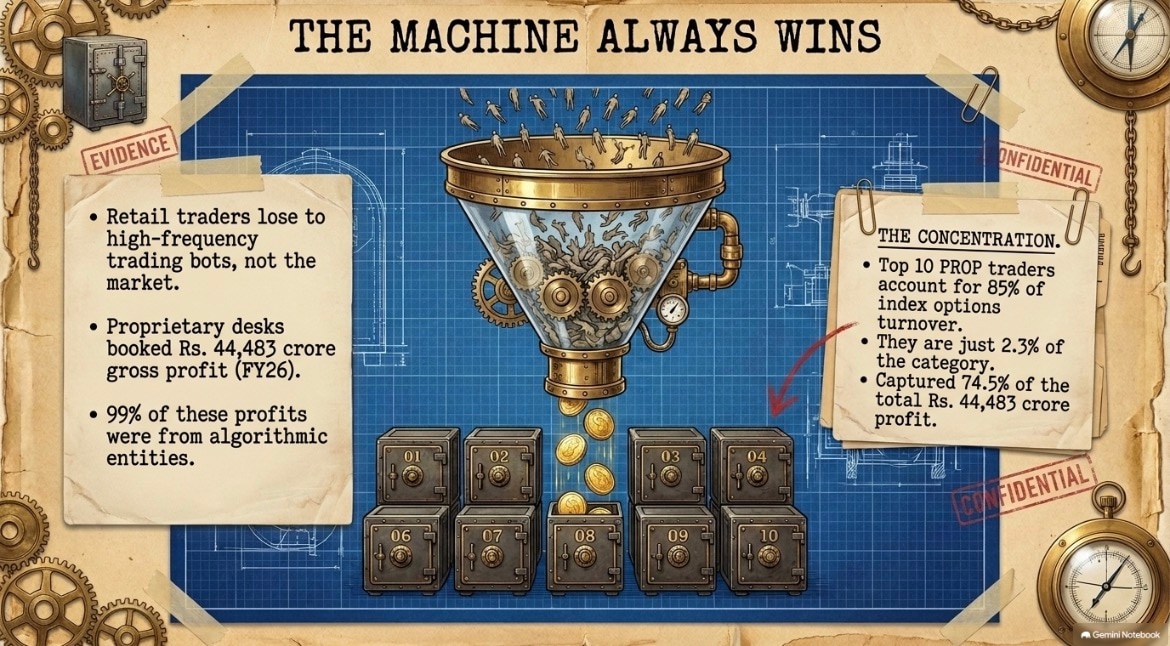
Proprietary trading desks, or PROP, booked massive gross profits of Rs 44,483 crore in fiscal 2026, while Foreign Portfolio Investors, or FPIs, netted Rs 13,896 crore. Notably, 99% of the gross profits made by FPIs and Proprietary traders came from algorithmic entities.
The concentration of these profits is equally staggering. Liquidity provision in India is effectively an oligopoly. The top 10 proprietary traders account for 85% of index options turnover. In terms of profitability, just the top 10 PROP traders, representing a mere 2.3% of the category, hoovered up 74.5% of the total Rs 44,483 crore profit. Retail traders are not losing to the market; they are losing to a highly concentrated cluster of high-frequency trading bots.
Retail behavior is overwhelmingly, almost dangerously, skewed toward options buying. A staggering 99.3% of individuals traded options in fiscal 2026, and 93% operated exclusively as "Only Options Buyers."
Options buying is the ultimate lottery ticket, requiring low upfront premium but offering a dismal probability of success. Consequently, 90% of options buyers lost money. Their median Return on Capital Employed (RoCE) was an abysmal -114% in fiscal 2026, meaning half of these traders lost more than their entire peak margin.
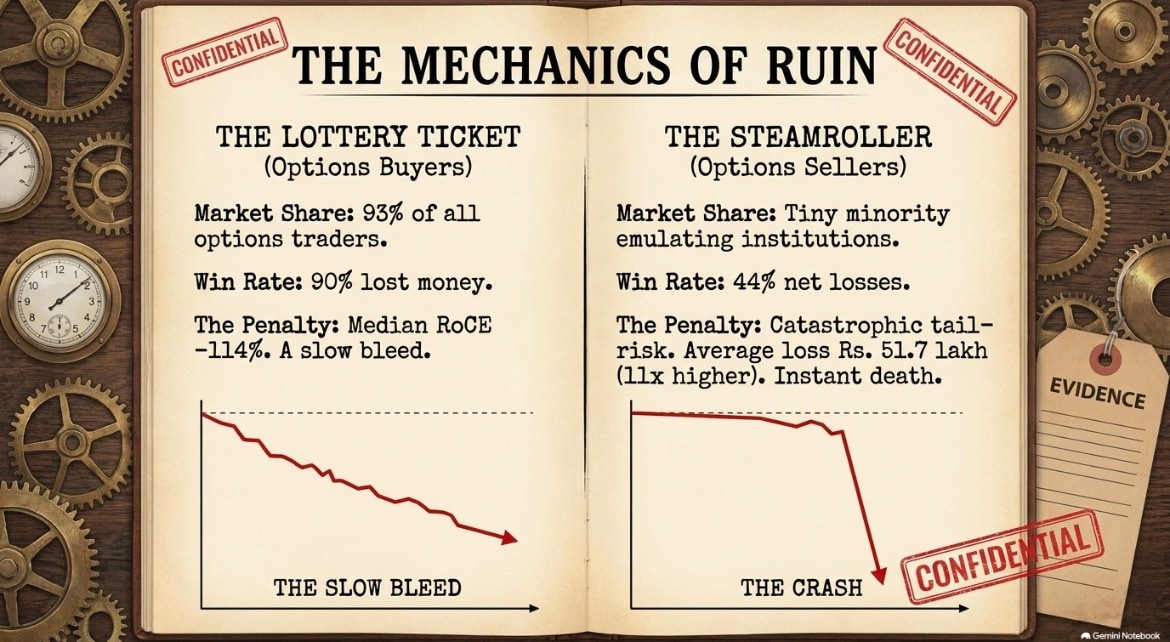
Retail traders who try to emulate the institutions by selling options won more frequently. Only 44% of "Majorly Options Sellers" recorded net losses. But when the market turned against them, the tail-risk was high. The average loss for a retail options seller was Rs 51.7 lakh in fiscal 2026; more than 11 times higher than the average loss of an options buyer.
Hyper-Leverage and the Illusion of Wealth
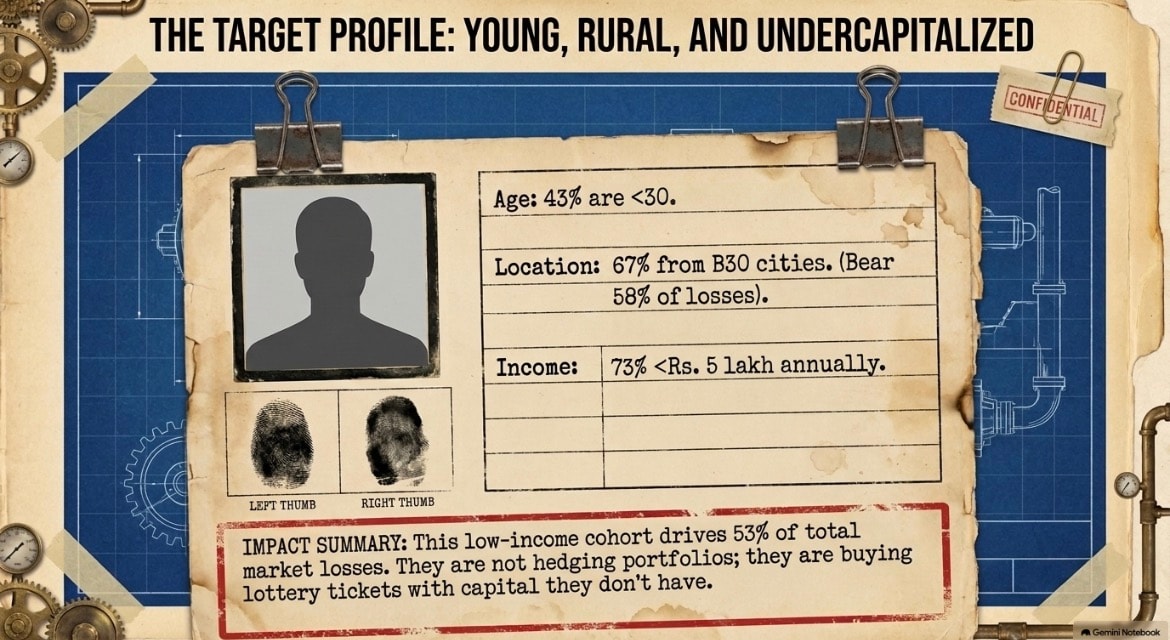
The demographic profile of the typical Indian derivatives trader shatters the illusion of a sophisticated investor hedging a portfolio. They are predominantly young, low-income, and over-leveraged.
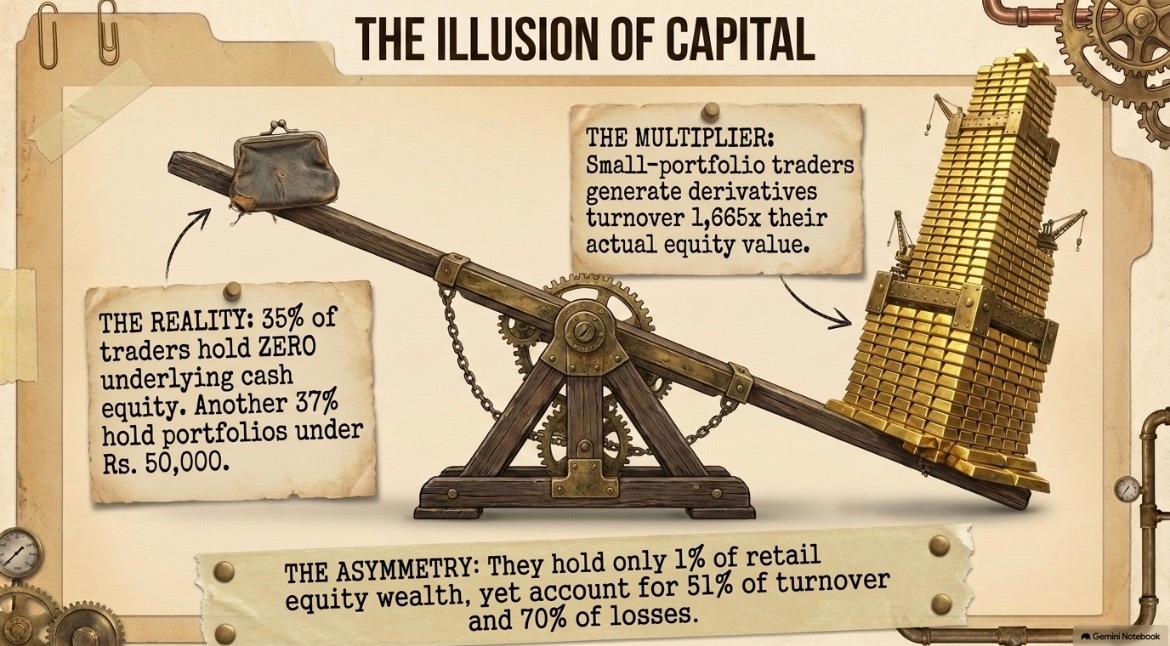
A shocking 35% of derivatives traders (42.8 lakh people) have absolutely zero underlying cash equity holdings. Another 37% hold portfolios under Rs 50,000. Yet, these small-portfolio traders generate derivatives turnover equivalent to 1,665 times their actual equity value. They account for 51% of market turnover and bear 70% of the aggregate losses despite holding only 1% of the total retail equity wealth.
Geographically, trading has moved to the hinterlands. Traders from "Beyond-30" (B30) tier cities now make up 67% of the trader base and suffer 58% of the losses. Demographically, 43% of the trader base is under 30 years old, and 73% declare an annual income below Rs 5 lakh. This low-income cohort drives 53% of the total market losses, burning capital they simply do not have.
Retail Persistence Sustained, Despite SEBI Curbs
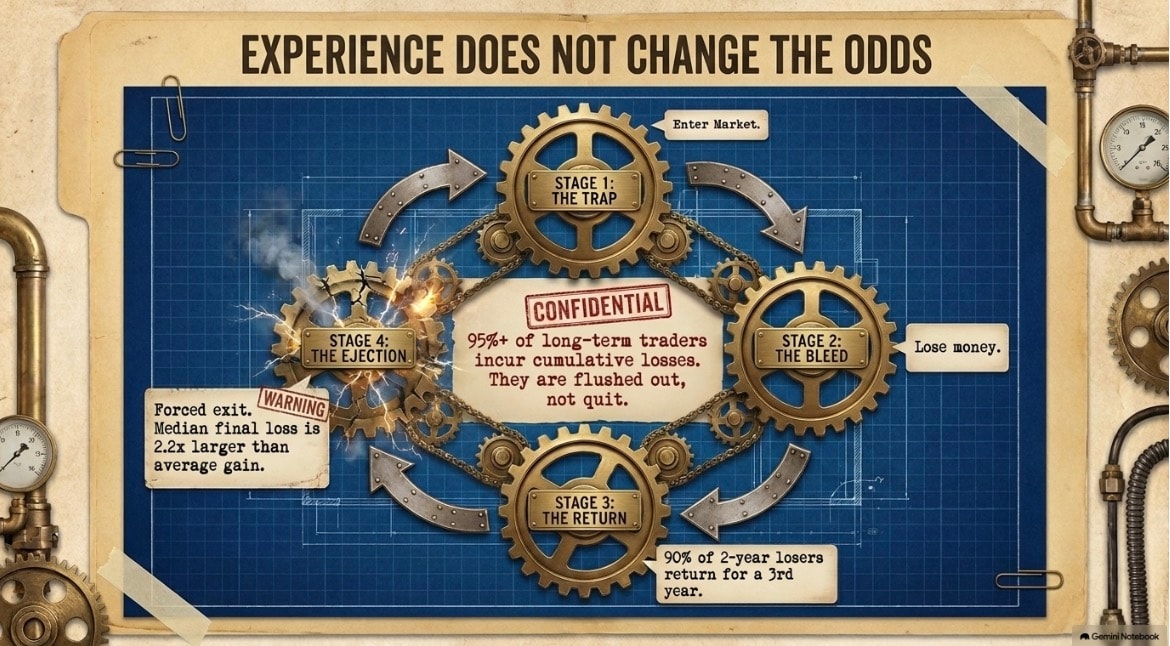
Perhaps the darkest finding in the SEBI data is the sheer psychological persistence of failing traders. Experience does not yield better results. Over 95% of traders who participated for four or five consecutive years incurred cumulative losses.
Furthermore, 90% of traders who lost money in two consecutive years simply returned for a third year and lost again. When retail traders finally do quit, it is rarely a calculated risk-management decision. It is usually a forced exit due to catastrophic ruin: the median loss in a trader's final quarter before quitting was 2.2 times larger than their average historical profitable quarters.
To curb this speculative frenzy, SEBI and the government intervened heavily in late 2024. Weekly expiries were restricted, lot sizes increased, and the Securities Transaction Tax (STT) was hiked, pushing STT collections up 35% and bringing retail transaction costs to roughly Rs 24,800 crore.
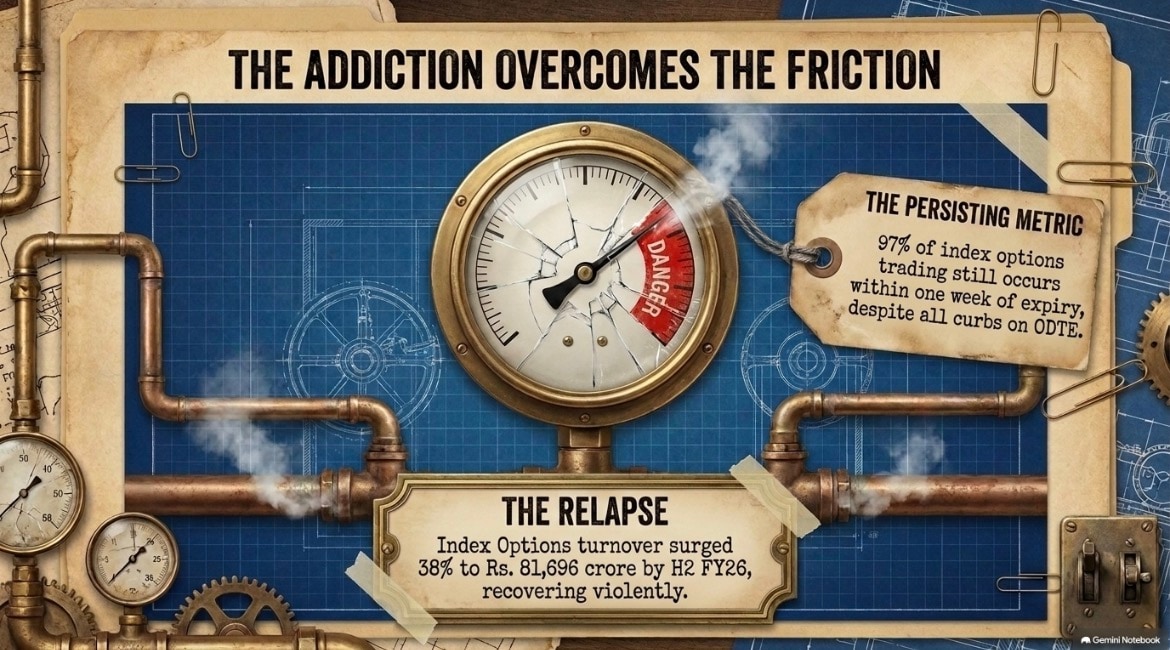
The regulatory friction had an immediate impact. The share of "0DTE" (Zero Days-to-Expiry) options turnover dropped from 70% in fiscal 2025 to 59% in fiscal 2026. Average Daily Turnover (ADT) in Index Options initially contracted by 17.4%. Yet, the addiction remains potent. By the second half of fiscal 2026, Index Options turnover had violently recovered, surging 38% to hit Rs 81,696 crore. 97% of all index options trading still occurs within one week of expiry.
The Indian derivatives market is undergoing a brutal structural correction. The weakest, most undercapitalized retail participants are being flushed out by algorithmic predators and higher regulatory hurdles. Yet, for the millions who remain, the game has not changed. It is a highly leveraged, hyper-short-term arena where human hope consistently subsidizes institutional code.
Essential Business Intelligence, Sharp Market Insights, Practical Personal Finance Advice, Daily Fuel, Gold and Silver Prices and Latest Stories — On NDTV Profit.